Protecting AI Models from Adversarial Attacks
JUL 7, 2025 |
As the adoption of artificial intelligence (AI) continues to grow across various sectors, the need to ensure the robustness and reliability of AI models becomes increasingly crucial. One of the most significant threats to AI systems is adversarial attacks. These are deliberate attempts to deceive AI models by introducing small, often imperceptible perturbations to the input data, leading to incorrect predictions or classifications.
Adversarial attacks exploit the vulnerabilities in AI models, particularly those based on deep learning, by taking advantage of the models' sensitivity to slight changes in input data. For instance, an image classification model might erroneously classify an image of a cat as a dog if minor pixel modifications are made to the image. This not only undermines the reliability of AI systems but also poses substantial risks in applications like autonomous vehicles, medical diagnosis, and financial services.
Types of Adversarial Attacks
To effectively protect AI models, it is essential to understand the different types of adversarial attacks. Broadly, these attacks can be categorized into three groups: white-box, black-box, and gray-box attacks.
White-box attacks occur when the attacker has full knowledge of the AI model, including its architecture, parameters, and training data. This allows the attacker to craft highly effective adversarial examples that can easily fool the model. Black-box attacks, on the other hand, take place when the attacker has no prior knowledge about the model. They rely on observing the model's outputs to create adversarial inputs. Gray-box attacks lie in between, where the attacker has partial knowledge of the model.
Another classification is based on the attack's intention: targeted and untargeted attacks. Targeted attacks aim to mislead the model into making a specific incorrect prediction, while untargeted attacks seek to cause any incorrect prediction, regardless of what it may be.
Strategies for Defending Against Adversarial Attacks
Developers and researchers have proposed several strategies to defend AI models against adversarial attacks. These strategies focus on improving the model's resilience and robustness.
1. Adversarial Training: This involves augmenting the training dataset with adversarial examples, allowing the model to learn and adapt to such inputs. By exposing the model to potential adversarial samples during training, it becomes better equipped to handle them during deployment.
2. Defensive Distillation: This technique aims to reduce the model's sensitivity to small input perturbations. It involves training the model on a softened probability distribution output by itself, which helps smooth out the decision boundaries and makes the model more robust to adversarial inputs.
3. Input Preprocessing: This method involves transforming input data before it is fed into the model, making it harder for adversarial perturbations to affect the model's predictions. Common preprocessing techniques include image resizing, noise filtering, and feature squeezing.
4. Model Ensemble: Using a combination of multiple models can enhance robustness against adversarial attacks. By aggregating the predictions of several models, the influence of adversarial examples on any single model can be reduced.
5. Regularization Techniques: Techniques like weight regularization and dropout can be employed to improve the generalization of AI models, thus mitigating the effects of adversarial attacks.
Challenges in Protecting AI Models
Despite the development of various defensive strategies, protecting AI models from adversarial attacks remains a challenging task. One of the major challenges is the constant evolution of attack techniques. As defenses improve, so do the methods employed by attackers. This creates a continuous arms race between adversaries and defenders.
Additionally, some defensive strategies may degrade the performance of AI models on clean, non-adversarial data. Balancing robustness against adversarial attacks and maintaining high accuracy on legitimate data is a delicate task.
Lastly, the lack of standardized evaluation metrics for adversarial robustness poses a challenge. Without consistent metrics, comparing different defense mechanisms becomes difficult, hindering progress in the field.
The Future of AI Security
As AI systems become more integrated into critical infrastructure, ensuring their security and reliability against adversarial attacks will be of utmost importance. Future research must focus on developing adaptive models that can dynamically respond to new attack strategies. Collaboration between academia, industry, and policymakers will be essential to create robust AI systems that can withstand adversarial threats while maintaining their intended performance.
In conclusion, protecting AI models from adversarial attacks is a multifaceted challenge that requires a combination of technical solutions and continuous vigilance. By understanding the nature of adversarial attacks and employing effective defense strategies, we can work towards building AI systems that are both robust and reliable.
Empower Your Wireless Innovation with Patsnap Eureka
From 5G NR slicing to AI-driven RRM, today’s wireless communication networks are defined by unprecedented complexity and innovation velocity. Whether you’re optimizing handover reliability in ultra-dense networks, exploring mmWave propagation challenges, or analyzing patents for O-RAN interfaces, speed and precision in your R&D and IP workflows are more critical than ever.
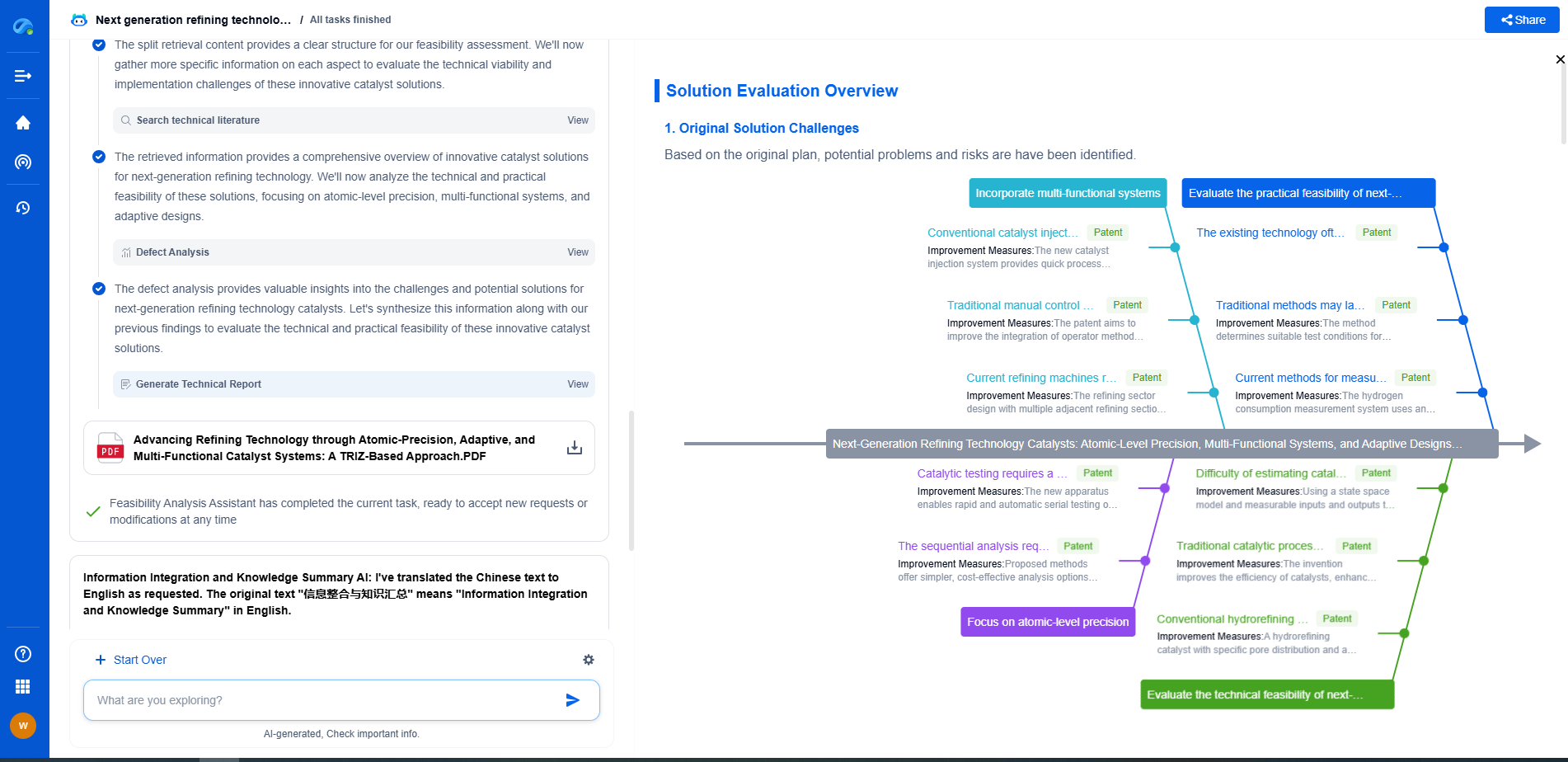
Patsnap Eureka, our intelligent AI assistant built for R&D professionals in high-tech sectors, empowers you with real-time expert-level analysis, technology roadmap exploration, and strategic mapping of core patents—all within a seamless, user-friendly interface.
Whether you work in network architecture, protocol design, antenna systems, or spectrum engineering, Patsnap Eureka brings you the intelligence to make faster decisions, uncover novel ideas, and protect what’s next.
🚀 Try Patsnap Eureka today and see how it accelerates wireless communication R&D—one intelligent insight at a time.