Solving mmWave Beam Alignment Failures
JUL 7, 2025 |
Millimeter wave (mmWave) technology is an essential component in the advancement of 5G, offering high data rates and increased capacity. However, one of the challenges in implementing mmWave technology is the beam alignment process. Beam alignment is crucial for establishing a reliable communication link between the transmitter and receiver, especially given the directional nature of mmWave signals. Failures in beam alignment can lead to reduced performance and unreliable connections. In this blog, we will delve into the causes of mmWave beam alignment failures and offer solutions to address these issues.
Common Causes of Beam Alignment Failures
To effectively solve beam alignment failures, it is important to first understand what causes them. Several factors can contribute to these failures:
1. Environmental Obstacles: Physical barriers such as buildings, trees, and even moving vehicles can obstruct mmWave signals, causing misalignment between transmitter and receiver beams. These obstacles can also reflect the signals, creating interference that further complicates alignment.
2. Device Mobility: Mobile devices constantly change their position and orientation, which can disrupt the alignment of mmWave beams. As users move around, the devices can experience frequent disconnection and reconnection, leading to alignment failures.
3. Atmospheric Conditions: Weather conditions such as rain and fog can attenuate mmWave signals. This attenuation affects the signal strength and can result in alignment failures if not properly compensated.
4. Hardware Limitations: The precision of beamforming hardware is crucial for accurate alignment. Imperfections in antennas or errors in the beamforming process can lead to misalignment.
Strategies for Solving Alignment Failures
Having identified the common causes of beam alignment failures, we can explore practical strategies to address these issues:
1. Advanced Beamforming Techniques: Implementing sophisticated beamforming algorithms can enhance the accuracy of beam alignment. Techniques such as adaptive beamforming and beam steering allow the system to dynamically adjust the direction and shape of the beams in response to environmental changes and device mobility.
2. Real-Time Environment Mapping: Using real-time data to map the environment can help predict and mitigate potential alignment issues. By understanding the locations and movements of obstacles, systems can adjust the beams proactively to maintain a strong communication link.
3. Multi-Path Signal Exploitation: Instead of relying on a single beam path, leveraging the multiple paths that mmWave signals can take can improve reliability. Techniques such as spatial diversity can be used to combine signals from different paths, compensating for alignment failures caused by obstacles and atmospheric conditions.
4. Enhancing Hardware Capabilities: Investing in high-precision antenna arrays and beamforming equipment can reduce hardware-induced alignment errors. Regular calibration and maintenance of these components are essential to ensure optimal performance.
Testing and Feedback Loop
To ensure that the proposed solutions are effective in real-world scenarios, extensive testing and feedback loops are vital. Conducting field tests in various environments, including urban, suburban, and rural settings, allows for the evaluation of how well the solutions perform under different conditions. Feedback from these tests can be used to fine-tune algorithms, improve hardware design, and create adaptive systems that learn from previous alignment failures to prevent future occurrences.
Conclusion
Solving mmWave beam alignment failures is a multifaceted challenge that requires a combination of advanced technologies, real-time data, and robust testing frameworks. By understanding the root causes of these failures and implementing targeted strategies, we can enhance the reliability and performance of mmWave communication systems. As the deployment of 5G technology continues to expand, addressing beam alignment failures will be crucial to realizing the full potential of mmWave technology in delivering high-speed, high-capacity wireless communication.
Empower Your Wireless Innovation with Patsnap Eureka
From 5G NR slicing to AI-driven RRM, today’s wireless communication networks are defined by unprecedented complexity and innovation velocity. Whether you’re optimizing handover reliability in ultra-dense networks, exploring mmWave propagation challenges, or analyzing patents for O-RAN interfaces, speed and precision in your R&D and IP workflows are more critical than ever.
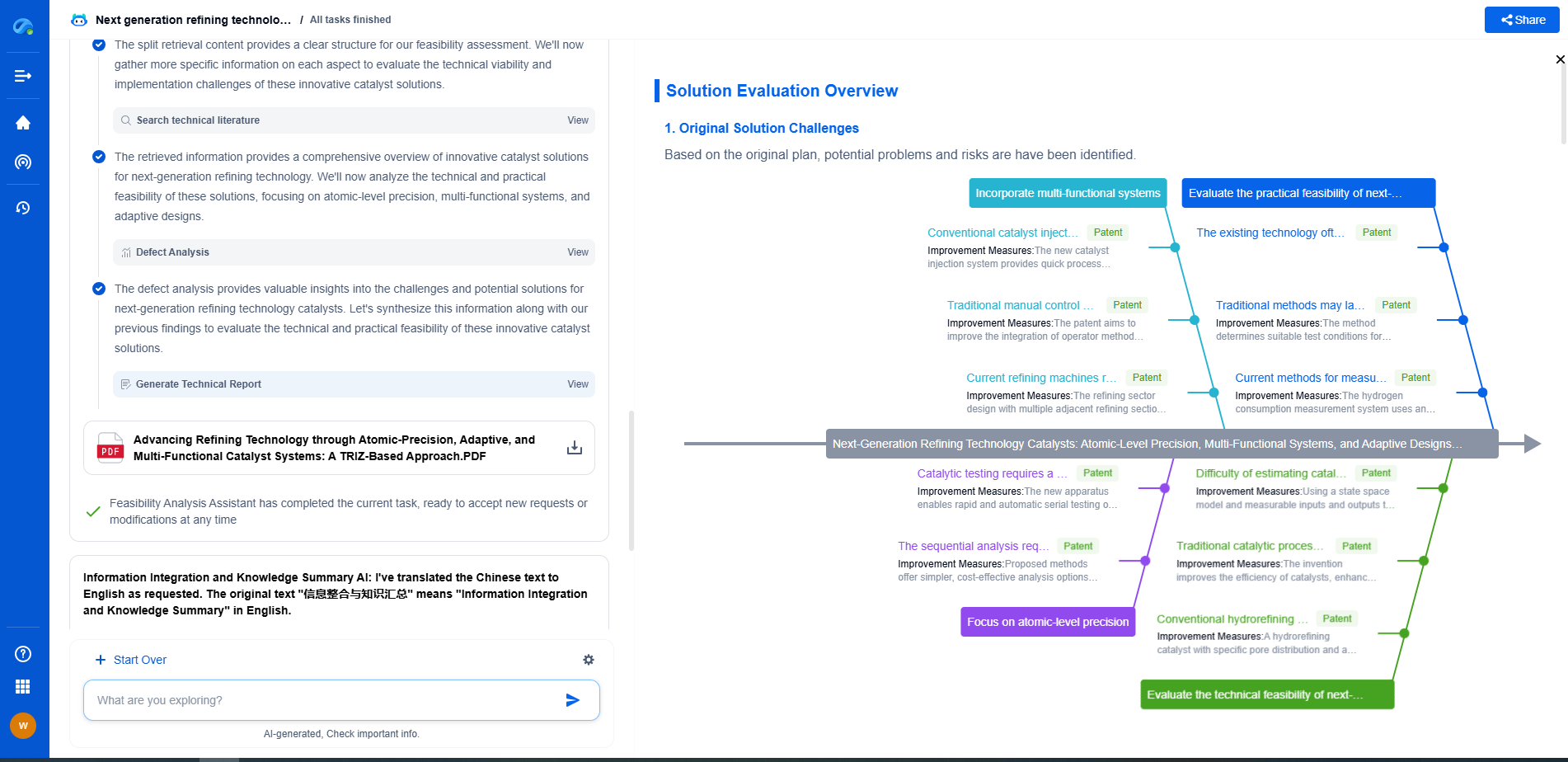
Patsnap Eureka, our intelligent AI assistant built for R&D professionals in high-tech sectors, empowers you with real-time expert-level analysis, technology roadmap exploration, and strategic mapping of core patents—all within a seamless, user-friendly interface.
Whether you work in network architecture, protocol design, antenna systems, or spectrum engineering, Patsnap Eureka brings you the intelligence to make faster decisions, uncover novel ideas, and protect what’s next.
🚀 Try Patsnap Eureka today and see how it accelerates wireless communication R&D—one intelligent insight at a time.