Why Use Self-Supervised Learning Instead of Manual Labeling?
JUN 26, 2025 |
Self-supervised learning has recently emerged as a powerful alternative to traditional supervised learning methods, which rely heavily on manually labeled data. At its core, self-supervised learning involves training models on raw, unlabeled data by creating auxiliary tasks that generate labels from the data itself. This approach not only reduces the need for extensive manual labeling but also leverages massive datasets that would otherwise be too cumbersome to annotate manually. The resulting models are often robust and capable of generalizing well to various tasks.
The Limitations of Manual Labeling
The traditional approach of manually labeling data is fraught with challenges. First and foremost, it is an incredibly time-consuming and labor-intensive process. Imagine training a machine learning model to recognize everyday objects in images: labeling thousands or even millions of images individually is daunting. This necessity for human involvement not only slows down the model development process but also introduces potential for error and inconsistency. Human annotators may interpret data differently, leading to a lack of uniformity in the labels. Moreover, manual labeling can become prohibitively expensive, especially when subject matter experts are required to ensure accuracy in complex domains such as medical imaging or legal document analysis.
Harnessing the Power of Data Abundance
Self-supervised learning shines in its ability to tap into vast amounts of unlabeled data. In today's digital world, data is being generated at an unprecedented rate from social media, sensors, online transactions, and more. This wealth of information holds immense potential for training machine learning models, provided it can be harnessed effectively. Self-supervised methods create opportunities to utilize these rich datasets by designing pretext tasks that allow models to learn underlying patterns and structures in data without the need for external labels.
Creating Robust and Generalizable Models
One of the greatest advantages of self-supervised learning is its capacity to create models that are not only accurate but also robust and generalizable. By learning from a wide array of data, self-supervised models can capture intricate patterns and variabilities that might be overlooked in manually labeled datasets. This diverse learning experience often results in models that perform well across different tasks and domains. For instance, a self-supervised model trained on a wide range of images can be fine-tuned to excel in specific image classification tasks, transfer learning, or even be adapted to entirely new tasks such as video analysis or natural language processing.
Accelerating Development and Innovation
By foregoing the traditional data labeling process, self-supervised learning significantly accelerates the development cycle of machine learning applications. Researchers and practitioners can iterate rapidly, experimenting with different model architectures and strategies without being bogged down by the need for extensive human-labeled data. This acceleration fosters innovation, allowing for quicker deployment of cutting-edge models that can address real-world problems more efficiently. Additionally, with reduced dependence on human annotations, teams can focus their resources on other critical aspects of machine learning projects, such as model interpretability and ethical considerations.
Addressing Real-World Complexity
Self-supervised learning is particularly effective at addressing the complexity and diversity found in real-world data. In scenarios where creating exhaustive labeled datasets is impractical, such as understanding nuanced human emotions in videos or predicting future trends based on historical data, self-supervised learning offers a viable solution. By training models to uncover hidden structures and relationships in data, this approach equips them to handle the ambiguity and unpredictability often encountered in everyday applications.
The Road Ahead
While self-supervised learning has already demonstrated significant promise, it is important to recognize that it is not a one-size-fits-all solution. Certain applications may still require a combination of self-supervised and supervised learning approaches. Nonetheless, the advancements in this domain indicate a transformative shift in how we approach machine learning and data utilization. As researchers continue to refine and innovate self-supervised methods, the future holds exciting possibilities for harnessing the full potential of data, driving progress across industries, and creating intelligent systems that can seamlessly integrate into our lives.
In conclusion, self-supervised learning stands out as a compelling alternative to manual labeling, offering efficiency, scalability, and the ability to unlock insights from vast datasets. As the field evolves, embracing self-supervised techniques will be crucial for staying at the forefront of technological advancements and addressing the growing demand for intelligent and adaptable machine learning solutions.
Unleash the Full Potential of AI Innovation with Patsnap Eureka
The frontier of machine learning evolves faster than ever—from foundation models and neuromorphic computing to edge AI and self-supervised learning. Whether you're exploring novel architectures, optimizing inference at scale, or tracking patent landscapes in generative AI, staying ahead demands more than human bandwidth.
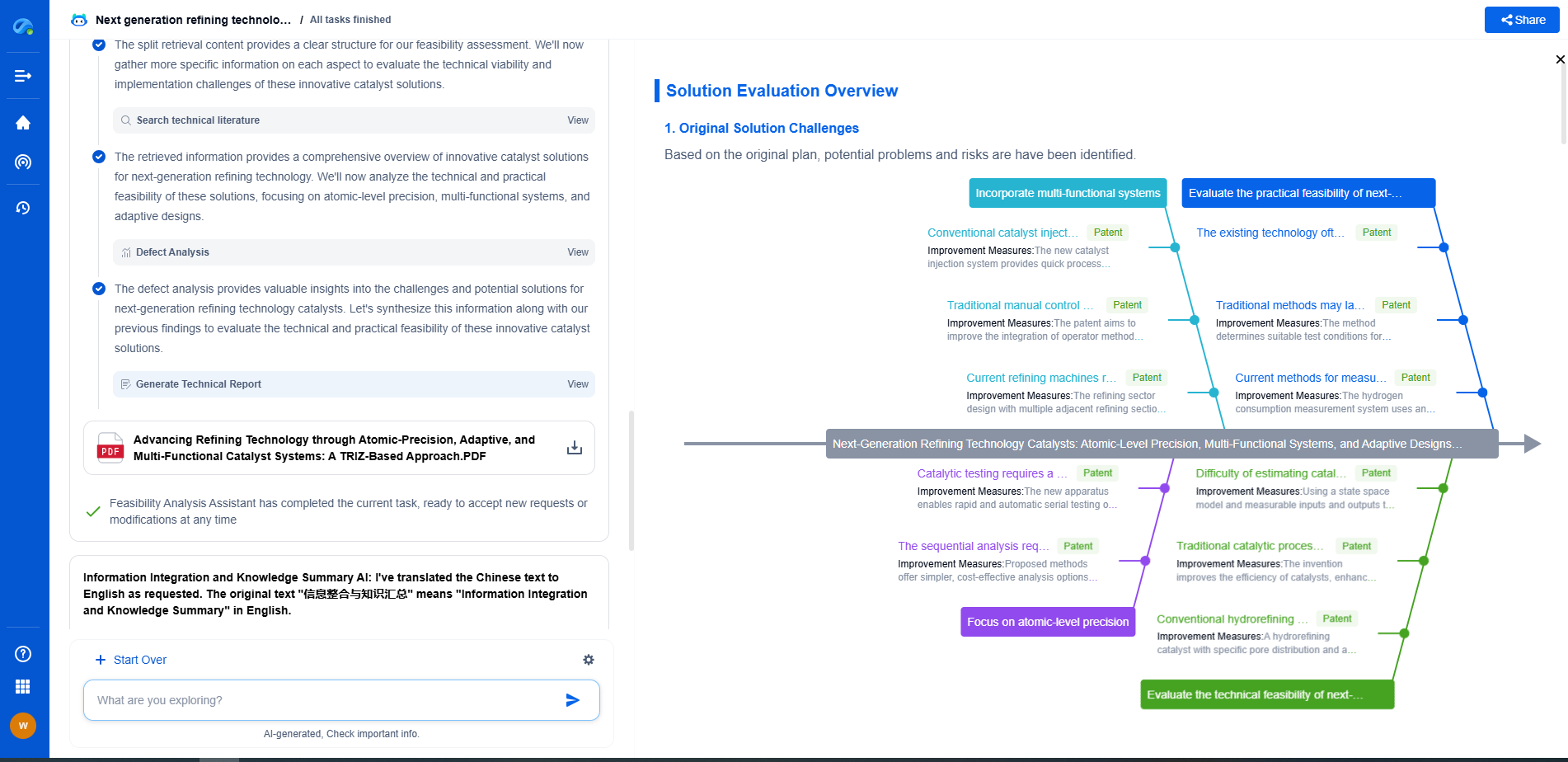
Patsnap Eureka, our intelligent AI assistant built for R&D professionals in high-tech sectors, empowers you with real-time expert-level analysis, technology roadmap exploration, and strategic mapping of core patents—all within a seamless, user-friendly interface.
👉 Try Patsnap Eureka today to accelerate your journey from ML ideas to IP assets—request a personalized demo or activate your trial now.