


In the realm of quantum physics, time crystal represents a groundbreaking discovery that has sparked curiosity among scientists and researchers. Unlike traditional crystals, which exhibit periodic structures in space, time crystals exhibit a form of “time symmetry,” where their structure repeats not in space, but in time. This article explores the science behind time crystals, their potential applications, and the latest developments in this intriguing field.
Understanding Time Crystals: What Are They?
Time crystals are quantum many-body systems exhibiting spontaneous breaking of time translation symmetry. Unlike conventional crystal with spatial periodicity, time crystal displays temporal order where system observables (e.g., magnetization, particle density) oscillate at frequencies distinct from the driving frequency.
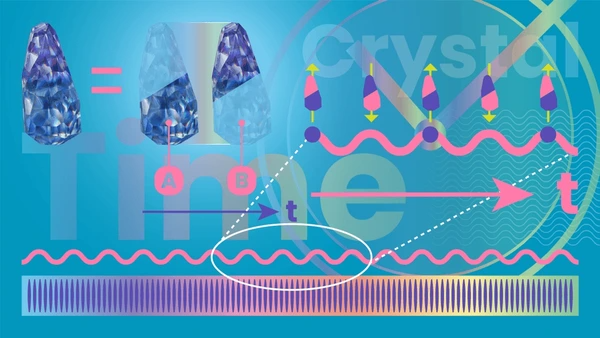
- Discrete vs. Continuous:
- Discrete time crystals (DTCs) arise in periodically driven (Floquet) systems, evolving with periods n×T (integer multiples of the driving period T). For example, ultracold atoms on oscillating mirrors show motion with periods up to 10×T.
- Continuous time crystals (CTCs) occur in non-driven dissipative systems, breaking continuous symmetry (e.g., limit cycles in atom-cavity systems).
Traditional Crystals vs. Time Crystals
- Traditional Crystals: These are materials where atoms are arranged in a repeating pattern, creating a stable structure. For example, in quartz, atoms are arranged in a repeating pattern that extends through space.
- Time Crystals: In contrast, time crystals exhibit a structure that repeats over time, instead of in space. They are systems that break time-translation symmetry, meaning they undergo a perpetual oscillation without consuming energy. This property challenges the laws of thermodynamics and opens up new possibilities for quantum computing and energy storage.
Key Characteristics
- Repetition in time, not space
- Periodic oscillation without energy consumption
- Non-equilibrium system
- Breaks time-translation symmetry
⭐️ As illustrated in recent quantum physics research, time crystal provides an exciting pathway to discovering new quantum states of matter.
The Science Behind Time Crystals
Spontaneous symmetry breaking forms the core principle, where driven quantum systems select periodic motion despite time-translation-invariant Hamiltonians. Discrete time crystals (DTCs) emerge in periodically driven systems (Floquet systems) when interactions enforce motion at integer multiples of the driving period. For example, ultracold atoms on oscillating mirrors achieve period-doubling dynamics through resonant driving and strong interactions. Continuous time crystals (CTCs), observed in dissipative atom-cavity systems, break continuous symmetry via limit cycles with random phase initialization .
Key technical parameters:
- DTC periodicity ratios: 2:1 (period doubling) to tens:1
- CTC oscillation frequencies: 0.5–5 Hz in cavity photons
- Stability metrics: Coherence times up to 1,000 seconds in magnon systems
Curious about time crystals? Eureka Technical Q&A explores the fascinating science behind time crystals, explaining how these unique structures break traditional physics by exhibiting movement without energy input. Discover their potential applications in quantum computing, energy storage, and more, along with their groundbreaking impact on the future of technology.
How Time Crystals Work
Time crystals are created in highly controlled quantum systems, typically using quantum bits (qubits) or spins in a material. These systems oscillate in a manner similar to traditional crystals, but instead of a spatial repetition, the pattern repeats over time.
Scientific Benefits of Time Crystals
- Quantum Computing: Time crystals could offer a way to store quantum information more efficiently, leading to advancements in quantum computing.
- Energy Efficiency: Time crystals do not lose energy during their oscillation, unlike conventional systems, which waste energy through friction or heat.
- Stability: Their perpetual motion without energy loss makes them highly stable, offering potential for developing more resilient quantum devices.
Applications and Implications of Time Crystals
Quantum Computing
Time crystals could improve the performance of quantum computers by offering stable qubits that are less susceptible to noise and decay. This could lead to more reliable and faster computations.
Energy Storage
Due to their perpetual motion, time crystal may be used in creating more efficient energy storage systems, making them a potential game-changer in energy technology.
New Materials for Research
Their discovery opens new avenues for material scientists, as researchers explore ways to harness time symmetry for other quantum technologies.
Potential Impact on Industries
Time crystals have the potential to revolutionize multiple industries, from computing to energy, by providing a new way to store and manipulate information without the losses traditionally associated with energy dissipation.
Application Cases
| Product/Project | Technical Outcomes | Application Scenarios |
|---|---|---|
| Ultracold Atom Bouncing System Uniwersytet Jagiellonski | Demonstrates spontaneous formation of discrete time crystals with rational period ratios | Studying quantum many-body systems and condensed matter phenomena in the time domain |
| NMR Quantum Emulator Massachusetts Institute of Technology | Observed prethermal U(1) time crystalline state at quasi-infinite temperature | Investigating non-equilibrium quantum phenomena and long-range correlations |
| Atom-Cavity System University of Hamburg | Demonstrated continuous time crystal with emergent oscillations in intracavity photon number | Studying spontaneous symmetry breaking and limit cycle phases in quantum optics |
| Superfluid Quantum Gas Apparatus University of Utrecht | Observed space-time crystal with periodic structure in both space and time | Exploring novel non-equilibrium phases of matter in ultracold atom systems |
| Magnon Time Crystal System Aalto University | Demonstrated macroscopic two-level system with nonlinear feedback and quantum-coherent interactions | Investigating quantum phenomena and potential applications in coherent magnon technology |
Technological Applications
- Precision timekeeping and low-noise sensors: The robustness of time-crystalline phases against perturbations suggests applications in atomic clocks and quantum sensors. For example, phonon frequency shifts in ultracold atom-based time crystal could enable sub-Hz stability in timing devices.
- Quantum computing and networks: Bifurcation effects in Rydberg atom systems reveal bistable time-crystalline states with hysteresis, providing a platform for multi-state quantum memory. Recent proposals leverage time crystal to simulate exponentially large networks with minimal qubits, enabling efficient quantum algorithms for optimization and machine learning .
- Photonic metamaterials: 2D photonic time crystals amplify electromagnetic waves via parametric driving, achieving ~20 dB gain in microwave signals . This could revolutionize 6G communications and compact laser systems by enhancing signal-to-noise ratios.
Performance Comparison: Time Crystal vs. Traditional Quantum Systems
| Feature | Traditional Quantum Systems | Time Crystals |
|---|---|---|
| Energy Efficiency | Losses energy over time | No energy loss |
| Stability | Prone to noise and decay | Highly stable |
| Application Potential | Limited to specific tasks | Broad potential in quantum computing and energy storage |
| Complexity of Creation | Well-established techniques | Emerging technology |
| Scalability | Difficult at large scale | Potential for scalability |
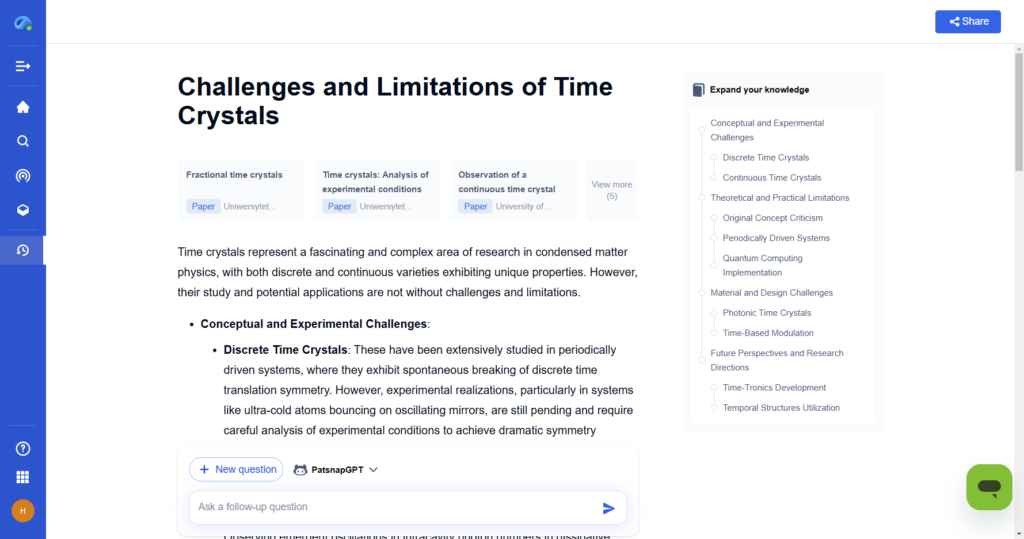
Challenges and Limitations of Time Crystals
1. Fundamental Theoretical Challenges
- Spontaneous Symmetry Breaking in Time: Time crystals require spontaneous breaking of time translation symmetry, a process fundamentally distinct from spatial symmetry breaking. The original Wilczek proposal for continuous time crystal (ground state-based) was invalidated due to the no-go theorem for equilibrium systems . Discrete time crystals (DTCs) in driven systems circumvent this but rely on non-equilibrium dynamics, introducing complexity in modeling many-body interactions .
- Thermalization and Decoherence: Closed quantum systems tend to thermalize, erasing time-crystalline order. Stabilizing DTCs requires finely tuned many-body localization (MBL) to suppress thermalization, which is experimentally demanding and sensitive to disorder .
2. Experimental Realization Barriers
- Precision in Driving and Interactions:
- Discrete time crystal in ultra-cold atom systems (e.g., bouncing on oscillating mirrors) require resonant driving periods and strong interactions to enforce period-doubling motion. Deviations in driving frequency (>1% error) destabilize the crystalline phase .
- Continuous time crystals demand continuous pumping and dissipation (e.g., in atom-cavity systems) to sustain limit-cycle oscillations. Maintaining phase coherence under noise remains challenging, with reported photon-number oscillations lasting only ~100 cycles in experiments .
- Scalability: Current demonstrations involve small-scale systems (e.g., spin chains with ≤20 qubits or atomic ensembles). Scaling to macroscopic sizes amplifies decoherence and control errors .
3. Material and Engineering Limitations
- Platform-Specific Constraints:
- Spin Systems (Solid-State): DTCs in NV centers or trapped ions face qubit decoherence times (T₂ ~ milliseconds) incompatible with long-lived time-crystalline phases .
- Ultra-Cold Atoms: Achieving the necessary isolation from external perturbations (e.g., magnetic field fluctuations) and stabilizing high-order resonances (e.g., period-n motion for n > 2) require sub-nK temperatures and ultra-high vacuum conditions .
- Dynamic Disorder: Random perturbations in mirror motion (for atomic DTCs) or driving fields can induce Anderson localization in the time domain, disrupting periodicity .
4. Critical Evaluation of Current Solutions
- Higher-Order Resonant Driving: Proposals to stabilize DTCs using multi-frequency drives (e.g., period-tripling) lack experimental validation and may introduce parasitic heating.
- Dissipative Engineering: Continuous time crystal in cavity QED systems rely on open quantum dynamics, making them vulnerable to parameter drift in pump lasers or cavity losses.
5. Future Directions and Innovations
Topological Time Crystal: Theoretical extensions propose using topological invariants to protect time-crystalline order, though experimental platforms remain speculative .
Hybrid Systems: Combining MBL with dissipation (e.g., cavity-mediated interactions) could enhance stability .
How Eureka by PatSnap Accelerates Research in Time Crystal Technologies
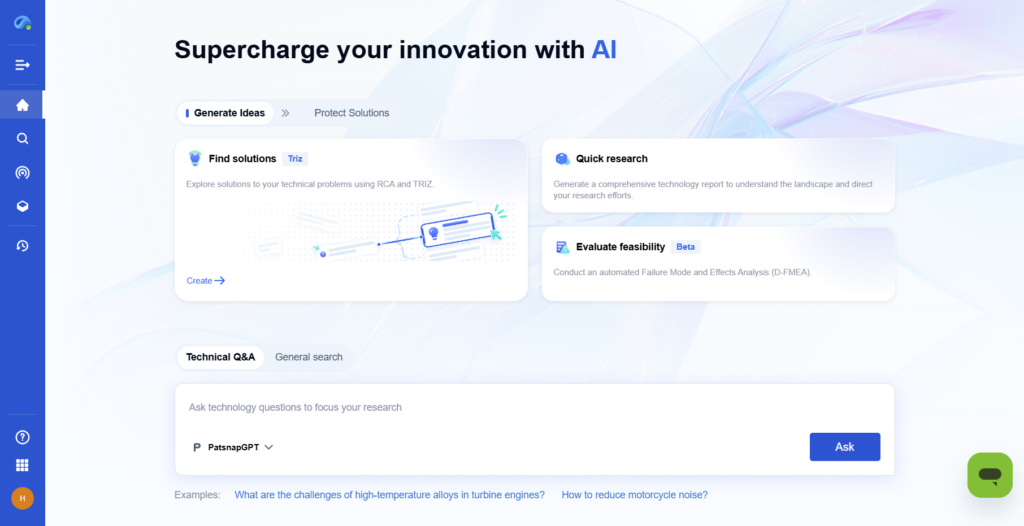
What is Eureka by PatSnap?
Eureka by PatSnap is an innovation intelligence platform that provides researchers with cutting-edge insights into the latest developments in time crystal technology.
How It Benefits Time Crystal Research
- Patent Analysis: Helps identify emerging trends and patents in the time crystal field.
- Competitive Intelligence: Enables researchers to stay ahead of the competition by providing access to the latest research and innovations.
- Technology Roadmapping: Offers insights into future directions for time crystal applications and research.
For anyone involved in quantum physics or material science, Eureka by PatSnap can significantly enhance research efforts and keep you informed on the latest breakthroughs.
Conclusion
Time crystals represent an exciting leap forward in the field of quantum physics, with the potential to revolutionize everything from computing to energy storage. Their unique ability to break time-translation symmetry and oscillate without energy loss sets them apart from traditional quantum systems. While there are still challenges to overcome, the possibilities for future technological advancements are immense.
As researchers continue to explore the potential of time crystal, tools like Eureka by PatSnap offer a powerful way to accelerate innovation and stay at the forefront of this cutting-edge technology.
🚀 Want to dive deeper into the world of time crystal and quantum innovations? Sign up for Eureka by PatSnap today to stay ahead of the curve in time crystal research.
FAQs
1️⃣ What are time crystals?
Time crystals are quantum systems that exhibit periodic motion in time without consuming energy. Unlike traditional crystal, which repeat in space, time crystals repeats over time.
2️⃣ How could time crystals impact quantum computing?
Time crystal could improve quantum computing by providing stable qubits that are less affected by noise, leading to more reliable and faster computations.
3️⃣ Are time crystals energy-efficient?
Yes, time crystals do not lose energy during their oscillation, making them highly energy-efficient compared to traditional systems.
4️⃣ What are the challenges in creating time crystal?
Time crystals are difficult to create due to the need for extreme conditions like ultra-low temperatures and strong magnetic fields.
5️⃣ How can Eureka by PatSnap help in time crystal research?
Eureka by PatSnap provides valuable insights into patents, research trends, and competitive intelligence, helping researchers stay ahead in the rapidly evolving field of time crystals.
To get detailed scientific explanations of Time Crystal, try Patsnap Eureka.
