


Blue light-emitting diodes (LEDs) have transformed the lighting and display industries over the past few decades. They are the cornerstone of modern full-color displays, white LED lighting, and high-efficiency solid-state illumination. From smartphones and TVs to streetlights and automotive headlights, blue LEDs are everywhere — but their use also raises important technical, visual, and health-related considerations.
Why are blue LEDs so important? Eureka Technical Q&A explains how blue LEDs revolutionized lighting and displays by enabling full-color RGB technology and energy-efficient white light—while also exploring challenges like efficiency drop-off and material limitations.

This article explores how blue LEDs work, their advantages, common use cases, and the challenges associated with their widespread adoption in lighting and display technologies.
What Are Blue LEDs?
Blue LEDs are semiconductor-based light-emitting diodes that emit light in the blue region of the visible spectrum (typically around 450–495 nm). They are made from materials like gallium nitride (GaN) and indium gallium nitride (InGaN), which allow for high-energy photon emission needed to generate blue light.
The development of the first practical blue LED in the 1990s — a milestone credited to Isamu Akasaki, Hiroshi Amano, and Shuji Nakamura — enabled the creation of white LEDs by combining blue light with yellow phosphors, revolutionizing global lighting.
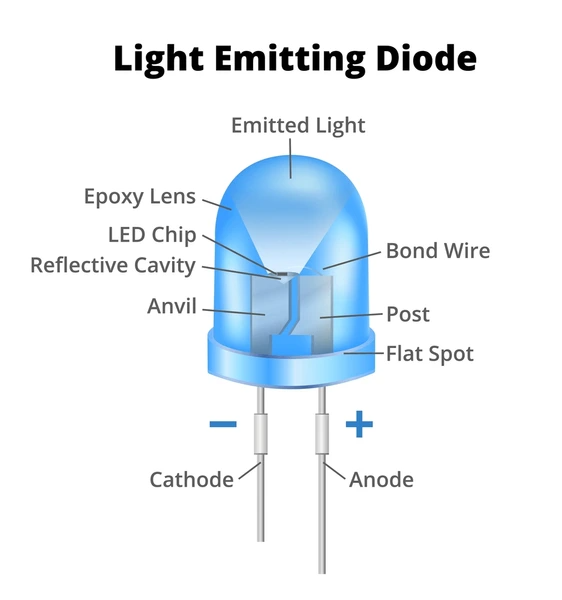
How Do Blue LEDs Work?
Blue LEDs operate on the same principle as other LEDs: electroluminescence. When an electric current passes through the p-n junction of a semiconductor, electrons and holes recombine, releasing energy in the form of photons.
In blue LEDs:
- The bandgap of GaN materials is engineered to emit high-energy blue photons.
- InGaN layers are tuned to control emission wavelength.
- Blue light can be used directly or converted to other colors using phosphor coatings or color filters in displays.
Benefits of Blue LEDs in Lighting
1. High Efficiency
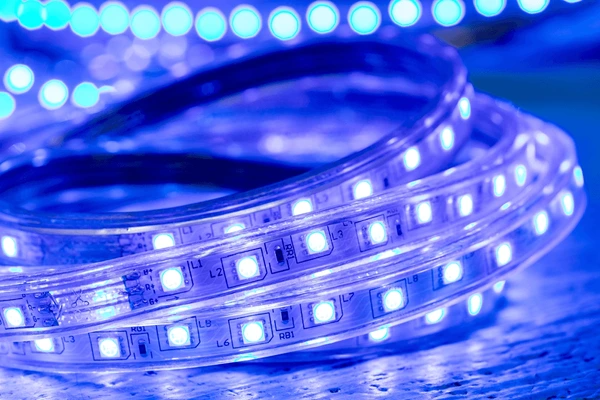
Blue LEDs are highly efficient light sources. When combined with phosphors to produce white light, they can achieve luminous efficacies >150 lm/W — significantly higher than incandescent or fluorescent bulbs.
2. Compact and Durable
As solid-state devices, blue LEDs are robust, vibration-resistant, and long-lasting, with lifespans exceeding 25,000 hours.
3. Versatile Color Generation
Blue LEDs are critical for creating white light and RGB displays. Adjusting phosphor materials allows for warm, neutral, or cool white lighting.
4. Low Energy Consumption
LEDs consume less electricity for the same brightness, making them ideal for energy-efficient lighting in homes, cities, and commercial buildings.
5. Environmental Impact
They contain no mercury and reduce carbon emissions due to lower power consumption — supporting global sustainability efforts.
Applications of Blue LEDs in Displays
Blue LEDs are fundamental in display backlighting and color generation:
1. LCD Backlighting
- Blue LEDs with yellow phosphor produce white light to illuminate LCDs.
- Used in TVs, monitors, smartphones, tablets.
2. RGB Pixel Composition
- In OLED and MicroLED displays, individual red, green, and blue emitters generate full-color images.
- Blue is critical for color accuracy and white balance.
3. Quantum Dot Displays
- Blue LEDs excite quantum dots (QDs) that emit pure red and green, improving color gamut and brightness.
4. Mini and MicroLEDs
- High-resolution microdisplays rely on precise blue LEDs as individual subpixels or excitation sources.
Challenges of Blue LEDs
Despite their advantages, blue LEDs face several technical and perceptual issues:
1. Blue Light Hazard
Prolonged exposure to blue light (especially short wavelengths < 450 nm) can:
- Cause eye strain and discomfort
- Disrupt circadian rhythms and sleep cycles
- Increase the risk of retinal damage with high-intensity sources
This has raised health concerns in mobile screens and LED streetlights.
2. Color Rendering Limitations
Blue LEDs + yellow phosphors often lack red components, resulting in lower CRI (Color Rendering Index). This can make illuminated objects appear dull or unnatural.
3. Efficiency Droop
At high currents, blue LEDs suffer from efficiency droop, where increased current leads to lower light output due to non-radiative recombination.
4. Thermal Management
Blue LEDs generate heat during operation. Without adequate heat dissipation, performance degrades and lifespan shortens.
5. Material Stress and Aging
The InGaN material system used in blue LEDs is prone to lattice mismatch, introducing strain that can reduce long-term reliability.
Comparison: Blue LED vs Other LEDs
- Red LEDs tend to have better temperature characteristics compared to blue LEDs, as they are less affected by heat and can maintain their luminance at higher temperatures.
- Green LEDs are often used in conjunction with blue LEDs to create white light, as they can complement the blue light and improve color rendering.
| Feature | Blue LED | Red LED | Green LED |
|---|---|---|---|
| Wavelength | 450–495 nm | 620–750 nm | 495–570 nm |
| Material | InGaN / GaN | AlGaInP | InGaN / GaN |
| Efficiency | High | Very High | Moderate |
| Hazard Level | High (retina risk) | Low | Moderate |
| Display Use | Backlighting, RGB | RGB displays | RGB displays |
Future Directions for Blue LED Technology
To overcome current challenges and improve performance, research continues in the following areas:
- Improved Phosphor Materials: For better CRI and light spectrum tuning
- Laser LEDs: Blue laser diodes for high-brightness automotive lighting and projectors
- MicroLED Displays: With better color purity and lifetime
- Blue OLEDs: For emissive displays with better viewing angles and contrast
- Human-Centric Lighting: LEDs that adjust spectral output based on time of day to reduce blue light hazards
Conclusion
Blue LEDs have revolutionized modern lighting and display technologies by enabling high-efficiency illumination and vibrant color reproduction. From LCD backlighting to streetlights, they are everywhere — but their use also requires careful attention to health and technical limitations. As material science and optoelectronic design continue to evolve, blue LEDs will remain central to innovation in energy-efficient, human-friendly lighting and next-generation displays.
FAQs
They are essential for creating white light, powering full-color displays, and enabling high-efficiency lighting.
Prolonged exposure to high-intensity blue light can cause eye strain and may disrupt sleep cycles.
Yes. By coating blue LEDs with yellow phosphor, they emit white light — this is how most white LEDs work.
Blue LEDs are typically made from gallium nitride (GaN) and indium gallium nitride (InGaN).
Not directly — OLEDs use organic emitters. However, blue-emitting OLEDs are functionally similar and are key to full-color OLED displays.
To get detailed scientific explanations of Blue LED, try Patsnap Eureka.
