


As display technology evolves, energy efficiency and brightness are becoming just as important as resolution. One innovation that pushes these boundaries is PHOLED, or Phosphorescent Organic Light-Emitting Diode technology. PHOLEDs are a type of OLED that use phosphorescent materials to produce light more efficiently, making them ideal for next-generation screens in smartphones, TVs, and wearables. This article explains what PHOLED technology is, how it works, and why it matters in modern display engineering.
What Is PHOLED?
What is PHOLED technology and how does it work? Eureka Technical Q&A explains that PHOLED (Phosphorescent OLED) uses phosphorescent materials to achieve nearly 100% internal light emission efficiency, making displays brighter and more energy-efficient compared to traditional OLEDs—ideal for high-performance screens.

PHOLED stands for phosphorescent organic light-emitting diode. Like traditional OLEDs, PHOLEDs use organic compounds that emit light when an electric current is applied. The key difference lies in how they emit that light. PHOLEDs use phosphorescent emitters, which can convert up to 100% of electrical energy into light—compared to only 25% efficiency in traditional fluorescent OLEDs.
This makes PHOLED displays significantly more energy-efficient, especially in producing green and red light. Blue PHOLEDs are still in development due to stability challenges.
How PHOLED Technology Works
PHOLEDs work by emitting light through phosphorescence as excitons return to their ground state. This process uses both singlet and triplet excitons. As a result, PHOLEDs reach higher internal quantum efficiency than traditional fluorescent OLEDs.
1. Organic Layer Structure
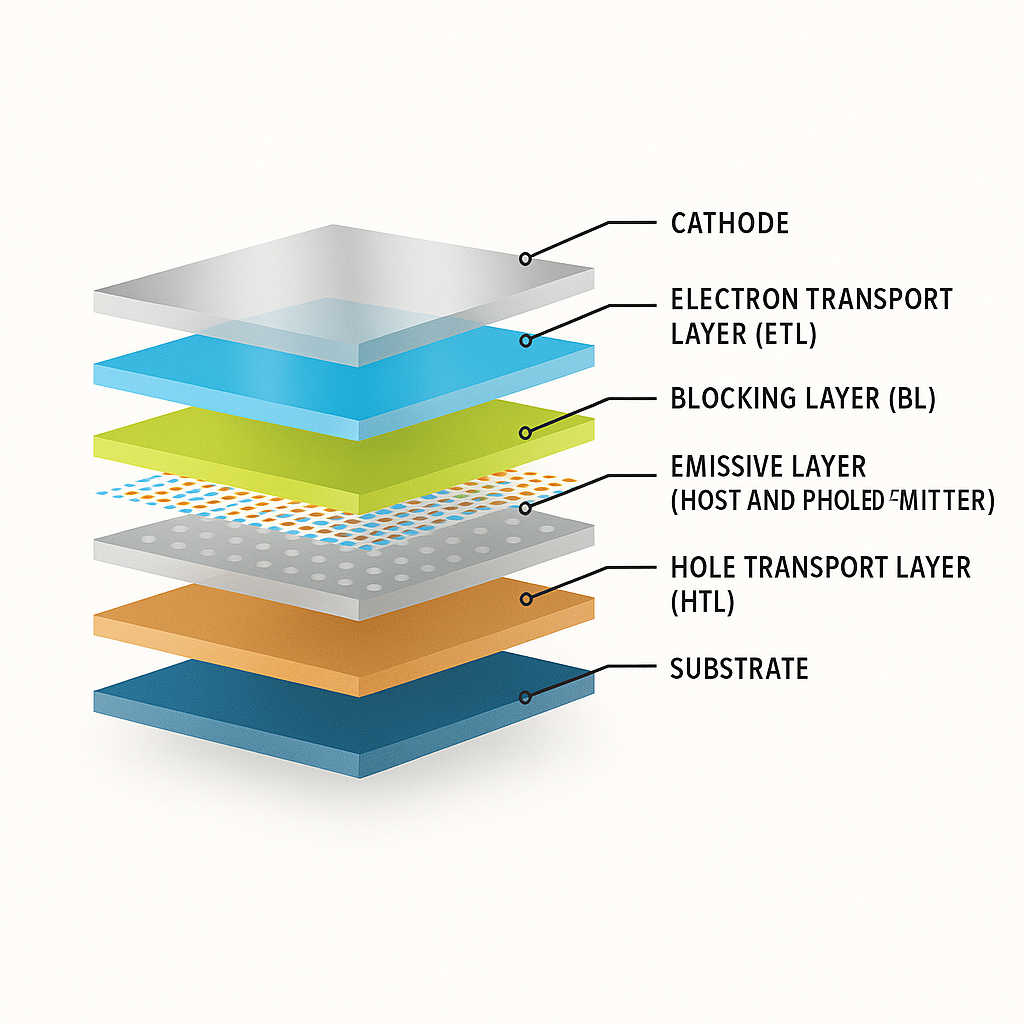
PHOLEDs contain multiple thin layers of organic materials, sandwiched between two electrodes:
- Anode: Positively charged electrode
- Hole Transport Layer (HTL): Carries positive charges (holes)
- Emission Layer (EML): Where light is generated
- Electron Transport Layer (ETL): Carries negative charges (electrons)
- Cathode: Negatively charged electrode
2. Exciton Formation
When voltage is applied, electrons and holes combine in the emission layer to form excitons, which are excited-state electron-hole pairs.
3. Phosphorescent Emission
In PHOLEDs, the emission layer contains phosphorescent dopants that can harness both singlet and triplet excitons—unlocking nearly 100% internal quantum efficiency. In contrast, fluorescent OLEDs waste most triplet excitons as heat.
4. Light Emission
The excitons release energy as photons (light), and the color depends on the specific phosphorescent material used (e.g., red, green, or blue). PHOLEDs typically use organometallic complexes with metal centers like iridium or platinum. Organic ligands around these metals define the energy gap and emission color. Designers carefully choose ligands and complexes to achieve high efficiency and accurate color rendering.
5. Host and Dopant Materials
Choosing the right host and dopant is crucial for performance and lifespan. CBP and TCTA are common hosts, though blue PHOLEDs face stability issues. C-N bond dissociation during operation often reduces device lifetime.
Benefits of PHOLED Technology
- Higher Efficiency: Converts almost all electrical energy into light
- Lower Power Consumption: Ideal for battery-powered devices like smartphones and wearables
- Brighter Displays: Requires less current to achieve the same brightness
- Improved Lifespan (Red/Green): Red and green PHOLEDs are stable and long-lasting
- Thinner and Lighter Devices: Enables more compact display designs
Limitations and Challenges
- Blue PHOLEDs: Still under development due to degradation issues; current blue emitters use fluorescent materials
- Cost: Phosphorescent materials are more complex and expensive to manufacture
- Color Balance: Mixing phosphorescent and fluorescent emitters requires careful calibration to maintain uniformity over time
Blue PHOLEDs still struggle with long-term stability. Researchers are developing new materials and exploring novel architectures. Promising directions include bipolar hosts and using polariton-enhanced Purcell effects to improve performance and extend lifespan.
Real-World Applications
Display Technology
- PHOLEDs are widely used in display technology, particularly in mobile displays and large-area TVs. They offer advantages such as low power consumption and low operating temperatures, making them ideal for portable and wearable devices.
- The ability to achieve high luminance and color purity makes PHOLEDs suitable for high-resolution displays, including those used in smartphones, tablets, and computer monitors.
Solid-State Lighting
- PHOLEDs are being explored for solid-state lighting applications, including general illumination and specialty lighting. Their ability to emit a wide range of colors and their efficiency in converting electrical energy to light make them promising candidates for next-generation lighting solutions.
- The development of PHOLEDs for lighting aims to provide energy-efficient, long-lasting, and customizable lighting options for various applications, from residential to commercial settings.
Automotive Lighting
- The automotive industry is increasingly adopting PHOLEDs for interior and exterior lighting. Their high efficiency and ability to produce vibrant colors make them suitable for dashboard displays, ambient lighting, and headlamps.
- PHOLEDs can contribute to the development of advanced driver assistance systems (ADAS) by providing high-quality lighting for cameras and sensors.
Wearable Technology
- The flexibility and lightweight nature of PHOLEDs make them suitable for wearable technology applications, such as smartwatches and fitness trackers. They can provide clear and vibrant displays in compact and energy-efficient packages.
- PHOLEDs can also be used for wearable lighting applications, offering customizable and stylish lighting options for fashion and accessories.
Medical Devices
- PHOLEDs are being explored for medical devices, including diagnostic tools and wearable health monitors. Their ability to provide clear and accurate visual information in a compact form factor is beneficial for medical applications.
- The durability and reliability of PHOLEDs make them suitable for use in harsh medical environments, where consistent performance is critical.
Gaming and Entertainment
- The gaming and entertainment industry is leveraging PHOLEDs for high-quality displays and lighting effects. Their ability to produce vivid colors and high contrast makes them ideal for gaming consoles, virtual reality (VR) headsets, and immersive entertainment systems.
- PHOLEDs can enhance the gaming experience by providing realistic and visually stunning graphics, contributing to the development of more immersive and engaging entertainment experiences.
Application Cases
| Product/Project | Technical Outcomes | Application Scenarios |
|---|---|---|
| PHOLED Technology Universal Display Corp. | Achieved green PHOLED with 4.3V, 70 cd/A, 50 lm/W and >10,000h lifetime at 1,000 cd/m2 | Mobile displays, large area TVs, low power consumption displays |
| Triphenylene-based PHOLED Universal Display Corp. | High triplet energy materials reduce energy quenching, improve luminous efficiency and stability | OLEDs with enhanced performance across different color emissions |
| Orthogonal Solution-Processed PHOLED University of Washington | Green PHOLEDs achieved 53.8 cd/A luminous efficiency and 16.1% external quantum efficiency | Multilayered organic electronic devices with solution-processed electron-transport layers |
| Simplified Bilayer White PHOLED Electronics & Telecommunications Research Institute | Achieved 12.9% external quantum efficiency, 30.3 cd/A current efficiency, and 30.0 lm/W power efficiency | Efficient white light emission for lighting applications |
| Deep Blue PHOLED Dankook University | Achieved 18.1% maximum quantum efficiency and 12.2% at 1000 cd/m2 with color coordinate of (0.137, 0.191) | High-performance displays requiring deep blue emission |
FAQs
PHOLED uses phosphorescent materials that are more efficient, while traditional OLEDs rely on fluorescent materials with lower light-emission efficiency.
Blue phosphorescent emitters tend to degrade faster, affecting display lifespan and requiring further material innovation.
No. Many OLEDs still use a combination of phosphorescent and fluorescent emitters, especially for the blue subpixel.
Yes. Because it’s more efficient, PHOLED can extend battery life, especially when displaying content that heavily uses red and green colors.
PHOLED was pioneered by Universal Display Corporation (UDC), which holds key patents for the technology and supplies emitters to major display manufacturers.
Conclusion
PHOLED is a game-changing display technology that brings high efficiency and brilliant visuals to modern screens. By using phosphorescent materials to harness more energy from each exciton, PHOLED panels deliver better performance with less power. While challenges like blue PHOLED stability remain, ongoing research continues to push the boundaries of what’s possible in OLED displays.
As the demand for thinner, brighter, and more energy-efficient screens grows, PHOLED is set to play a major role in shaping the future of consumer electronics.
To get detailed scientific explanations of PHOLED technology, try Patsnap Eureka.
