


What is a Fiber Optic Cable?
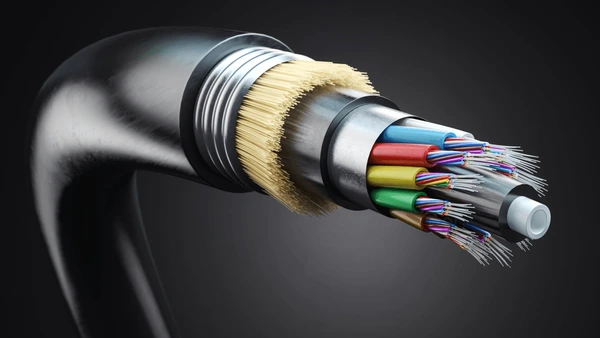
A fiber optic cable is an assembly of one or more optical fibers enclosed in a protective sheath or jacket. It is designed to transmit data in the form of light signals over long distances with minimal signal loss.
Components of a Fiber Optic Cable
- Optical Fiber: The core component responsible for transmitting light signals. It consists of a thin glass or plastic core surrounded by a cladding layer with a lower refractive index, allowing total internal reflection to guide light along the fiber. The core diameter typically ranges from 8-100 microns for single-mode and multi-mode fibers, respectively.
- Buffer Coating: A protective polymer coating, such as acrylate or polyimide, applied directly over the cladding to reinforce the fiber and absorb shocks.
- Strength Members: Aramid yarns, steel, or glass-reinforced plastic strands that provide tensile strength and protect the fibers from stress during installation and operation.
- Outer Jacket: The outermost layer, typically made of polyvinyl chloride (PVC) or other polymers, offering protection against moisture, chemicals, crushing, and abrasion
How Fiber Optic Cables Work
Fiber optic cables transmit data by converting electrical signals into light pulses at the transmitter end. These light pulses are guided through the core of the optical fibers by total internal reflection, with minimal loss over long distances. At the receiver end, the light pulses are converted back into electrical signals for data processing.
The key principles enabling efficient data transmission include:
- Total Internal Reflection: Due to the lower refractive index of the cladding, light is continuously reflected within the core, allowing long-distance propagation.
- Low Signal Attenuation: Optical fibers exhibit minimal signal loss, enabling high-bandwidth data transmission over extended distances without the need for signal regeneration.
- Immunity to Electromagnetic Interference: Unlike electrical cables, fiber optic cables are immune to electromagnetic interference, making them suitable for use in environments with high electromagnetic fields
Types of Fiber Optic Cables
Single-Mode Fibers
- Have a small core diameter (8-10 microns) that allows only one mode of light to propagate
- Offer higher bandwidth and longer transmission distances (up to hundreds of kilometers)
- Used for long-haul telecommunications and high-speed data networks
Multi-Mode Fibers
- Have a larger core diameter (50-100 microns) that allows multiple modes of light to propagate
- Lower bandwidth but suitable for shorter distances (up to a few kilometers)
- Commonly used in local area networks (LANs) and premises cabling
Advantages of Fiber Optic Cables
- High Bandwidth and Data Transmission Capacity: Fiber optic cables can transmit data at significantly higher rates and bandwidths compared to copper cables. They can support higher frequencies and suffer less signal attenuation, enabling faster and more efficient data transmission over long distances.
- Immunity to Electromagnetic Interference (EMI): Fiber optic cables are made of non-conductive materials like glass or plastic, making them immune to electromagnetic interference or noise from sources like lightning, radio waves, or nearby electrical equipment. This ensures reliable and secure data transmission.
- Low Signal Loss and Long-Distance Transmission: Optical fibers have very low signal loss, allowing data to be transmitted over much longer distances without the need for signal boosters or repeaters. This makes fiber optic cables ideal for long-haul communications and remote applications.
- Lightweight and Compact Design: Fiber optic cables are lighter and smaller in size compared to traditional copper cables, making them easier to install and manage, especially in confined spaces or weight-sensitive applications like aerospace and military.
- Enhanced Security: Fiber optic cables do not emit electromagnetic radiation, making it difficult to tap or intercept the transmitted data. This provides enhanced security and privacy for sensitive communications.
Disadvantages of Fiber Optic Cables
- Higher Installation and Maintenance Costs: The initial installation and deployment of fiber optic cables can be more expensive than copper cables due to the specialized equipment and skilled labor required. Maintenance and repairs can also be costlier.
- Fragility and Susceptibility to Damage: Optical fibers are made of delicate glass or plastic materials, making them more susceptible to physical damage from bending, crushing, or environmental factors like moisture or extreme temperatures. Proper handling and protection are essential.
Single-Mode vs. Multi-Mode Fiber
Fiber Structure and Light Propagation
Single-mode fibers (SMFs) have a small core diameter (typically 8-10 μm) and support only the fundamental mode of light propagation, while multi-mode fibers (MMFs) have a larger core diameter (50-62.5 μm) and allow multiple modes to propagate simultaneously.
This difference in core size and the number of supported modes leads to distinct characteristics and applications for each fiber type.
Modal Dispersion and Bandwidth
In MMFs, the different modes travel at slightly different velocities, causing modal dispersion and limiting the achievable bandwidth and transmission distance.
SMFs, on the other hand, are free from modal dispersion, enabling higher bandwidths and longer transmission distances.
Network designers prefer single-mode fibers (SMFs) for long-haul and high-speed applications. In contrast, they typically use multimode fibers (MMFs) for short-range communications, such as local area networks (LANs) and data centers.
Wavelength and Attenuation
Engineers optimize single-mode fibers (SMFs) for longer wavelengths, such as 1310 nm or 1550 nm, to reduce attenuation and dispersion, making them ideal for long-distance transmission. Multimode fibers (MMFs) typically operate at shorter wavelengths, such as 850 nm, but experience higher attenuation over extended distances.
Cost and Complexity
MMF systems are generally less expensive than SMF systems due to the lower cost of light sources, connectors, and maintenance. However, SMFs offer higher capacity and performance, justifying their higher cost for applications that require long-distance or high-bandwidth transmission.
Installation and Maintenance Tips
Installation of Fiber Optic Cables
- Proper cable routing and management are crucial to prevent excessive bending, twisting, or crushing.
- Furcation assemblies and strain relief devices should be securely mounted to protect fibers during transitions.
- Connectors and splices should be carefully installed and cleaned to minimize signal loss.
- Cable shielding or armoring may be necessary in harsh environments or areas with high electromagnetic interference.
- Consideration of cable weight, flexibility, and environmental factors like temperature and solar radiation is important for optimal performance.
- Proper cable labeling and documentation are essential for future maintenance and troubleshooting.
Maintenance of Fiber Optic Cables
- Regular inspection and cleaning of fiber end faces and connectors to remove debris and contamination.
- Monitoring and testing of signal strength and quality to detect potential issues or degradation.
- Replacement or repair of damaged or degraded cable sections, connectors, or splices.
- Proper cable management and organization to prevent excessive bending, twisting, or tension.
- Adherence to manufacturer recommendations for environmental conditions, temperature ranges, and cable handling.
- Periodic recalibration and adjustment of active components like amplifiers or filters
Applications of Fiber Optic Cable
Telecommunications
Telecommunication systems widely use fiber optic cables to transmit voice, video, and data signals due to their high bandwidth and low noise operation. Providers increasingly deploy these cables in fiber-to-the-home (FTTH) and fiber-to-the-premises (FTTP) networks to deliver high-speed internet and services directly to end-users.
Data Centers and Central Offices
Fiber optic cables are essential in data centers and central offices for interconnecting equipment racks and active/passive components. Their high bandwidth and low signal loss enable efficient data transmission over long distances.
Aerospace and Defense
The aerospace and defense industries utilize fiber optic cables for various applications, including communication networks, sensors, navigation, and prognostics and health management. Their lightweight, small diameter, and resistance to harsh environments make them suitable for aircraft, spacecraft, and military systems.
Industrial and Harsh Environments
Industrial settings and harsh environments use fiber optic cables because they resist extreme temperatures, vibrations, radiation, and corrosion. Industries rely on them for applications like process control, monitoring, and sensing due to their durability.
Medical and Scientific
The medical field uses fiber optic cables in endoscopes, surgical instruments, and imaging systems. They also find applications in scientific research, such as in fiber optic sensors for measuring various parameters.
Emerging Applications
Emerging technologies increasingly use fiber optic cables in autonomous vehicles, smart cities, and the Internet of Things (IoT). Their high bandwidth and low latency make them suitable for transmitting large amounts of data in real-time.
Application Cases
| Product/Project | Technical Outcomes | Application Scenarios |
|---|---|---|
| Fiber Optic Cable with Strength Member Corning Optical Communications LLC | Enhanced durability and protection against damage during installation and operation. | Used in environments where fiber optic cables are subject to physical stress and require additional strength. |
| Fiber Optic Cable Assembly with Furcation Corning Optical Communications LLC | Improved installation process and protection for spliced optical fibers. | Ideal for data centers and central offices where precise and secure fiber optic connections are critical. |
| Fiber Optic Cable Slack Storage Module Corning Optical Communications LLC | Efficient management of fiber optic cable slack, easy installation and removal. | Applicable in data centers and central offices to manage excess fiber optic cable lengths. |
| Connectors for Micro-Duct Terminations of Fiber Optic Cable PPC Broadband, Inc. | Allows for easy and secure optical fiber feed-through connections. | Used in telecommunications networks where micro-duct terminations are required. |
| Fiber Optic Technology for Harsh Environments | Provides resistance to extreme temperatures, shock, vibration, and electromagnetic interference. | Suitable for aerospace and defense applications, including aircraft and space exploration systems. |
Latest Technical Innovations in Fiber Optic Cable
Cable Design and Materials
- Robust and versatile cable designs for aerial, buried, and duct applications with relatively large slack storage capacity.
- Corrosion-resistant metal outer tubes or polymer tubes with fins for harsh environments like oil/gas wells.
- Small cross-section yet robust cable designs to reduce size and weight.
Cable Components
- Hardened connectors (plugs/receptacles) suitable for outdoor plant applications.
- Gel-filled plastic tubes to protect optical fibers.
- Strength members (e.g. aramid/glass yarns) to protect optical fibers from physical damage.
Fiber Optic Terminations
- Compact, low-profile fiber terminations with precise alignment for miniaturization.
- Hermetic seals and strain relief for harsh environments.
- Lenses to focus light signals from sources onto fibers or from fibers onto receptors.
Manufacturing and Testing
- Optimized manufacturing processes and fixtures for fiber optic connectors and termini.
- Standards and quality plans for fiber optic cable assembly manufacturing and inspection.
- New procedures for high-power laser pulse injection into fibers without damage
To get detailed scientific explanations of fiber optic cable, try Patsnap Eureka.
