Technical Background and Objectives
Background
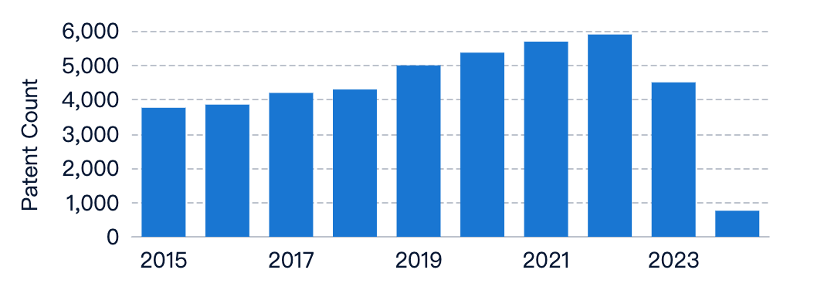
The field of ‘resonator improve performance’ shows a consistent upward trend in patent applications, indicating growing interest and investment in research and development. This trend suggests that improving resonator performance is a key focus for technological advancements. In contrast, literature publications show a fluctuating pattern, indicating variable levels of academic research activity. The divergence between patent and literature trends suggests a strong commercial focus on developing and protecting intellectual property related to resonator performance improvements, while academic research activity has varied over time.
Objectives
The primary objective is to explore and develop innovative techniques to enhance the performance of resonators. This research aims to address challenges such as energy dissipation, frequency instability, and temperature sensitivity. The goal is to improve resonator performance, leading to significant advancements in fields like communication systems, sensors, and signal processing devices.
To get a detailed scientific explanations of resonator improve performance, try Eureka.
Technical Current Status Analysis
Resonators
Resonators are essential components in communication systems, radar systems, and precision measurement instruments due to their ability to generate and filter specific frequencies with high accuracy and stability. Improving resonator performance is crucial for enhancing overall system performance and enabling new applications.
Applications and Impact:
- Communication Systems: Resonators ensure stable and accurate frequency generation and filtering, essential for reliable data transmission and reception.
- Radar Systems: Improved resonator performance enhances radar sensitivity, range, and resolution.
- Precision Measurement Instruments: Resonators determine system accuracy and stability, crucial for applications like atomic clocks and frequency synthesizers.
Technical Characteristics and Challenges:
- Quality Factor (Q-Factor): Higher Q-factors improve performance but are challenging to achieve while maintaining small size and integration with circuits.
- Temperature Stability: Critical for accurate performance over a wide temperature range.
- Phase Noise: Important for short-term frequency stability, particularly in communication and measurement systems.
- Aging: Frequency drift over time due to material degradation or stress.
- Power Handling Capability: Important for applications requiring high power levels.
- Integration and Miniaturization: Demand for compact resonators integrated into small packages or directly onto circuits.
Technological Paths:
- Material Research and Development: New materials with high Q-factors, excellent temperature stability, and low aging rates.
- Advanced Fabrication Processes: Techniques like MEMS technology for miniaturized resonators.
- Compensation and Control Techniques: Temperature compensation circuits, phase-locked loops, and digital signal processing algorithms.
- System-Level Optimization: Co-design approaches for optimal performance.
- Hybrid and Integrated Approaches: Combining different resonator technologies for improved performance.
- Modeling and Simulation: Advanced tools for design and optimization.
Research Content
Research Objectives
The primary objective is to develop innovative techniques to enhance resonator performance, focusing on overcoming existing performance barriers such as energy dissipation, frequency instability, and temperature sensitivity.
Research Direction and Focus
Resonator Materials and Structures
- Explore novel materials with superior mechanical, electrical, and thermal properties.
- Investigate advanced structures like phononic crystals, metamaterials, and MEMS.
- Conduct theoretical modeling and simulations to optimize designs.
Fabrication Techniques and Processes
- Develop innovative techniques like additive manufacturing, nanolithography, and self-assembly.
- Investigate scalable and cost-effective manufacturing processes.
- Establish quality control and characterization protocols.
Performance Characterization and Validation
- Conduct experimental studies to evaluate performance, including frequency stability, Q-factor, temperature sensitivity, and power handling.
- Develop advanced measurement and characterization techniques.
- Validate theoretical models with experimental data.
Integration and Application Development
- Explore strategies for integrating improved resonators into existing and emerging applications.
- Collaborate with industry partners to tailor resonator technologies to specific application requirements.
- Develop prototypes and demonstrate proof-of-concept implementations.
Technical Development Roadmap
Key Areas of Advancement
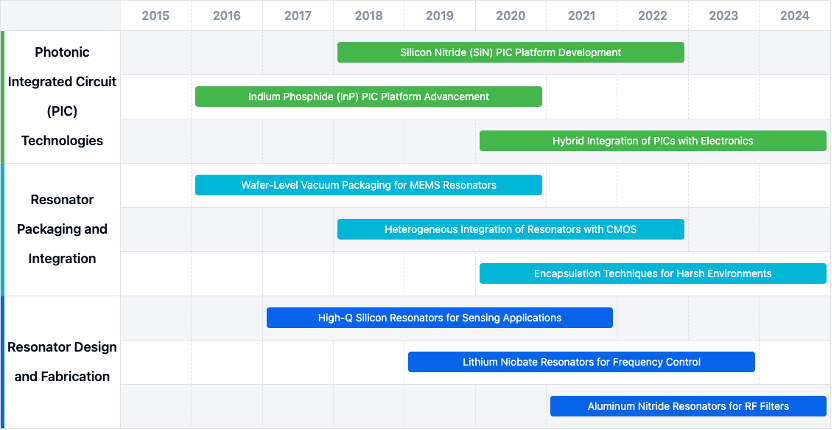
- Photonic Integrated Circuit (PIC) Technologies: Development of SiN and InP platforms and hybrid integration with electronics.
- Resonator Design and Fabrication: High-Q silicon resonators, lithium niobate resonators, and aluminum nitride resonators.
- Resonator Packaging and Integration: Wafer-level vacuum packaging for MEMS resonators, heterogeneous integration with CMOS technology, and encapsulation techniques for harsh environments.
These advancements enable the development of innovative resonator-based solutions with enhanced performance, miniaturization, and robustness.
Main Player Analysis
Key Players and Focus
- Chinese Academy of Sciences: Research on acoustic energy harvesters, infrared target detection, reservoir computing, graphene-based optoelectronics, and laser resonators.
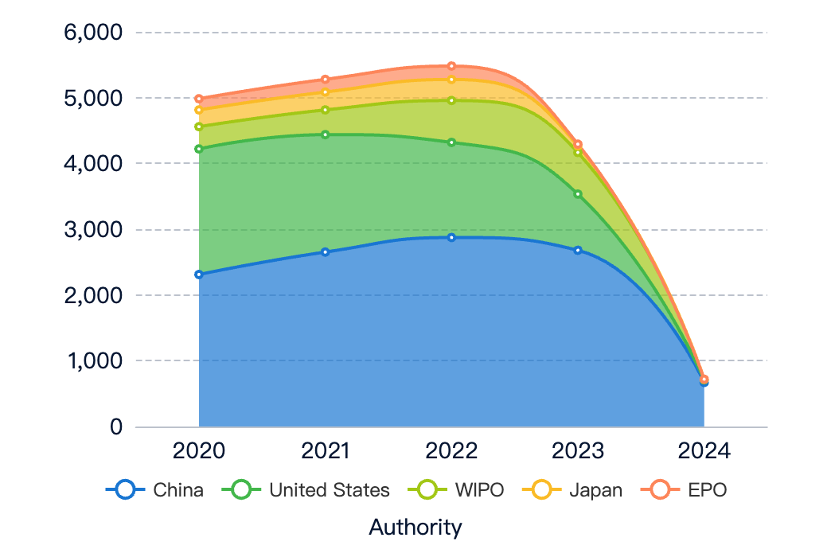
- Matsushita Electronics Corp.: Over 1500 patents in resonator design, fabrication, and integration.
- University of Electronic Science & Technology of China: Research on nanowire metamaterial absorbers, temperature-compensated film bulk acoustic resonator filters, and dielectric resonator antennas.
- Murata Manufacturing Co. Ltd.: Over 2100 patents in resonator performance improvement.
- Seiko Epson Corp.: Over 1600 patents in resonator design, fabrication, and integration.
Current Technical Solution Overview
Resonator Design for Improved Performance
Resonator Design Optimization: Techniques like geometric optimization, material selection, and structural modifications to improve performance characteristics such as resonance frequency, Q-factor, and power handling capability.
Resonator Design for Improved Thermal Performance: Incorporating heat sinks, optimizing thermal conductivity, or implementing active cooling mechanisms to maintain stable operation.
Resonator Design for Improved Mechanical Performance: Enhancing structural integrity, vibration resistance, and durability through optimized geometry, material selection, and mounting mechanisms.
Resonator Design for Improved Electrical Performance: Enhancing impedance matching, reducing signal losses, and improving power handling capabilities.
Design for Manufacturability of Resonators: Techniques like design rule checking, design for testability, and design for yield optimization to improve manufacturability and reduce defects.
Resonator Control and Tuning Methods
Voltage-Controlled Oscillator (VCO) Tuning and Calibration: Techniques for tuning and calibrating VCOs to improve performance and stability.
Tuning and Stabilizing Stringed Instruments: Methods and devices for tuning and stabilizing the tune of stringed instruments.
Improving Vehicle Performance through Engine Tuning: Techniques for tuning and calibrating engines to improve performance.
Tuning and Optimizing RF Components: Methods and systems for tuning and optimizing RF components like antennas and amplifiers.
Improving Performance through Tune Selection and Playback: Techniques for selecting and playing back musical tunes or audio content to enhance performance or user experience.
Resonator Applications in Electromagnetic Devices
Resonators for Enhancing Electromagnetic Device Performance: Using resonators to improve performance in devices like antennas, filters, and amplifiers.
Electromagnetic Shielding for Improved Device Performance: Techniques for reducing electromagnetic interference (EMI) to improve device operation and reliability.
Resonator Design for Optimized Electromagnetic Performance: Adjusting resonator geometry, materials, or coupling mechanisms to achieve desired characteristics.
Electromagnetic Techniques for Enhancing Application Performance: Optimizing signal propagation, reducing interference, and leveraging electromagnetic principles.
Electromagnetic Materials for Improved Shielding and Absorption: Developing materials with high conductivity, tailored permittivity, and permeability.
Resonator Cooling and Thermal Management
Improving Cooling Performance through Thermal Management Techniques: Enhancing cooling performance with systems like heat sinks, thermal buffers, or active cooling mechanisms.
Monitoring and Evaluation of Thermal Performance: Systems and methods for assessing cooling and thermal management effectiveness.
Thermoelectric Cooling for Performance Enhancement: Using thermoelectric cooling devices for precise temperature control and efficient heat transfer.
Optimizing Cooling System Design for Improved Performance: Modifying components like heat exchangers and radiators for better heat dissipation and airflow.
Resonator Applications in Vehicle and Engine Performance
Resonators for Improving Engine Performance: Incorporating resonators into intake or exhaust systems to optimize air or exhaust flow, improving combustion efficiency and power output.
Resonators for Improving Vehicle Acceleration: Enhancing engine responsiveness and torque delivery through optimized flow of air or exhaust gases.
Resonators for Enhancing Catalyst Performance: Optimizing exhaust gas flow through resonators to improve catalytic converter efficiency.
Resonators for Improving Engine Warm-Up Performance: Helping engines reach optimal operating temperature more quickly.
Resonators for Improving Vehicle Performance through Electronic Control: Using sensors and control algorithms to optimize air or exhaust flow, enhancing engine efficiency and emission control.
Key Patent Interpretation
Patent Highlights
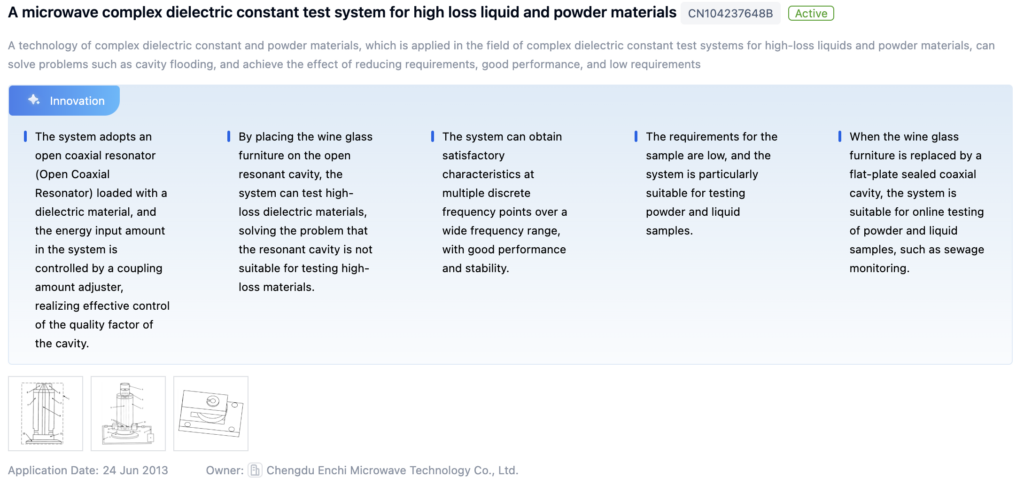
Patent 1: A Microwave Complex Dielectric Constant Test System for High Loss Liquid and Powder Materials
- Core Invention Points:
- Uses an open coaxial resonator loaded with a dielectric material and controlled energy input.
- Effective for testing high-loss dielectric materials.
- Achieves good performance and stability over a wide frequency range.
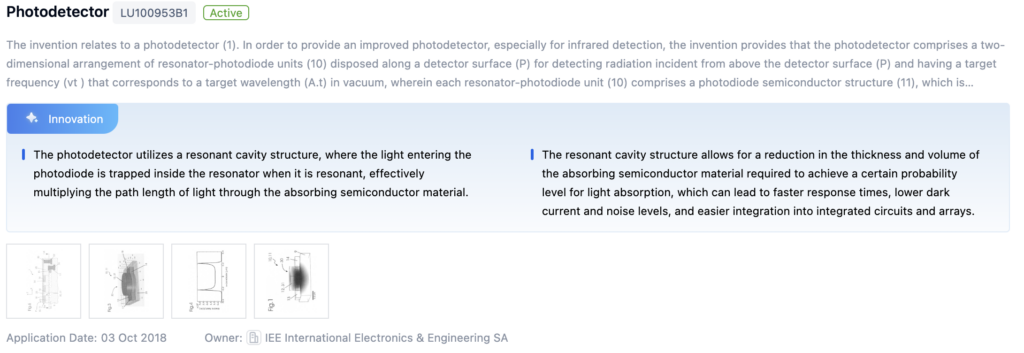
Patent 2: Photodetector
- Core Invention Points:
- Utilizes a resonant cavity structure to enhance light absorption.
- Reduces the thickness and volume of absorbing semiconductor material.
- Results in faster response times, lower dark current and noise levels, and easier integration.
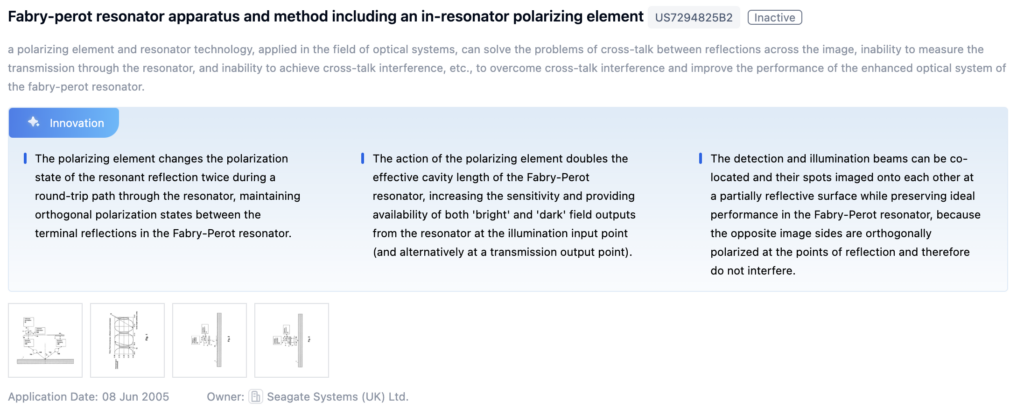
Patent 3: Fabry-Perot Resonator Apparatus and Method Including an In-Resonator Polarizing Element
- Core Invention Points:
- Uses a polarizing element to change the polarization state of resonant reflections.
- Doubles the effective cavity length, increasing sensitivity.
- Provides both ‘bright’ and ‘dark’ field outputs, overcoming cross-talk interference.
Possible Research Directions
- Resonator Design for Improved Performance: Techniques to enhance performance by optimizing geometry, materials, and other parameters for higher efficiency, wider bandwidth, or better selectivity.
- Resonator Applications for Performance Enhancement: Using resonators in amplifiers, filters, or oscillators to enhance signal processing capabilities, reduce distortion, or improve stability.
- Resonator Control and Tuning for Performance Optimization: Adjusting parameters like bias currents, feedback networks, or input signals to optimize performance characteristics.
- Resonator Integration for System Performance Enhancement: Incorporating resonators into larger systems to improve efficiency, reliability, or responsiveness.
If you want an in-depth research or a technical report, you can always get what you want in Eureka Technical Research. Try now!