


Technical Background and Objectives
Background
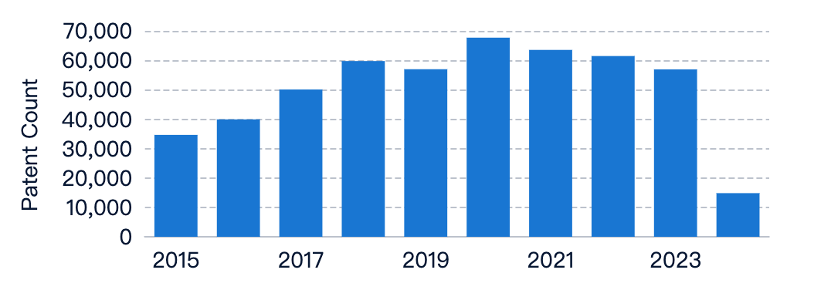
Improving welding quality has been a longstanding focus of research and development. The data on patent applications shows a consistent upward trend, indicating sustained innovation and technological advancements in enhancing weld quality. In contrast, literature publications exhibit a more fluctuating pattern, with periods of increased research activity. This disparity suggests that a significant portion of R&D efforts is driven by industrial and commercial interests, focusing on practical applications and commercialization.
Objectives
The primary objective is to enhance the quality of welding processes and weld joints. By investigating various aspects of welding technology, the aim is to develop innovative solutions that can improve weld integrity, reduce defects, and increase overall reliability. The ultimate goal is to provide the industry with advanced welding techniques leading to improved product performance, enhanced safety, and cost-effective manufacturing processes.
To get a detailed scientific explanations of Improving Welding Quality, try Eureka.
Technical Current Status Analysis
Welding Industry Overview
Welding is a crucial process in various industries, including construction, automotive, aerospace, and manufacturing. Ensuring high-quality welds is essential for maintaining the structural integrity, safety, and reliability of the final product.
Industry-Specific Applications and Impact:
- Construction: Fabrication of steel structures like buildings, bridges, and pipelines. Improving welding quality ensures longevity and safety.
- Automotive: Assembly of vehicle bodies, chassis, and components. High-quality welds maintain structural integrity and passenger safety.
- Aerospace: Manufacturing aircraft components such as fuselages, wings, and engines. Strict quality standards are essential for reliability and safety.
- Manufacturing: Producing machinery and consumer products. High-quality welds ensure durability, performance, and aesthetics.
Technical Characteristics and Challenges:
- Weld Integrity: Ensuring mechanical strength, ductility, and resistance to cracking or defects.
- Metallurgical Properties: Controlling thermal cycles and post-weld heat treatment to maintain desirable properties.
- Distortion and Residual Stresses: Managing localized heating and cooling to prevent inaccuracies and premature failure.
- Defect Detection and Inspection: Employing advanced non-destructive testing (NDT) techniques to identify and characterize defects.
- Automation and Process Control: Implementing consistent and repeatable processes to minimize human error and ensure quality.
Technological Paths:
- Advanced Welding Processes: Friction stir welding, laser beam welding, and electron beam welding.
- Computational Modeling and Simulation: Optimizing parameters and minimizing distortion or residual stresses.
- Intelligent Process Monitoring and Control: Integrating sensors, machine learning algorithms, and real-time monitoring.
- Advanced Materials and Filler Metals: Developing materials with tailored properties for improved weld quality.
- Additive Manufacturing and Hybrid Processes: Combining techniques for complex geometries and reduced waste.
- Non-Destructive Testing (NDT) Advancements: Improving techniques like phased array ultrasonic testing and digital radiography.
- Workforce Training and Qualification: Comprehensive training programs and certification processes for consistent application of best practices.
Research Content
Research Objectives
Enhance the quality of welding processes and resulting weld joints, aiming for improved weld integrity, reduced defects, and increased overall reliability.
Research Direction and Focus
Weld Metallurgy and Microstructure
- Study the effects of heat input, cooling rates, and filler materials on the microstructure and properties of weld metal and heat-affected zones.
- Use advanced characterization techniques like electron microscopy and X-ray diffraction.
Welding Process Optimization
- Explore various welding processes, including arc welding (GMAW, GTAW, SMAW), laser welding, and friction stir welding.
- Optimize process parameters using computational modeling and simulation.
Advanced Welding Technologies
- Investigate additive manufacturing and hybrid welding processes for complex geometries and reduced material waste.
Non-Destructive Evaluation and Quality Control
- Develop advanced non-destructive evaluation (NDE) techniques for defect detection and characterization.
- Implement in-process monitoring and control systems for real-time quality assurance.
Welding Automation and Robotics
- Explore automation and robotics for consistency, repeatability, and productivity.
- Develop intelligent welding systems with sensors and feedback control mechanisms.
Technical Development Roadmap
Key Areas of Advancement
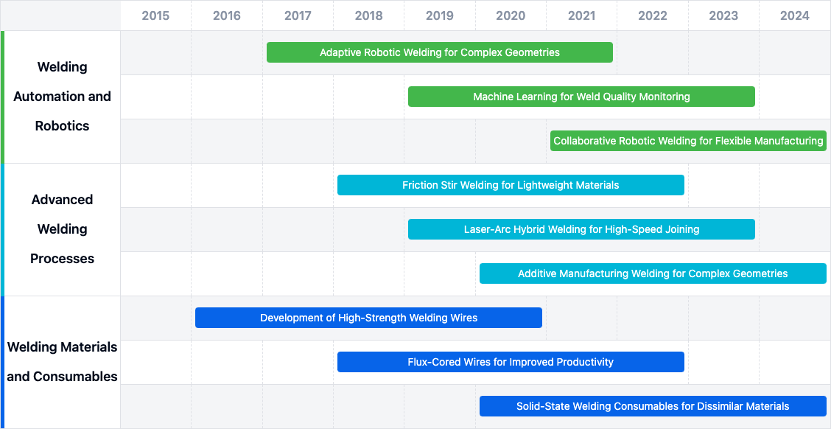
- Advanced Welding Processes: Friction stir welding, laser-arc hybrid welding, and additive manufacturing welding.
- Welding Automation and Robotics: Adaptive robotic welding, machine learning for weld quality monitoring, and collaborative robotic welding.
- Welding Materials and Consumables: High-strength welding wires, flux-cored wires, and solid-state welding consumables.
Main Player Analysis
Key Players and Focus
- Matsushita Electronics Corp.: Focus on process optimization, material compatibility, defect detection, and quality control.
- Harbin Institute of Technology: Expertise in laser welding, friction stir welding, magnetic pulse welding, and microstructure analysis.
- Canon Inc.: Research on precision welding, material compatibility, and quality control measures.
- NIPPON STEEL CORP.: Optimizing welding processes for steel and other metals, developing advanced techniques and quality control measures.
- Shanghai Jiao Tong University: Research in laser welding, friction stir welding, ultrasonic welding, and defect detection using machine learning and computer vision.
Current Technical Solution Overview
Monitoring and Controlling Welding Parameters
- Quality Monitoring Systems: Real-time monitoring using sensors to measure parameters like temperature, current, and voltage.
- Feedback Control for Parameter Adjustment: Adjusting welding parameters in real-time based on feedback.
- Resistance Welding Quality Monitoring: Monitoring electrical parameters during resistance welding.
- Laser Welding Quality Monitoring: Techniques like pyrometry and optical sensing.
- Arc Welding Quality Monitoring: Analyzing arc characteristics and weld pool geometry.
Weld Quality Assessment and Inspection Techniques
- Image Processing Techniques: Using machine vision and deep learning for defect detection and quality assessment.
- Ultrasonic Techniques: Inspecting internal weld quality.
- Radiographic Techniques: X-ray and gamma-ray imaging for internal defect detection.
- Machine Learning and AI: Automated defect detection and quality assessment.
- Mechanical Testing: Tensile, bend, and hardness testing for mechanical property evaluation.
Improving Material Properties and Joint Design
- Evaluation Techniques: Monitoring weld parameters and using NDT methods.
- Joint Design and Configuration: Optimizing joint preparation and design for improved performance.
- Real-Time Monitoring and Control: Systems for assessing weld quality during welding.
- Material Property Analysis and Enhancement: Techniques to improve material properties.
- Specialized Welding Processes and Equipment: Hybrid welding and laser shock wave processing.
Weld Quality Prediction and Modeling
- Machine Learning and Data Analytics: Predicting weld quality using algorithms and data analysis.
- Sensor Data Analysis: Monitoring weld quality through sensor data.
- Resistance Spot Welding Quality Prediction: Analyzing process parameters for quality prediction.
- Non-Destructive Testing and Imaging: Assessing weld quality using NDT techniques.
- Numerical Simulation and Modeling: Predicting weld quality characteristics through simulations.
Post-Weld Treatment and Quality Improvement Techniques
- Heat Treatment Processes: Improving properties through post-weld heat treatment.
- Inspection and Monitoring: Ensuring quality through various inspection techniques.
- Process Optimization: Improving quality through parameter optimization.
- Specialized Equipment and Fixtures: Facilitating effective post-weld heat treatment.
Key Patent Interpretation
Patent Highlights
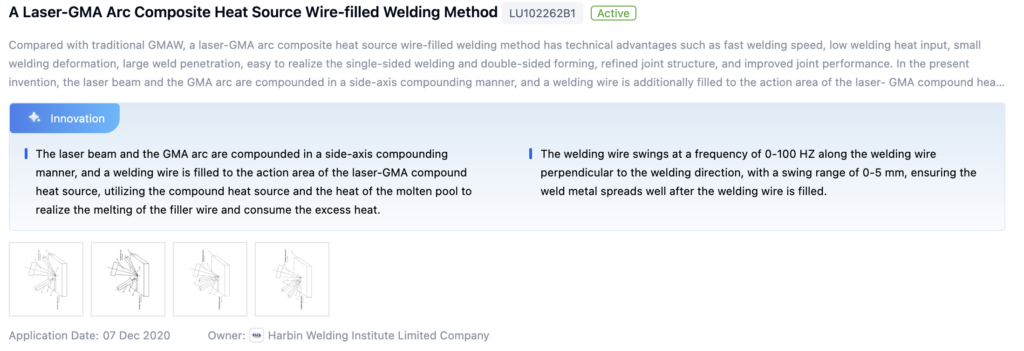
Patent 1: A Laser-GMA Arc Composite Heat Source Wire-Filled Welding Method
- Core Invention Points:
- Side-axis compounding of laser beam and GMA arc, utilizing compound heat source and molten pool heat for filler wire melting.
- Welding wire swings at 0-100 Hz with a 0-5 mm range to ensure proper weld metal spread.
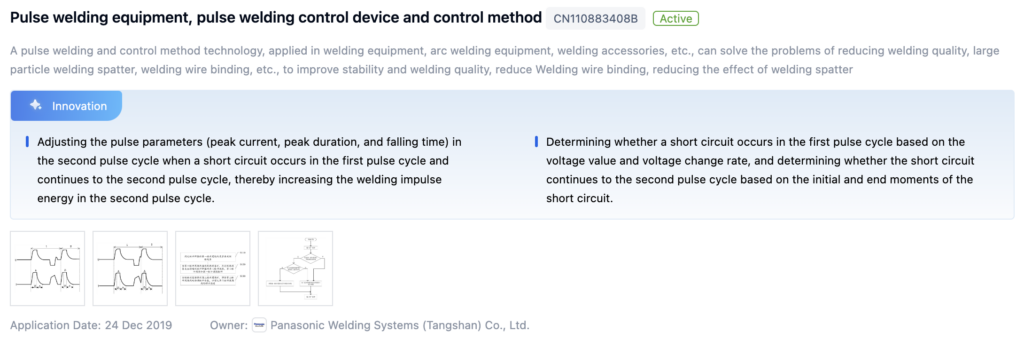
Patent 2: Pulse Welding Equipment, Control Device, and Method
- Core Invention Points:
- Adjusting pulse parameters to increase welding impulse energy during short circuits.
- Determining short circuit presence and continuation based on voltage values and changes.
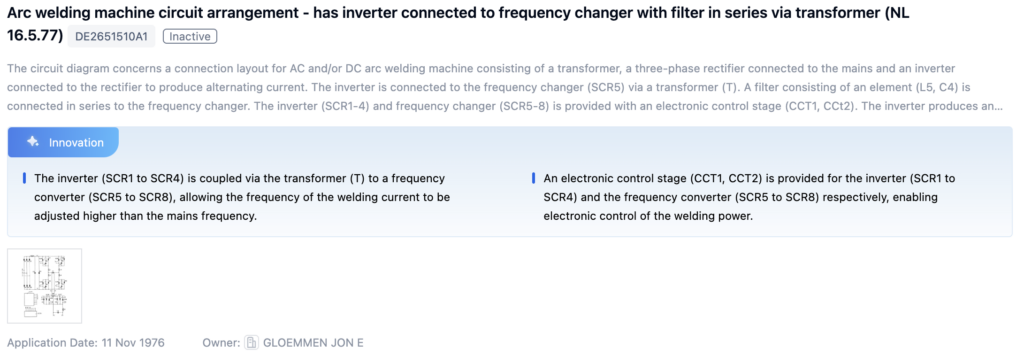
Patent 3: Arc Welding Machine Circuit Arrangement
- Core Invention Points:
- Inverter coupled to frequency converter via transformer, allowing frequency adjustment.
- Electronic control stage for inverter and frequency converter, enabling welding power control.
Possible Research Directions
- Monitoring and Controlling Welding Parameters: Real-time monitoring and feedback control for adjusting parameters.
- Weld Quality Assessment and Inspection: Techniques for defect detection and quality evaluation.
- Improving Weld Quality through Material Selection and Treatment: Enhancing material properties and joint design.
- Weld Quality Prediction and Modeling: Predictive models and simulations for optimizing processes.
- Weld Quality Certification and Documentation: Methods for certifying and documenting weld quality.
If you want an in-depth research or a technical report, you can always get what you want in Eureka Technical Research. Try now!
