


Technical Background and Objectives
Background
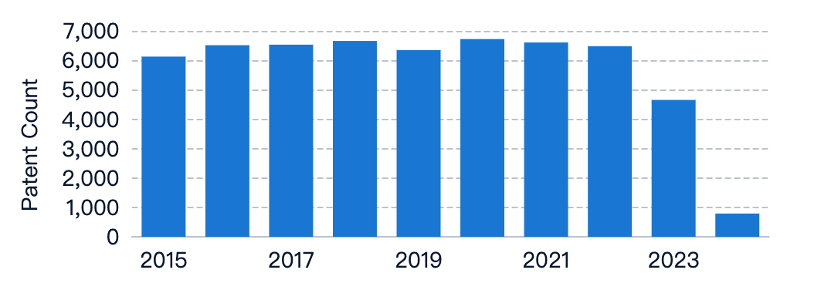
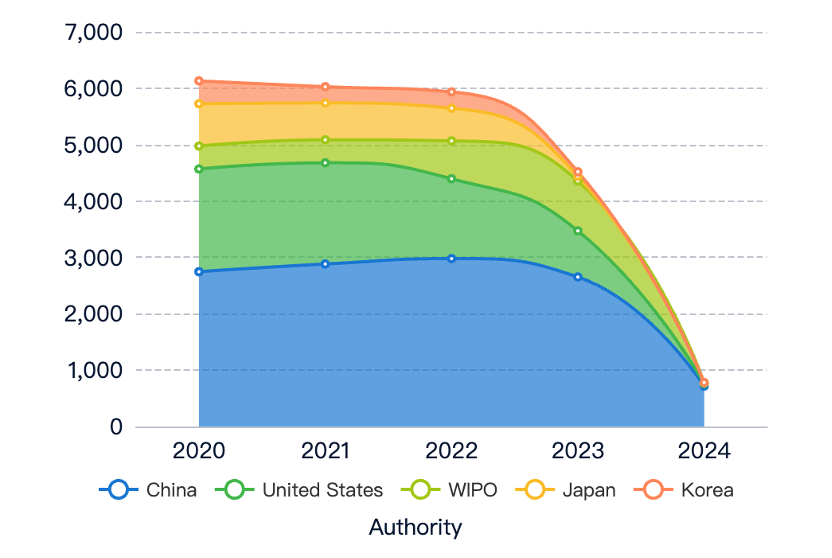
Patent application data related to reducing the brazing process shows a stable trend, with around 6,500 applications annually, indicating sustained interest and ongoing research. Literature publications initially increased, peaking before declining, suggesting academic research has gained momentum to address challenges or explore new approaches in reducing the brazing process. The recent decline in both patent applications and literature publications may be temporary, reflecting a lull in research and development activities.
Objectives
The primary objective is to develop innovative techniques and methodologies to reduce the brazing process, enhancing efficiency, cost-effectiveness, and environmental sustainability. This research aims to streamline the brazing process, reduce energy consumption, shorten production cycles, and lower operational costs.
To get a detailed scientific explanations of reducing the brazing process, try Eureka.
Technical Current Status Analysis
Brazing Overview
Brazing is widely used in automotive, aerospace, electronics, and construction industries. It involves using a filler metal to join materials by applying heat and allowing the filler metal to flow into the joint through capillary action.
Applications and Impact:
- Automotive: Joining components like heat exchangers, radiators, and exhaust systems.
- Aerospace: Joining structural components, fuel lines, and critical assemblies.
- Electronics: Joining components in power electronics, semiconductors, and PCBs.
- Construction: Joining pipes, fittings, and HVAC systems.
Technical Characteristics and Challenges:
- Temperature and Heating Requirements: High temperatures are needed to melt the filler metal, affecting energy consumption and process time.
- Joint Design and Clearance: Proper joint design and clearance are crucial for effective capillary action and reducing filler metal requirements.
- Filler Metal Selection: Choosing filler metals with lower melting points and better wetting characteristics can reduce process time and temperature.
- Surface Preparation and Cleanliness: Effective surface preparation techniques are essential for strong, reliable joints.
- Flux and Atmosphere Control: Optimizing flux compositions and atmosphere control systems can enhance joint quality and reduce process time.
- Process Monitoring and Control: Advanced monitoring and control systems can ensure consistent quality and optimize process parameters.
Technological Paths:
- Low-Temperature Brazing Materials: Develop filler metals with lower melting points and improved wetting characteristics.
- Joint Design Optimization: Research and simulate optimal joint designs and clearances.
- Advanced Surface Preparation: Develop efficient surface preparation techniques like laser cleaning and plasma treatment.
- Flux and Atmosphere Innovations: Develop new flux compositions and atmosphere control systems.
- Advanced Process Monitoring and Control: Integrate advanced sensors and control systems.
- Process Simulation and Modeling: Use computational modeling and simulation for process optimization.
Research Content
Research Objectives
Develop innovative techniques and methodologies to reduce the brazing process, enhancing efficiency, cost-effectiveness, and environmental sustainability.
Research Direction and Focus
Alternative Brazing Techniques
- Investigate novel methods like transient liquid phase bonding, diffusion brazing, or vacuum brazing to simplify the process.
Filler Metal Optimization
- Develop or identify filler metals with lower melting points, enhanced wettability, and better corrosion resistance.
Process Modeling and Simulation
- Use computational models to simulate the brazing process and optimize parameters.
Brazing Automation and Control
- Explore integration of sensors, control systems, and robotic technologies for precise control.
Environmental and Sustainability Considerations
- Investigate eco-friendly brazing techniques, renewable energy sources, and minimizing hazardous byproducts.
Technical Development Roadmap
Key Areas of Advancement
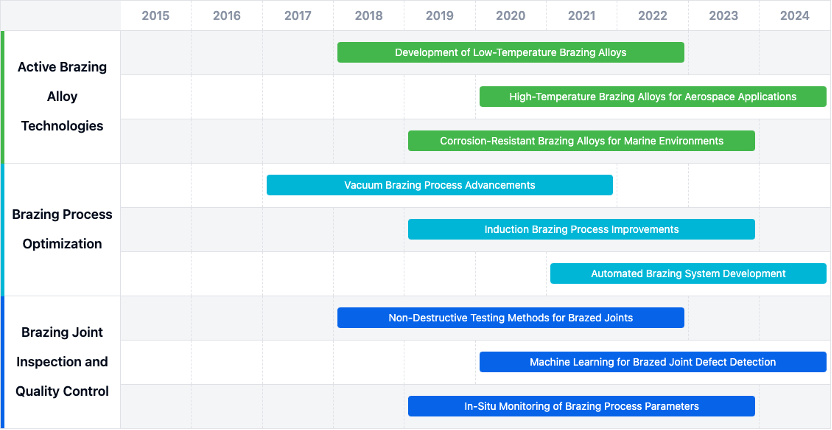
- Controlled Atmosphere Brazing (CAB): High-purity atmosphere control systems, optimized alloy compositions, and advanced furnace designs.
- Active Brazing Technologies: Plasma-assisted, ultrasonic-assisted, and induction brazing.
- Advanced Brazing Filler Metal Development: High-temperature alloys, optimized compositions, and nanoparticle-reinforced filler metals.
Main Player Analysis
Key Players and Focus
- Mitsubishi Electric Corp.: Focus on optimizing brazing parameters, developing new filler materials, and exploring laser brazing.
- DENSO Corp.: Efficient brazing processes for automotive applications like heat exchangers and sensors.
- Kyocera Corp.: Advanced ceramic materials, optimizing brazing parameters, and exploring ceramic-to-metal joints.
- Harbin Institute of Technology: Material development, joint design, and process optimization for energy and aerospace.
- Shanghai Jiao Tong University: Process simulation, joint quality inspection, and process optimization for dissimilar material joining.
Current Technical Solution Overview
Fluxless Brazing
- Process for Aluminum: Specialized alloys and controlled atmospheres for fluxless brazing.
- Low-Temperature Processes: Techniques to reduce energy requirements and material degradation.
- Electrical Applications: Fluxless techniques for PCBs and electronic components.
Low-Temperature Brazing
- Materials: Low-melting-point alloys like indium, tin, silver, antimony, bismuth, and zinc.
- Methods for Specific Materials: Optimized for aluminum alloys, ceramics, glass, and dissimilar materials.
- Fluxless and Controlled Atmosphere: Processes in vacuum or inert gas environments.
Brazing Alloy Compositions
- Improved Wettability and Reduced Temperature: Alloys with elements like nickel, cobalt, chromium, and titanium.
- Joining Superalloys and High-Temperature Materials: Alloys for demanding environments.
- Amorphous and Ductile Alloys: Increased strength and ductility.
- Aluminum Alloys: Improved wettability and joint strength.
- Wear-Resistant and Protective Coatings: Alloys with hard particles for enhanced wear resistance.
Automated and Controlled Brazing Processes
- Automated Systems: Robotic arms, conveyor belts, and control systems for efficient brazing.
- Controlled Material Application and Flow: Precise control of brazing material.
- Low-Temperature and Fluxless Processes: Simplified processes for specific applications.
- Specialized Alloys and Materials: Tailored for specific applications.
Novel Brazing Techniques and Methods
- Reducing Process Time: Specialized materials and advanced heating methods like laser brazing.
- Improved Joint Quality: Advanced techniques like vacuum brazing or diffusion brazing.
- Novel Materials and Compositions: Low-temperature, corrosion-resistant materials.
- Novel Fixtures and Tooling: Specialized for precise positioning and efficient material application.
- Techniques for Specific Materials or Applications: Tailored for aluminum alloys, ceramics, and composites.
Key Patent Interpretation
Patent Highlights
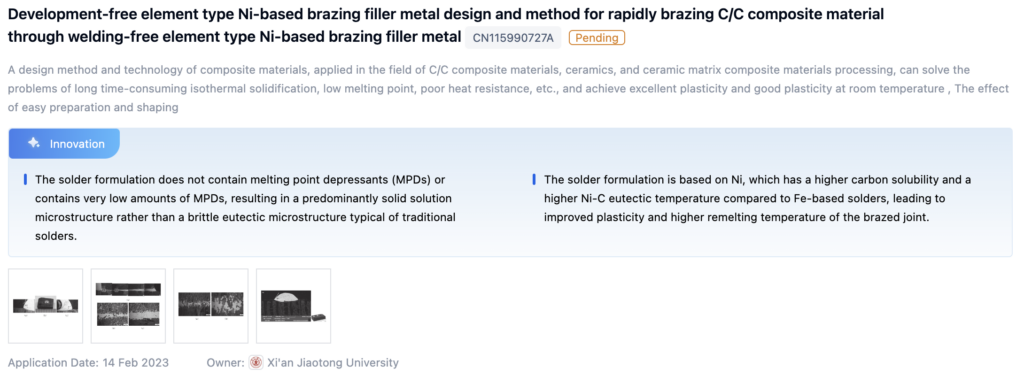
Patent 1: Development-Free Element Type Ni-Based Brazing Filler Metal
- Core Invention Points:
- No MPDs, resulting in a solid solution microstructure.
- Ni-based formulation with higher carbon solubility and eutectic temperature.
- Improved plasticity and higher remelting temperature.
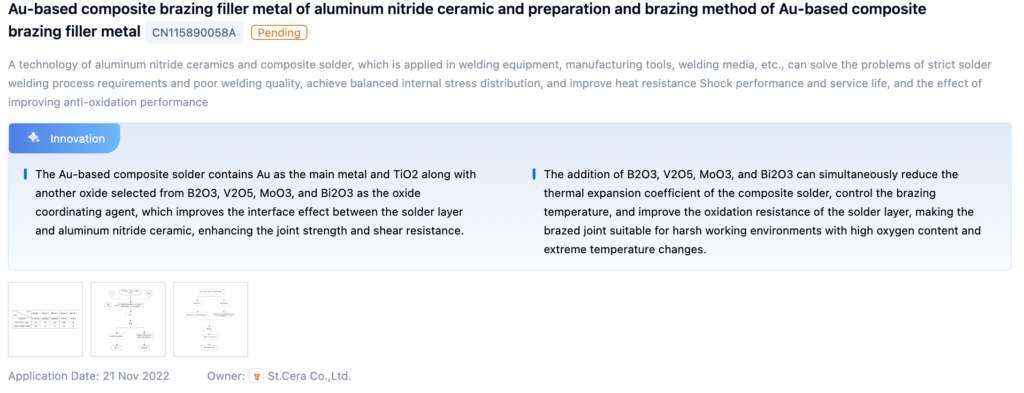
Patent 2: Au-Based Composite Brazing Filler Metal for Aluminum Nitride Ceramic
- Core Invention Points:
- Contains Au and TiO2 along with other oxides for enhanced joint strength.
- Reduces thermal expansion coefficient and improves oxidation resistance.
- Suitable for harsh environments with high oxygen content and extreme temperature changes.
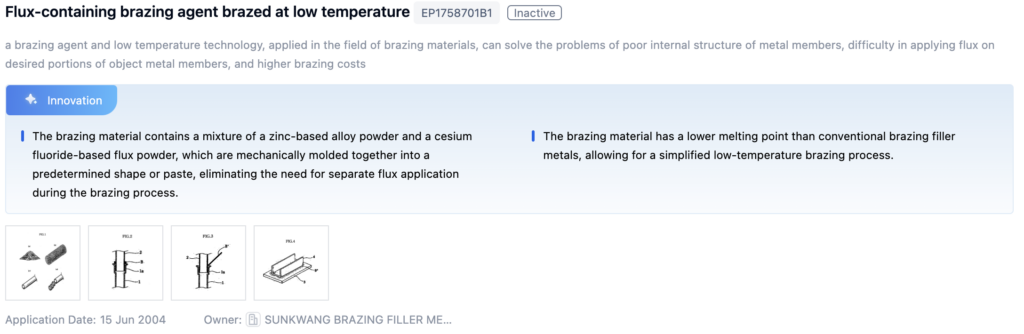
Patent 3: Flux-Containing Brazing Agent for Low-Temperature Brazing
- Core Invention Points:
- Mixture of zinc-based alloy powder and cesium fluoride-based flux powder.
- Lower melting point than conventional brazing filler metals.
- Simplified low-temperature brazing process.
Possible Research Directions
- Reducing Brazing Temperature: Lower temperature methods and compositions.
- Enhancing Brazing Efficiency: Advanced techniques like microwave or electromagnetic field-enhanced brazing.
- Automated Brazing Processes: Increased efficiency, consistency, and repeatability through automation.
- Reducing Braze Material Consumption: Techniques to minimize material usage.
- Fluxless Brazing Techniques: Simplified processes eliminating the need for flux.
If you want an in-depth research or a technical report, you can always get what you want in Eureka Technical Research. Try now!
