


Technical Background and Objectives
Background
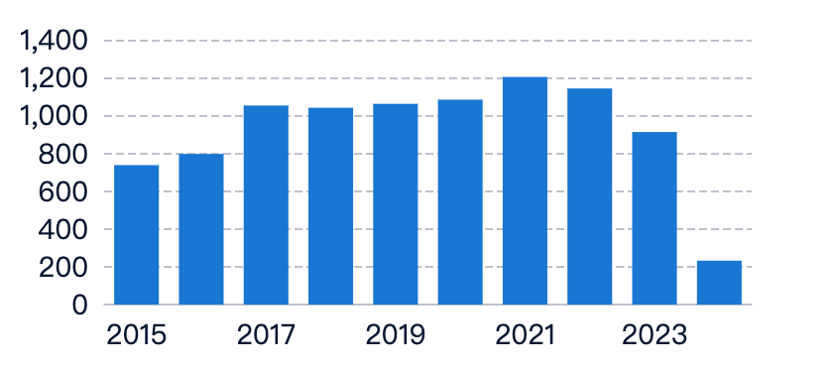
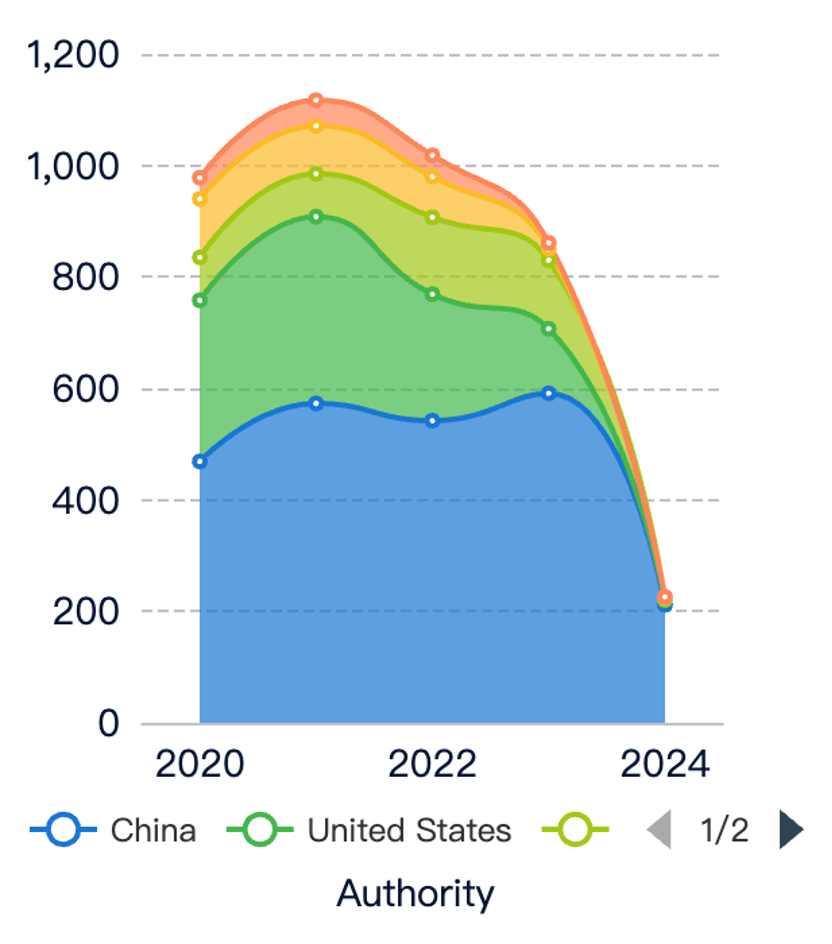
Electron beam welding (EBW) is a specialized welding technique that utilizes a concentrated beam of high-energy electrons to fuse materials. Improving EBW precision is crucial for applications requiring high-quality welds with minimal defects. Patent application data shows a steady increase in filings related to EBW precision, indicating ongoing research and industrial interest. However, literature publications in this area are limited, suggesting that industrial entities primarily drive the advancements in EBW precision.
Objectives
The main objective is to enhance EBW precision to ensure high-quality welds with minimal defects. This involves addressing challenges related to beam focus, alignment, workpiece positioning, vacuum environment stability, and process monitoring.
To get a detailed scientific explanations of Electron Beam Welding, try Eureka.
Technical Current Status Analysis
EBW Overview
EBW is essential in industries requiring high-quality, precise welds. It is characterized by its ability to achieve deep penetration with minimal distortion.
Applications and Impact:
- Aerospace: Joining critical components like turbine blades and rocket nozzles.
- Automotive: Welding powertrain components, suspension systems, and body structures.
- Medical Devices: Joining implantable devices such as pacemakers and stents.
- Electronics: Manufacturing semiconductor devices and vacuum tubes.
Technical Characteristics and Challenges:
- Beam Focusing and Stability: Precise focus and stability of the electron beam are critical for accurate welds.
- Positioning and Alignment: Accurate positioning and alignment of workpieces are crucial for consistent welds.
- Process Control and Monitoring: Effective control and monitoring of welding parameters are essential for maintaining weld quality.
- Material Interactions: Different materials interact differently with the electron beam, affecting weld quality.
- Thermal Effects and Distortion: High heat input can cause thermal distortions and residual stresses.
Technological Paths:
- Advanced Beam Control Systems: Develop systems to shape and align the electron beam precisely.
- Intelligent Fixturing Systems: Implement systems that accurately position and secure workpieces.
- Vacuum Optimization: Enhance vacuum systems to maintain stable levels during welding.
- In-Situ Process Monitoring: Use advanced monitoring systems to detect and correct deviations in real-time.
- Material Characterization: Conduct studies to understand material behavior and optimize joint design.
- Simulation and Modeling: Use computational models to predict and optimize the welding process.
Research Content
Research Objectives
Enhance the precision and accuracy of EBW processes to achieve consistent, high-quality welds.
Research Direction and Focus
Beam Positioning and Control Systems
- Investigate advanced beam positioning technologies like magnetic deflection systems and dynamic beam steering mechanisms.
- Develop reliable systems for maintaining precise beam positioning and control.
Weld Parameter Optimization
- Use modeling and simulation to optimize parameters like beam current, voltage, travel speed, and focus.
- Explore intelligent control algorithms for real-time parameter adjustments based on monitoring data.
In-Process Monitoring and Feedback Systems
- Develop systems employing optical, thermal, and acoustic sensors to monitor the welding process.
- Use signal processing and machine learning for real-time feedback and process control.
Technical Development Roadmap
Key Areas of Advancement
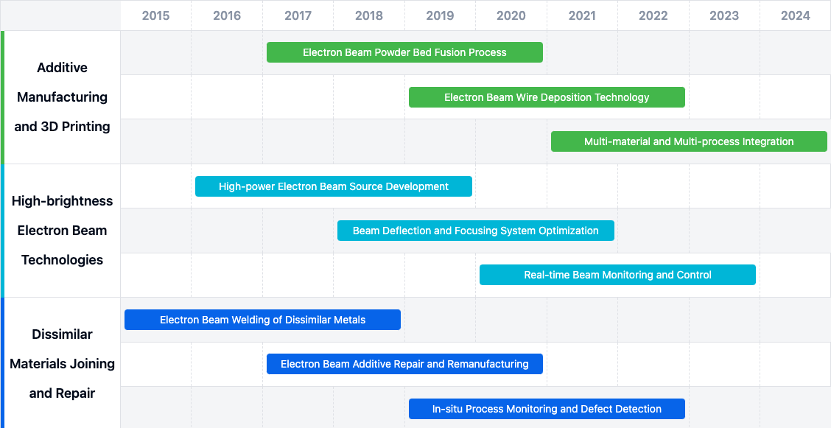
- Advanced Equipment Technologies: High-power electron beam guns, improved deflection and focusing systems, and integrated monitoring systems.
- Optimized Process Technologies: Multi-pass welding, additive manufacturing applications, and parameter optimization for dissimilar materials.
- Enhanced Materials and Applications: Welding high-strength steels, joining refractory metals, and applications in aerospace and nuclear industries.
Main Player Analysis
Key Players and Focus
- Hitachi Ltd.: 349 patents focused on beam control systems, real-time monitoring, and advanced welding techniques.
- Tianjin University: Research on post-weld heat treatment and its effects on microstructure and fracture toughness.
- Toshiba Corp.: 332 patents on beam control, real-time monitoring, and advanced welding techniques.
- Harbin Institute of Technology: Research on fluid transport phenomena in EBW of aluminum alloys.
- Canon Inc.: 405 patents focused on beam control systems, real-time monitoring, and advanced welding techniques.
Current Technical Solution Overview
Techniques to Improve EBW Accuracy
- Beam Position and Alignment Control: Techniques for precise beam positioning, automatic alignment adjustments, and groove detection.
- Beam Shaping and Control: Methods for adjusting beam shape, rocking width, and regulating current and energy distribution.
- Machine Design and Components: Advanced electron gun design, beam deflection systems, and vacuum chambers.
- Welding Methods and Process Control: Automated welding, parameter control, and process optimization for different materials.
Apparatus and Equipment Improvements
- Apparatus Improvements: Enhancements to electron guns, vacuum chambers, and control systems.
- Precision Control: Techniques for maintaining alignment, managing shrinkage, and accurate positioning.
- Equipment Components: Improved electron guns, vacuum chambers, and control systems.
- Welding Methods: New methods like annular and vertical welding for specific applications.
- Exposure and Applications: Techniques for turbine components and specialized industrial processes.
Methods for Specific Materials
- Material-Specific Methods: Techniques for welding aluminum, dissimilar metals, low alloy steels, and thick plates.
- Precision Techniques: Methods for positioning, beam control, and post-weld heat treatment.
- Apparatus and Devices: Specialized welding chambers and beam control systems for large structures.
- General Methods: Techniques for welding plates, frames, and other components.
Complex Geometries
- Complex Geometry Techniques: Advanced beam parameters for varying angles and curvatures.
- Precision Enhancement: Real-time monitoring, advanced control systems, and specialized fixtures.
- Dissimilar Materials: Methods for welding materials like aluminum and other metals.
- Equipment and Systems: Advanced electron beam guns, vacuum chambers, and workpiece manipulation systems.
Post-Weld Treatments
- Heat Treatment Methods: Techniques for improving weld properties through specific temperature cycles.
- Precision and Control: Methods for beam parameter adjustments and workpiece positioning.
- Material-Specific Methods: Tailored processes for welding particular materials.
- Defect Prevention and Quality Control: Techniques for monitoring and inspection to minimize defects.
Key Patent Interpretation
Patent Highlights
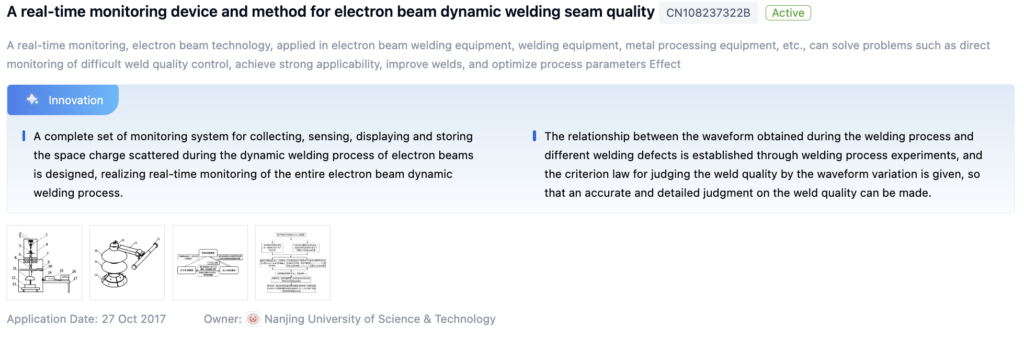
Patent 1: Real-Time Monitoring Device and Method for Electron Beam Dynamic Welding Seam Quality
- Core Invention Points:
- Real-time monitoring system for collecting and analyzing space charge scattered during welding.
- Establishes relationship between waveform variations and welding defects for accurate quality assessment.
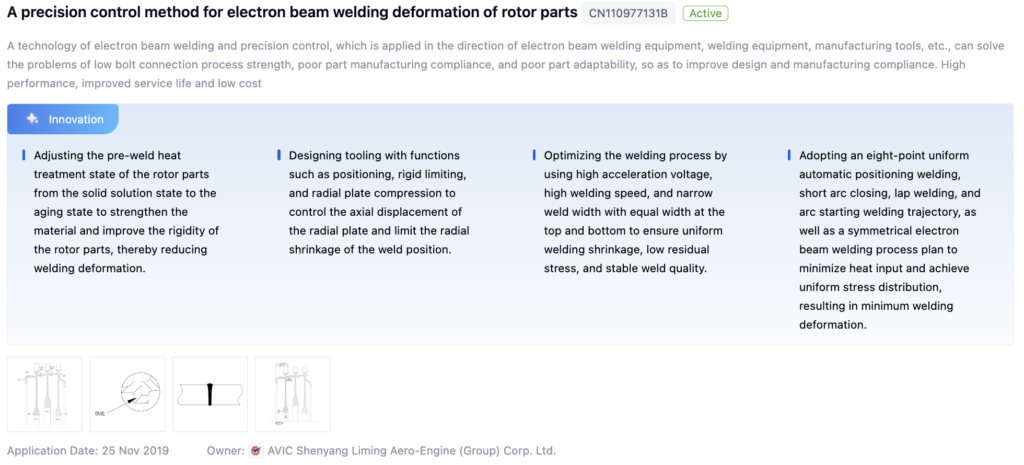
Patent 2: Precision Control Method for Electron Beam Welding Deformation of Rotor Parts
- Core Invention Points:
- Adjusts pre-weld heat treatment to improve material rigidity and reduce deformation.
- Utilizes specialized tooling for positioning and limiting radial shrinkage.
- Optimizes welding process parameters for uniform welding shrinkage and low residual stress.
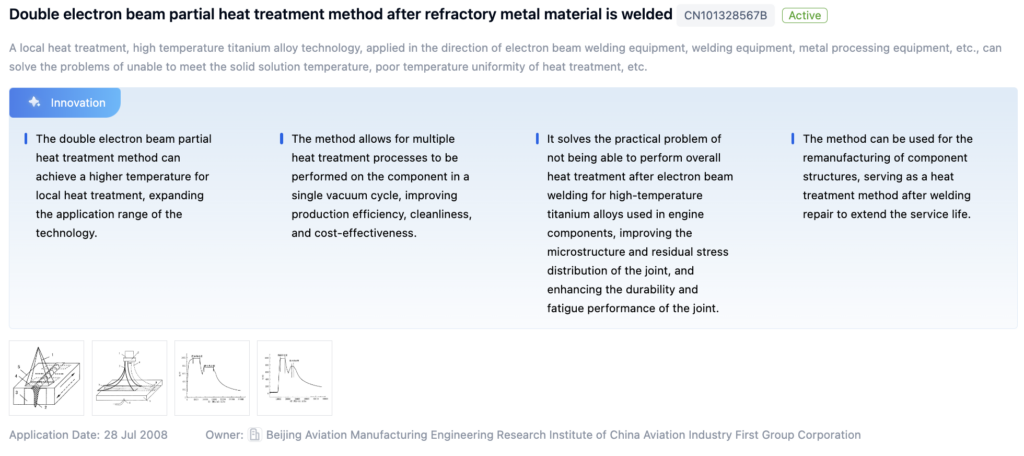
Patent 3: Double Electron Beam Partial Heat Treatment Method After Refractory Metal Material is Welded
- Core Invention Points:
- Achieves higher temperature for local heat treatment in a single vacuum cycle.
- Improves microstructure and residual stress distribution, enhancing durability and fatigue performance.
Possible Research Directions
- Adjusting Electron Beam Focus for Improved Precision: Techniques for real-time focus adjustment and calibration.
- Electron Beam Deflection and Positioning Control: Methods for precise beam steering and positioning.
- Monitoring and Feedback Systems for Beam Alignment: Utilizing sensors and imaging for real-time corrections.
- Optimizing Welding Parameters for Precision Control: Techniques for determining and maintaining optimal parameter settings.
If you want an in-depth research or a technical report, you can always get what you want in Eureka Technical Research. Try now!
