


Technical Background and Objectives
Background
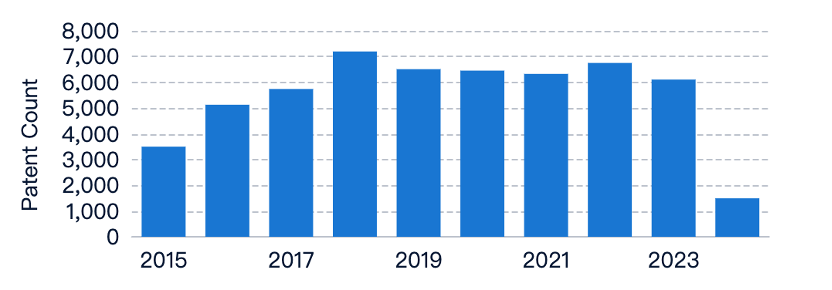
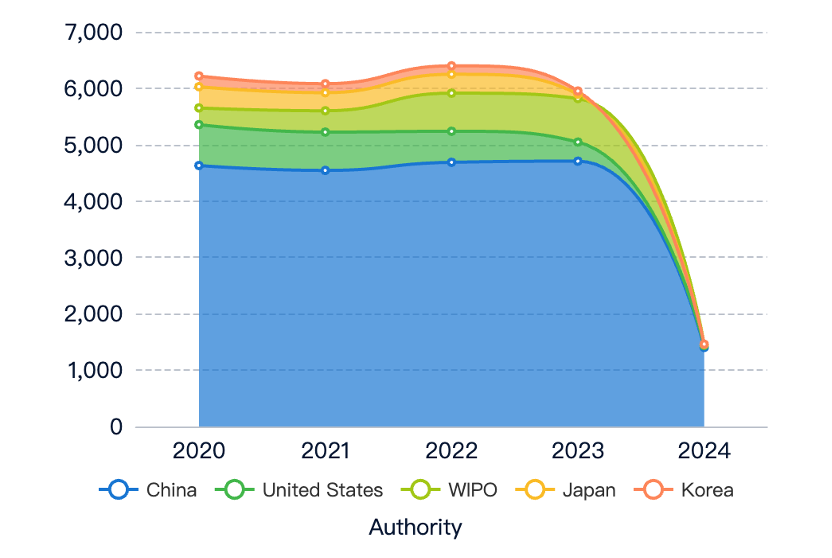
The field of ‘graphene oxide good dispersion’ has experienced significant growth in patent applications, peaking in recent years before a slight decline. This trend suggests an innovation surge followed by a maturation phase. The stable trend in literature publications indicates ongoing academic interest and exploration, contrasting with the fluctuating patent activities.
Objectives
The primary objective is to develop novel and effective methods for achieving good dispersion of graphene oxide (GO) in various solvents and matrices. This research aims to enhance the dispersibility of GO, unlocking its full potential for diverse applications.
To get a detailed scientific explanations of Graphene Oxide, try Eureka.
Technical Current Status Analysis
Graphene Oxide Overview
Graphene oxide (GO) is a derivative of graphene, known for its excellent dispersion in water and various organic solvents. It is used in many fields due to its unique properties.
Applications and Impact:
- Composites and Coatings: Enhanced mechanical, thermal, and electrical properties.
- Energy Storage and Conversion: Improved electrochemical performance in supercapacitors and batteries.
- Environmental Remediation: Effective in water treatment processes.
- Biomedical Applications: Promising for drug delivery and biosensing.
- Optoelectronics and Sensors: Used in transparent conductive films and various sensors.
Technical Challenges:
- Stability and Aggregation: Maintaining long-term stability in various media.
- Functionalization and Compatibility: Enhancing dispersion and compatibility in specific environments.
- Scalability and Reproducibility: Ensuring consistent dispersion on a large scale.
- Toxicity and Environmental Impact: Evaluating biocompatibility and environmental effects.
- Application-Specific Challenges: Addressing specific needs in composites, energy storage, remediation, and biomedical fields.
Technological Paths:
- Advanced Synthesis and Purification Methods: Scalable and reproducible synthesis methods.
- Surface Functionalization Strategies: Enhancing dispersion and compatibility.
- Dispersion Stabilization Techniques: Using surfactants, polymers, or other additives.
- Characterization and Modeling: Studying dispersion behavior and underlying mechanisms.
- Application-Specific Optimization: Tailoring surface properties and dispersion for specific applications.
- Toxicity and Environmental Impact Assessment: Comprehensive studies on potential effects.
Research Content
Research Objectives
Develop a novel method for achieving good dispersion of graphene oxide in various solvents and matrices.
Research Direction and Focus
Surface Modification and Functionalization
- Introduce functional groups or modify surface properties to enhance compatibility and interaction.
- Explore chemical functionalization, polymer grafting, and incorporation of surfactants.
Solvent Selection and Optimization
- Investigate different solvents for effective dispersion.
- Study interactions between GO and solvents and optimize solvent mixtures.
Dispersion Techniques and Process Optimization
- Explore sonication, high-shear mixing, ball milling, and microfluidic techniques.
- Optimize parameters like energy input, processing time, and temperature.
Characterization and Analysis
- Use techniques like UV-visible spectroscopy, DLS, zeta potential measurements, and microscopy.
- Evaluate dispersion quality, stability, and morphological characteristics.
Application-Specific Evaluation
- Assess properties like electrical conductivity, mechanical reinforcement, barrier properties, or catalytic activity.
- Validate practical utility and provide feedback for further refinement.
Technical Development Roadmap
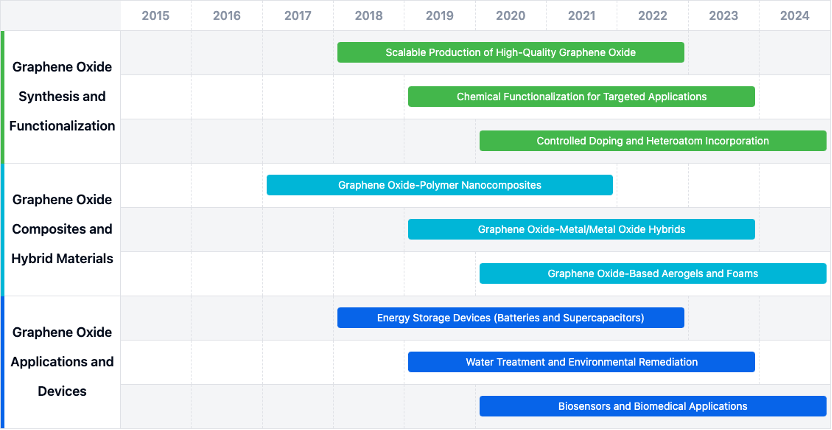
Key Areas of Advancement
- Graphene Oxide Synthesis and Functionalization: Scalable production and chemical functionalization.
- Graphene Oxide Composites and Hybrid Materials: Developing advanced composites and hybrid materials.
- Graphene Oxide Applications and Devices: Energy storage devices, water treatment, and biomedical applications.
Main Player Analysis
Key Players and Focus
- Chinese Academy of Sciences: Novel composites and coatings with well-dispersed GO.
- Semiconductor Energy Laboratory Co. Ltd.: Techniques for improving GO dispersion in various media.
- Contemporary Amperex Technology Co. Ltd.: GO-based materials for energy storage applications.
- FUJIFILM Corp.: Techniques for achieving uniform dispersion of GO in different matrices.
- Sichuan University: Novel composites and materials with well-dispersed GO.
Current Technical Solution Overview
Preparation Methods for Graphene Oxide Dispersions
- Chemical Oxidation and Mechanical Exfoliation: Stable dispersions in aqueous or organic solvents.
- Using Surfactants or Stabilizers: Improving dispersion and stability.
- Chemical Modification: Enhancing dispersibility.
- Mechanical Exfoliation: Techniques like ultrasonication and high-shear mixing.
- Tailored Dispersions for Specific Applications: Coatings, composites, energy storage devices.
- Reduced Graphene Oxide Dispersions: Chemical or thermal reduction for improved properties.
Graphene Oxide Dispersions for Composite Materials
- Graphene Oxide-Polymer Composites: Improved mechanical, electrical, or thermal properties.
- Graphene Oxide-Metal Oxide Composites: Enhanced properties for photocatalytic activity, energy storage, and shielding.
- Graphene Oxide-Carbon Composites: Improved conductivity, strength, and adsorption properties.
- Graphene Oxide-Based Composite Membranes: Enhanced permeability, selectivity, and fouling resistance.
Modification and Functionalization of Graphene Oxide Dispersions
- Chemical Modification: Improving dispersion stability.
- Using Surfactants or Stabilizers: Overcoming van der Waals forces.
- In-Situ Reduction and Functionalization: Simultaneous reduction and functionalization.
- Polymer Composites: Enhanced dispersion and properties.
- Surface Modification: Tailoring surface properties for specific applications.
Graphene Oxide Dispersions for Membrane Applications
- Stable and Well-Dispersed GO: Preparing stable dispersions for membrane fabrication.
- Graphene Oxide Membranes: Techniques like vacuum filtration and spin-coating.
- Modification and Functionalization: Enhancing performance and selectivity.
- Composite Membranes: Combining GO with other materials for improved performance.
- Applications: Water treatment, desalination, gas separation, and energy storage.
Characterization and Purification of Graphene Oxide Dispersions
- Characterization Techniques: Analyzing dispersion quality, oxidation state, and structural features.
- Stable Dispersions: Methods to prepare and maintain stable dispersions.
- Modification and Functionalization: Enhancing properties and functionalities.
- Purification and Concentration: Removing impurities and concentrating dispersions.
- Applications: Composites, coatings, energy storage, and electronics.
Key Patent Interpretation
Patent Highlights
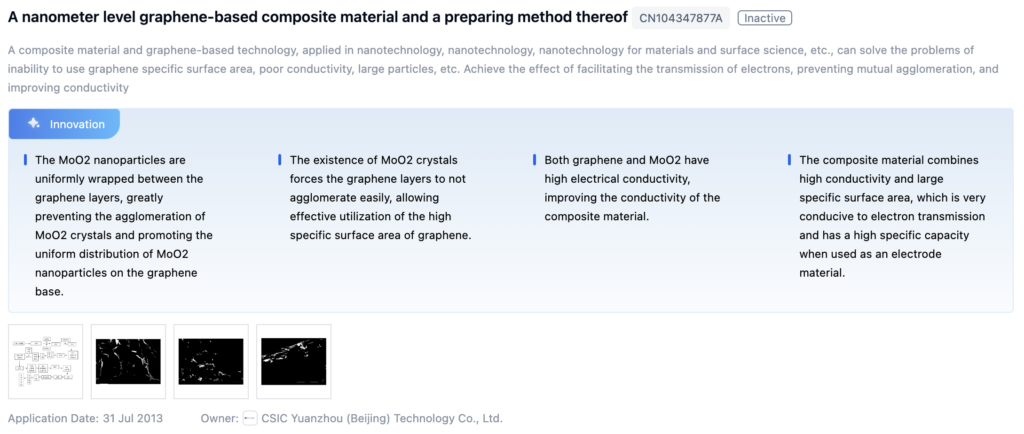
Patent 1: Nanometer Level Graphene-Based Composite Material
- Core Invention Points:
- Uniformly wrapped MoO2 nanoparticles prevent agglomeration.
- High specific surface area utilization of graphene.
- Improved conductivity through combined properties of graphene and MoO2.
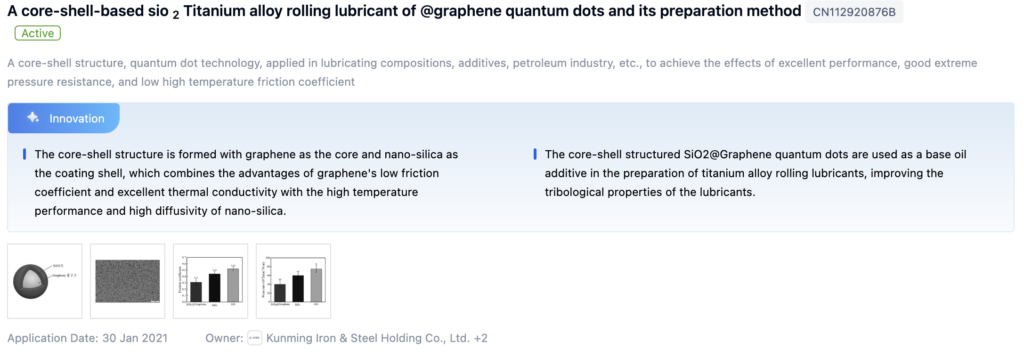
Patent 2: Core-Shell-Based SiO2 Titanium Alloy Rolling Lubricant
- Core Invention Points:
- Graphene core and nano-silica shell for improved performance.
- Enhanced tribological properties in lubricants.
- Combines low friction and excellent thermal conductivity of graphene with high-temperature performance of nano-silica.
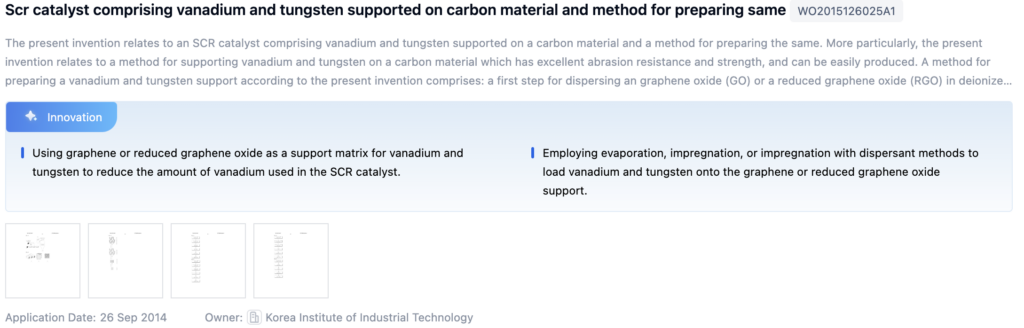
Patent 3: SCR Catalyst with Vanadium and Tungsten on Graphene
- Core Invention Points:
- Reduced vanadium usage with graphene support matrix.
- Improved abrasion resistance and strength.
- Efficient production methods using evaporation impregnation.
Possible Research Directions
- Preparation Methods for Stable GO Dispersions: Techniques for achieving stable dispersions in various solvents.
- GO Dispersions for Composite Materials and Coatings: Enhancing properties in composites.
- Reduced GO Dispersions: Applications in energy storage, electronics, and sensors.
- GO Dispersions for Specific Applications: Tailoring dispersions for target applications.
- GO Composites and Their Preparation Methods: Combining GO with other materials for enhanced properties.
If you want an in-depth research or a technical report, you can always get what you want in Eureka Technical Research. Try now!
