Abscisic Acid (ABA) is a pivotal plant hormone that regulates various physiological processes including seed dormancy, stomatal closure, and responses to abiotic stresses. Originally identified as a growth inhibitor, ABA has become a cornerstone of modern plant biotechnology due to its role in environmental adaptation and developmental control.
In a world increasingly challenged by climate change, water scarcity, and soil salinity, ABA-based signaling mechanisms offer scalable solutions to improving crop resilience and performance.
This article explores the chemical properties of ABA, its signaling pathways, and its applications across six domains: drought resistance, seed biology, crop improvement, synthetic analog development, abiotic stress signaling, and gene expression regulation. We’ll conclude with comparative insights, future research directions, and a demonstration of how PatSnap Eureka AI Agent empowers data-driven innovation in ABA research.

Material Composition & Key Properties of Abscisic Acid
- Chemical Name: (S)-(+)-Abscisic Acid
- Molecular Formula: C₁₅H₂₀O₄
- Functional Groups: Carboxylic acid, ketone, double bond
- Origin: Synthesized in plastids from carotenoid precursors via the MEP pathway
- Transport: Moves between roots and leaves via xylem and phloem
- Key Bioactivity:
- Regulates stomatal closure to prevent water loss
- Induces gene expression related to stress response
- Maintains seed dormancy during unfavorable conditions
Comparative Advantages & Limitations of Abscisic Acid
Abscisic Acid in Comparison with Other Phytohormones and Stress Regulators
| Aspect | Abscisic Acid (ABA) | Comparative Phytohormones / Molecules |
|---|---|---|
| Stress Response Specificity | Highly responsive to drought, salinity, cold | Auxins, gibberellins less responsive to abiotic stress |
| Rapid Signal Transduction | ABA triggers stomatal closure within minutes | Cytokinins and ethylene show slower physiological response |
| Synthetic Analog Availability | Multiple ABA analogs available for field application | Fewer effective analogs in other hormone classes |
| Regulatory Complexity | Fine-tuned via multiple receptors (PYR/PYL/RCAR) | Jasmonic acid and SA pathways often simpler |
| Biosynthesis Control | Enzymatic bottlenecks well-mapped (e.g. NCED pathway) | Some hormones lack clearly defined biosynthetic control |
| Transport Mechanisms | Mobile within xylem and phloem | Auxins show more polar transport, others less mobile |
| Environmental Sensitivity | Sensitive to temperature, UV, and pH degradation | Brassinosteroids are more stable under stress |
✅ Key Advantages
- Highly targeted stress regulation for drought, cold, salinity, and oxidative conditions.
- Low-dose efficacy due to signal amplification through SnRK2 cascades.
- Modular signaling allows synthetic biology integration (e.g., ABA-inducible promoters).
- Compatible with gene editing to enhance endogenous ABA biosynthesis for crop improvement.
- Broad functional versatility across plant species, from algae to angiosperms.
- Established field studies showing crop yield improvements under drought regimes.
- Emerging biostimulant markets increasingly adopt ABA analogs for precision agriculture.
Limitations
- Photodegradation limits shelf-life and long-term stability in open-field applications.
- Cross-talk interference with other phytohormones can lead to unintended phenotypes.
- Costly synthesis of natural ABA and some of its potent analogs remains a barrier.
- Narrow activation window; excessive ABA can lead to premature senescence or inhibited growth.
- Variable uptake efficiency across plant species and growth stages.
- Lack of standardization across commercial ABA formulations impedes large-scale adoption.
Application Domains of Abscisic Acid
Based on the provided reports, the application domains for Abscisic Acid (ABA) can be categorized into the following six main areas. Each area includes a representative set of related studies to illustrate research progress and real-world relevance.
🌾 Drought Tolerance and Water Use Efficiency
Application background:
With increasing global water scarcity, enhancing plant drought resistance is a top agricultural priority. Abscisic Acid plays a critical role in mediating stomatal closure, root architecture, and water conservation mechanisms.
Material action mechanism:
ABA regulates guard cell signaling and gene expression linked to water stress, enhancing drought survival and reducing transpiration losses.
Current research directions:
- Abscisic Acid in Drought Tolerance: Enhancing Plant Resilience
- Future Progressions in Abscisic Acid Research: Drought Resistance
- Harnessing Abscisic Acid for Water-Conserving Agriculture
- How Abscisic Acid Improves Water-Use Efficiency in Crops?
- Developing Water-Efficient Crops with Abscisic Acid Insights
- Abscisic Acid Applications in Enhancing Soil-Plant Water Relations
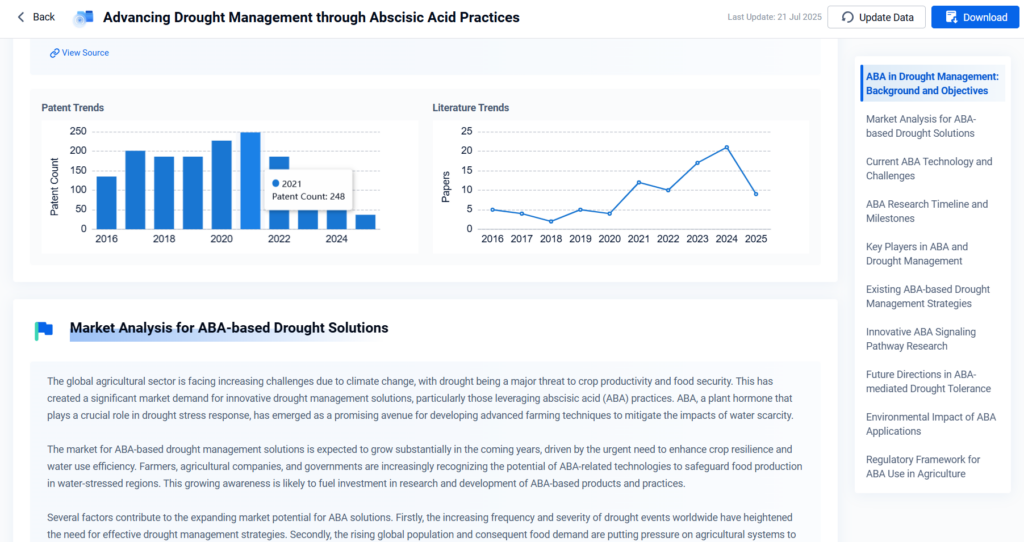
- How to Advance Drought Management with Abscisic Acid Practices?
🌱 Seed Dormancy, Germination, and Growth Regulation
Application background:
Seed vigor and controlled germination are vital for crop uniformity and yield. ABA modulates developmental transitions and prevents premature germination under unfavorable conditions.
Material action mechanism:
ABA influences key transcription factors and hormonal crosstalk, delaying germination while synchronizing seedling development with optimal conditions.
Current research directions:
- How to Enhance Seed Vigor by Modulating Abscisic Acid Levels?
- How to Advance Plant Hormone Technology Using Abscisic Acid?
- Abscisic Acid and Its Synergistic Effects with Other Phytohormones
- Abscisic Acid’s Contribution to Plant Genomic Resilience

🌿 Stress Response and Hormonal Signaling Networks
Application background:
Abiotic stresses such as salinity, heat, and cold significantly affect crop productivity. ABA is a master regulator of plant stress adaptation and hormonal signaling balance.
Material action mechanism:
ABA modulates signal transduction cascades, stress-responsive gene networks, and cross-talk with other phytohormones such as auxin, ethylene, and gibberellin.
Current research directions:
- Cutting-Edge Research on Abscisic Acid and Abiotic Stress Tolerance
- How Abscisic Acid Coordinates Plant Stress Acclimatization?
- How Abscisic Acid Enhances Abiotic Stress Management Techniques?
- Exploring Abscisic Acid-Inspired Methods for Abiotic Stress Alleviation

🌻 Crop Improvement and Agricultural Biotechnology
Application background:
Achieving higher yield, nutrient use efficiency, and climate adaptability requires innovative breeding and crop engineering strategies involving ABA pathways.
Material action mechanism:
ABA-related genes and signaling components are integrated into breeding programs and transgenic strategies for robust trait development.
Current research directions:
- Leveraging Abscisic Acid for Advanced Crop Management Techniques
- Harnessing Abscisic Acid for Improved Crop Yields
- How to Enhance Agricultural Productivity Using Abscisic Acid?
- Strategies to Manipulate Abscisic Acid for Crop Genetic Improvement
- How to Refine Crop Breeding Techniques Using Abscisic Acid?
- How to Harness Abscisic Acid for Next-Generation Crop Varieties?
🧬 Molecular Biology, Signal Transduction & Synthetic Biology
Application background:
Understanding ABA’s signal transduction and molecular targets enables precise intervention in stress pathways and advanced synthetic biology applications.
Material action mechanism:
ABA interacts with specific receptors (e.g., PYR/PYL/RCAR) and activates protein kinases and transcription factors critical for stress gene activation.
Current research directions:
- Technological Advances in Abscisic Acid Signal Transduction
- Mechanistic Insights into Abscisic Acid-Induced Gene Expression
- How to Optimize Abscisic Acid Production in Plants?
- Pathways of Abscisic Acid Synthesis: Advances and Applications
- How to Advance Crop Science with Abscisic Acid Pathway Engineering?
🌍 Sustainable Agriculture and Ecosystem Integration
Application background:
Sustainable farming demands smart inputs and ecological balance. ABA plays a role in root system optimization, microbiome interactions, and reducing input dependency.
Material action mechanism:
ABA modulates plant-microbe symbiosis, soil water retention, and hormonal balance to support low-input and regenerative practices.
Current research directions:
- How to Use Abscisic Acid for Maximizing Biotic Stress Tolerance?
- Leveraging Abscisic Acid for Ecosystem-Based Agricultural Strategies
- Abscisic Acid Dynamics in Eco-Friendly Agricultural Systems
- How Abscisic Acid Enhances Soil Health in Farming Systems?
Future Outlook & Research Frontiers of Abscisic Acid
Abscisic Acid continues to inspire multidisciplinary research efforts. Looking forward, key developments include:
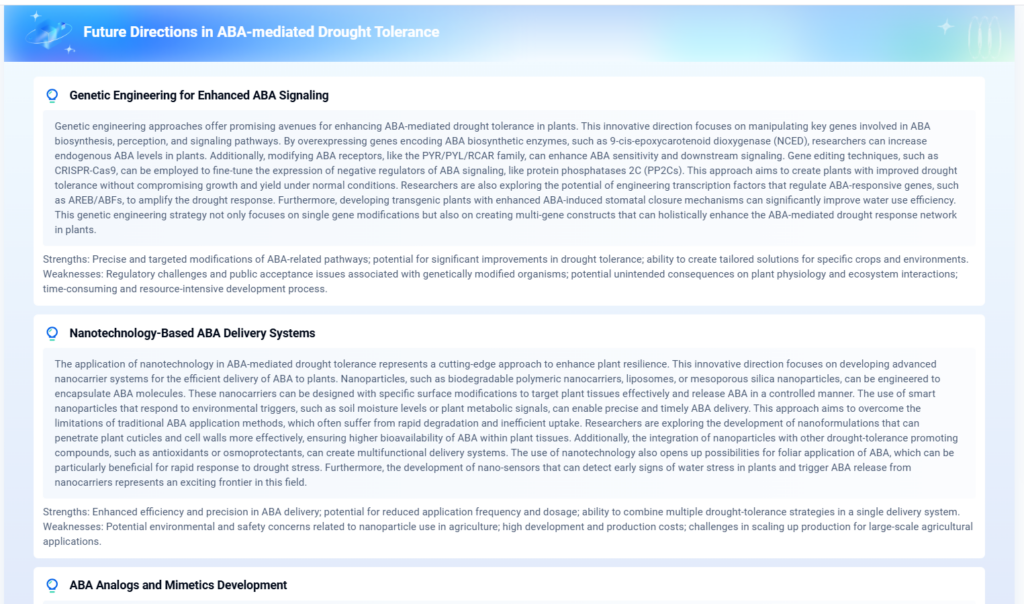
- Smart Agrochemicals: UV-stable ABA analogs for spray-based crop protection
- Precision Irrigation Integration: ABA sensor-feedback systems in smart farming
- Synthetic Biology: Engineered ABA pathways for predictable stress responses
- Climate Resilient Breeding: Trait stacking with ABA pathway markers
- Interkingdom ABA Applications: Microbial ABA manipulation for soil enhancement
Key Trends:
- 2025: Widespread use of ABA analogs in regulated drought-prone zones
- 2026–2027: Gene-edited crops with tunable ABA circuits
- 2028+: Commercial sensor-based ABA response control systems
Conclusion & Key Takeaways
Abscisic Acid is not just a stress hormone—it’s a command center for plant adaptation, survival, and performance. Its pivotal role in drought tolerance, seed dormancy, and stress gene activation positions ABA as an essential molecule in the future of agriculture. Whether through genetic manipulation, analog design, or smart delivery, ABA remains a frontier for scalable plant biotechnology innovation.
FAQ
Abscisic Acid (ABA) is a plant hormone that regulates stress responses, particularly under drought, salinity, and cold. It also controls seed dormancy, stomatal closure, and developmental transitions.
Yes. ABA and its analogs are used to improve crop tolerance to abiotic stress. Commercial formulations are applied as foliar sprays or seed treatments, especially in high-stress environments.
Natural ABA is extracted from plant or microbial sources, while synthetic ABA or its analogs (like Pyrabactin) are chemically modified to enhance stability, uptake, or specificity.
Yes. Overexpression of ABA biosynthetic genes (e.g., NCED3) or enhanced receptor sensitivity via genetic engineering has shown improved water-use efficiency and yield under limited irrigation.
ABA signaling is often studied using Arabidopsis mutants, fluorescent biosensors, transcriptome profiling, and synthetic reporter systems (e.g., ABA-responsive promoters driving GUS/GFP).
Currently, ABA is considered environmentally safe due to its natural degradation pathways. However, synthetic analogs must be tested for long-term ecological impact and non-target effects.
ABA is being investigated in synthetic biology, plant-microbe interaction modulation, and controlled bioreactor cultivation for stress-resilient crops and algae.
Ready to Power Innovation with ABA Intelligence?
PatSnap Eureka AI Agent helps R&D teams decode trends, benchmark key innovations, and uncover hidden opportunities across the ABA patent and research ecosystem.
👉 Book a Eureka demo and transform your ABA insights into field-ready impact.