


Understanding solubility rules is the key to predicting whether a precipitation reaction will occur when two aqueous solutions are mixed. This article will walk you through the fundamentals of solubility rules, how they relate to ionic compounds in water, and how to use them to identify and predict precipitation reactions accurately.
Stuck on solubility rules or wondering why certain compounds dissolve while others don’t? Eureka Technical Q&A connects you with chemistry experts who simplify complex concepts—making it easier to master solubility trends, exceptions, and how they apply to real-world reactions.

What Are Precipitation Reactions?
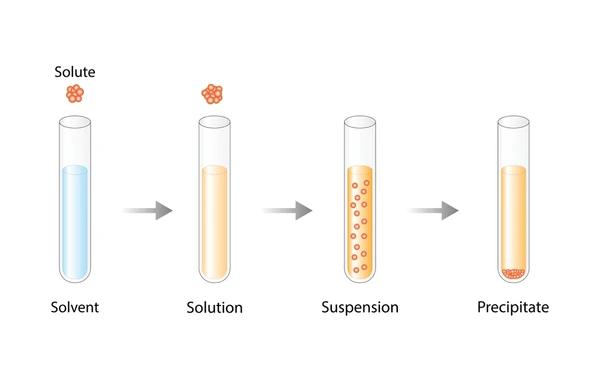
Precipitation reactions are chemical reactions where two soluble salts in aqueous solution react to form an insoluble product—a solid known as a precipitate. This solid forms when certain ions in the solution combine to create a compound that is not soluble in water.
Example:
When solutions of silver nitrate (AgNO₃) and sodium chloride (NaCl) are mixed, they form silver chloride (AgCl), a white precipitate
AgNO₃(aq) + NaCl(aq) → AgCl(s) + NaNO₃(aq)
Why Solubility Rules Matter
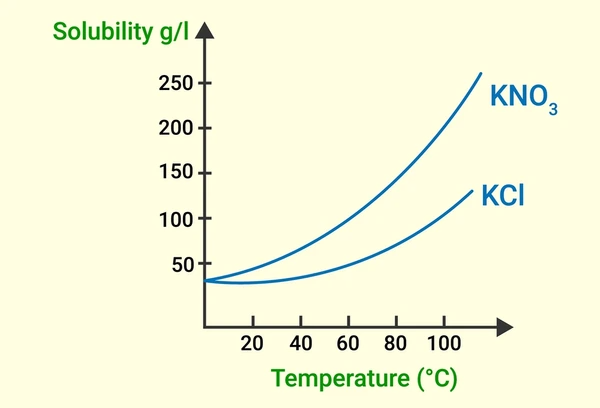
Solubility rules help chemists determine which ionic compounds will dissolve in water and which will not. This is crucial in fields like analytical chemistry, environmental science, and medicine, where understanding reactions in solutions is essential.
The General Solubility Rules for Ionic Compounds
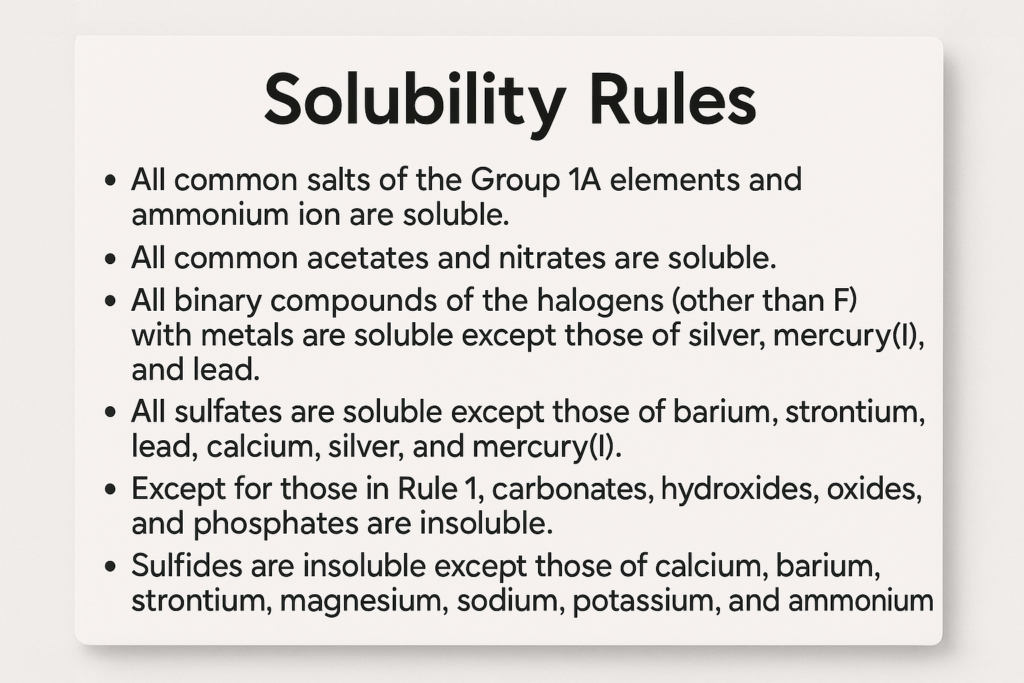
Below are the standard solubility rules that help predict the solubility of ionic compounds in water:
Always Soluble Compounds
- Group 1 (alkali metal) cations: Li⁺, Na⁺, K⁺, Rb⁺, Cs⁺
- Ammonium ion: NH₄⁺
- Nitrates (NO₃⁻), acetates (CH₃COO⁻), and perchlorates (ClO₄⁻)
These ions always form soluble compounds, regardless of the anion.
Generally Soluble (With Exceptions)
- Chlorides, bromides, iodides (Cl⁻, Br⁻, I⁻)
Except with: Ag⁺, Pb²⁺, Hg₂²⁺ - Sulfates (SO₄²⁻)
Except with: Ba²⁺, Pb²⁺, Ca²⁺, Sr²⁺, Hg₂²⁺
Generally Insoluble (With Exceptions)
- Carbonates (CO₃²⁻), phosphates (PO₄³⁻), chromates (CrO₄²⁻), sulfides (S²⁻)
Except with: Group 1 ions and NH₄⁺ - Hydroxides (OH⁻)
Except with: Group 1 ions, NH₄⁺, Ba²⁺, Sr²⁺, Ca²⁺ (slightly soluble)
How to Use Solubility Rules to Predict a Precipitation Reaction
Follow these steps to predict whether a precipitation reaction will occur:
1. Identify the Ions in Solution
Write down the cations and anions of each aqueous compound.
Example:
For BaCl₂ and Na₂SO₄:
- BaCl₂ → Ba²⁺ + 2Cl⁻
- Na₂SO₄ → 2Na⁺ + SO₄²⁻
2. Switch the Ions (Double Replacement)
Pair each cation with the opposite anion.
- Ba²⁺ + SO₄²⁻
- Na⁺ + Cl⁻
3. Check Solubility Using the Rules
- BaSO₄ is insoluble (forms a precipitate)
- NaCl is soluble
4. Write the Balanced Equation
BaCl₂(aq) + Na₂SO₄(aq) → BaSO₄(s) + 2NaCl(aq)
Since BaSO₄ is insoluble, a precipitate forms, confirming a precipitation reaction.
Common Examples of Precipitation Reactions
- Silver Nitrate and Potassium Iodide:
- Reaction: AgNO₃ (aq) + KI (aq) → AgI (s) + KNO₃ (aq)
- Description: This reaction produces silver iodide (AgI), which is a white precipitate.
- Lead Nitrate and Potassium Iodide:
- Reaction: Pb(NO₃)₂ (aq) + 2KI (aq) → PbI₂ (s) + 2KNO₃ (aq)
- Description: This reaction forms lead iodide (PbI₂), a yellow precipitate.
- Calcium Chloride and Potassium Hydroxide:
- Reaction: CaCl₂ (aq) + 2KOH (aq) → Ca(OH)₂ (s) + 2KCl (aq)
- Description: Calcium hydroxide (Ca(OH)₂) is formed as a white precipitate.
- Barium Chloride and Sodium Sulfate:
- Reaction: BaCl₂ (aq) + Na₂SO₄ (aq) → BaSO₄ (s) + 2NaCl (aq)
- Description: Barium sulfate (BaSO₄) is a white precipitate that is insoluble in water.
- Copper(II) Sulfate and Sodium Hydroxide:
- Reaction: CuSO₄ (aq) + 2NaOH (aq) → Cu(OH)₂ (s) + Na₂SO₄ (aq)
- Description: Copper(II) hydroxide (Cu(OH)₂) is a blue precipitate.
- Aluminum Chloride and Sodium Hydroxide:
- Reaction: AlCl₃ (aq) + 3NaOH (aq) → Al(OH)₃ (s) + 3NaCl (aq)
- Description: Aluminum hydroxide (Al(OH)₃) is a white precipitate.
- Iron(III) Nitrate and Ammonia:
- Reaction: Fe(NO₃)₃ (aq) + 3NH₃ (aq) → Fe(OH)₃ (s) + 3NH₄NO₃ (aq)
- Description: Iron(III) hydroxide (Fe(OH)₃) is a red-brown precipitate.
| Reactants (Aqueous) | Precipitate Formed |
|---|---|
| AgNO₃ + NaCl | AgCl |
| BaCl₂ + Na₂SO₄ | BaSO₄ |
| Pb(NO₃)₂ + KI | PbI₂ |
| CaCl₂ + Na₂CO₃ | CaCO₃ |
| FeCl₃ + NaOH | Fe(OH)₃ |
Tips for Recognizing Precipitation Reactions Quickly
- Always start with known soluble rules: Group 1 and NH₄⁺ salts are your best friends—they’re always soluble.
- Memorize the major exceptions: Especially for halides and sulfates.
- Use solubility tables for borderline cases: Some compounds like CaSO₄ are only slightly soluble.
- Balance all chemical equations properly: To reflect the true stoichiometry of the reaction.
Common Mistakes to Avoid
- Assuming all ionic compounds dissolve: Many students overlook exceptions like AgCl or BaSO₄.
- Not switching ion partners correctly: Double-replacement requires cross-combining cations and anions.
- Ignoring charges: Failing to balance charges leads to incorrect formulas (e.g., Al³⁺ and OH⁻ must form Al(OH)₃, not AlOH).
When No Precipitate Forms
If all possible product combinations are soluble, no precipitate forms. In that case, the reaction is said to be non-reactive or no net ionic reaction occurs.
Example:
NaNO₃(aq) + KCl(aq) → all products remain soluble
Result: No precipitate
Conclusion
Mastering solubility rules is essential for predicting precipitation reactions accurately. By learning which compounds dissolve in water and which do not, you can quickly determine whether a solid will form in a double-replacement reaction. These rules aren’t just academic—they’re foundational in lab work, chemical manufacturing, and environmental testing.
FAQs
Use flashcards, mnemonic devices, and practice problems to reinforce memory. Group 1 ions and NH₄⁺ are always soluble—start there.
Then no precipitation occurs. The ions remain in solution and no solid forms.
Typically, no. Precipitation reactions occur when two aqueous ionic solutions combine to form an insoluble salt.
Use solubility rules to determine which product is insoluble in water—it will be the solid formed.
No. Many are only slightly soluble, meaning they dissolve in very small amounts.
To get detailed scientific explanations of Solubility Rules, try Patsnap Eureka.
