


What Is Silver Iodide?
Silver iodide (AgI) is an inorganic compound with unique properties and applications. It is a yellow-colored solid with a high density of around 5.67 g/cm³.
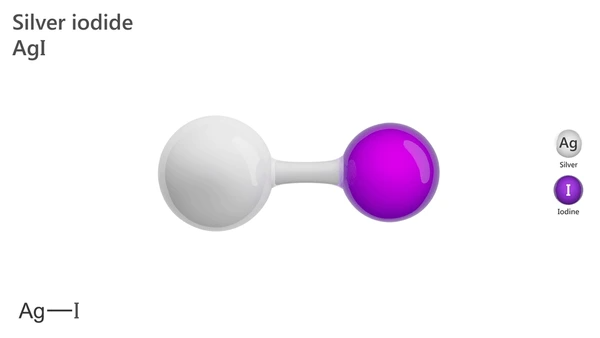
Proprieties of Silver Iodide
- Crystal Structure: It has a hexagonal crystal structure that closely resembles the structure of ice, making it an effective ice nucleation agent.
- Colour: Freshly prepared silver iodide is bright yellow in color.
- Photosensitivity: It is photosensitive and can undergo dissociation upon light exposure, producing it ions and potentially electrons, imparting metallic conductivity.
- Ion Conductivity: Its nanoparticles exhibit high ionic conductivity, even at low temperatures.
- Thermal Stability: It is stable at room temperature but can undergo phase transitions at higher temperatures.
Preparation of Silver Iodide
- Reaction of Silver Ions and Iodide Ions: It can be prepared by reacting silver ions with iodide ions in a solution containing a protective agent to inhibit particle agglomeration. This method allows the formation of fine its particles with high ion conductivity even at low temperatures.
- Decomposition of Solid Electrolyte: It can be produced by decomposing a solid electrolyte of the formula MAg4I5 (where M is a monovalent cation) with an ionic conductivity of >0.001 ohm^-1 cm^-1 in an organic solvent. The resulting is photosensitive and can be used in photothermographic elements.
- Precipitation Method: A common method is the precipitation of it by reacting a soluble silver salt (e.g., silver nitrate) with a soluble iodide salt (e.g., potassium iodide) in an aqueous solution.
Environmental and Safety Concerns
Environmental Toxicity
- Silver iodide has been shown to have a low environmental toxicity. Studies have indicated that insoluble silver iodide does not pose a significant threat to aquatic species, unlike soluble silver salts.
- The bioavailability of silver from silver iodide is limited due to its insolubility and the presence of ameliorating factors such as chloride, carbonate, and sulfide ions in water.
- Monitoring programs have shown that the use of silver iodide in cloud seeding projects has not resulted in adverse environmental effects, with silver concentrations remaining well below levels of concern.
Safety Concerns
- While silver iodide is generally considered safe, there are concerns about the potential release of silver ions into the environment. However, these concerns are mitigated by the compound’s low solubility and the presence of ameliorating factors in natural waters.
- The use of silver iodide in cloud seeding has been extensively reviewed, and the risk of adverse ecotoxicological impacts is considered negligible.
Applications of Silver Iodide
Photographic Materials
It has been widely used in photographic materials due to its bright yellow color and stability at room temperature. It is a key component in photographic emulsions and films, forming the light-sensitive grains that enable image capture.
Cloud Seeding
One of the most significant applications of it is in cloud seeding for weather modification and precipitation enhancement. Its particles serve as efficient ice nuclei, facilitating the formation of ice crystals in clouds and promoting precipitation.
Antimicrobial Applications
It exhibits antimicrobial properties, making it useful in medical devices, wound dressings, and coatings to prevent bacterial growth and infections. Its ability to release silver ions contributes to its antimicrobial efficacy.
Electronic Devices
It finds applications in electronic devices due to the high electrical conductivity of silver. It can be used in the fabrication of conductive patterns, electrodes, and wiring in printed circuit boards, displays, and organic thin-film transistors.
Catalysis
Its nanoparticles have shown promising photocatalytic activity, making them potential candidates for applications in environmental remediation, water treatment, and energy conversion processes.
Optical and Optoelectronic Applications
The unique optical properties, such as its bright yellow color and high refractive index, make it suitable for use in optical devices, lasers, and optoelectronic components.
Application Cases
| Product/Project | Technical Outcomes | Application Scenarios |
|---|---|---|
| Silver Iodide Cloud Seeding | Facilitates the formation of ice crystals in clouds, promoting precipitation and enhancing rainfall in drought-prone areas. | Weather modification and precipitation enhancement in arid regions and areas affected by drought. |
| Silver Iodide Photographic Films | Forms light-sensitive grains in photographic emulsions, enabling high-quality image capture and reproduction. | Traditional film-based photography, including professional and consumer applications. |
| Silver Iodide Antimicrobial Coatings | Releases silver ions that inhibit bacterial growth and prevent infections, providing long-lasting antimicrobial protection. | Medical devices, wound dressings, and coatings for surfaces in healthcare facilities and public spaces. |
| Silver Iodide Conductive Inks | Offers high electrical conductivity and stability, enabling the fabrication of conductive patterns and electrodes in electronic devices. | Printed circuit boards, displays, organic thin-film transistors, and flexible electronics. |
| Silver Iodide Nanoparticles | Exhibits enhanced antimicrobial and catalytic properties due to their high surface area to volume ratio, enabling efficient disinfection and chemical reactions. | Water treatment, air purification, and catalytic applications in chemical processes. |
Latest Technical Innovations of Silver Iodide
Silver Iodide Nanoparticles and Composites
- Synthesis of its nanoparticles with desired size, shape, and surface morphology through physical or chemical reduction processes.
- Development of silver iodide/carbon nanotube nanocomposites for enhanced photocatalytic and antibacterial properties.
Antimicrobial and Biofilm Prevention Properties
- Compositions comprising silver iodate compounds and their use as antimicrobial agents, including articles with silver iodate coatings or layers.
- Effectiveness of silver iodate compounds in preventing, treating, and eradicating biofilms.
- Obtaining silver iodate reaction products from diperiodatoargentate via hydrothermal reactions for antimicrobial applications.
Silver Iodide Complexes and Organic Silver Compounds
- Preparation of silver complexes by reacting silver oxide with a mixture of ammonium carbamate and isopropyl amine.
- Synthesis of organic silver compounds containing nanoparticles for various applications, such as chemical vapor deposition and thin film formation.
- Development of silver-metronidazole complexes for inhibiting the growth of pathogenic microorganisms.
Electrical and Optical Properties
- Silver iodide fine particles exhibiting high ion conductivity even at low temperatures for electrochemical devices.
- Photosensitive materials containing silver iodide produced by decomposing solid electrolytes for photothermographic elements.
- Paper modified with silver nanoparticles for sensitive determination of iodide ions based on surface plasmon resonance.
Novel Preparation Methods
- Hydrothermal synthesis of silver iodate compounds and their reaction products.
- Preparation of silver iodide fine particles in the presence of protective agents to inhibit particle agglomeration.
- Synthesis of silver iodide nanoparticles through physical or chemical reduction processes.
Technical Challenges of Silver Iodide
| Synthesis of Silver Iodide Nanoparticles | Developing methods for synthesising silver iodide nanoparticles with controlled size, shape, and surface morphology through physical or chemical reduction processes. |
| Silver Iodide Nanocomposites | Formulating silver iodide/carbon nanotube nanocomposites to enhance photocatalytic and antibacterial properties. |
| Antimicrobial Silver Iodide Compounds | Developing silver iodate compounds and compositions with antimicrobial and biofilm prevention properties for various applications. |
| Silver Iodide Complexes | Synthesising organic silver iodide complexes and compounds for applications like chemical vapour deposition and thin film formation. |
| Hydrothermal Synthesis of Silver Iodates | Obtaining silver iodate reaction products from diperiodatoargentate via hydrothermal reactions for antimicrobial applications. |
FAQs
- What is silver iodide used for?
Silver iodide is primarily used in weather modification (cloud seeding), photography, and as an antiseptic in medical applications. - How does silver iodide work in cloud seeding?
Silver iodide acts as a nucleating agent, helping water droplets in clouds freeze into ice crystals, which then grow and fall as rain or snow. - Is silver iodide safe for the environment?
While generally considered safe in small amounts, large-scale use in cloud seeding can raise concerns about silver accumulation in the environment. - What happens if silver iodide is exposed to light?
Silver iodide darkens when exposed to light, a property that made it essential in early photography. - What are the side effects of silver iodide exposure?
Prolonged or high-dose exposure can be toxic, potentially affecting skin or internal organs. Proper handling and precautions are crucial.
To get detailed scientific explanations of the silver iodide, try Patsnap Eureka.

Learn more
Hypertonic vs. Hypotonic vs. Isotonic: What’s the Difference?
Acetophenone: A Key Compound in Fragrance and Industry
Magnesium Nitrate: Key Uses, Definition, and Innovations