


What Is a P Wave?
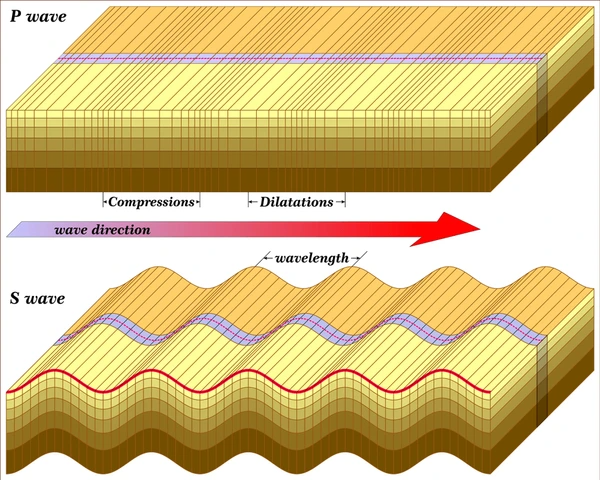
A P wave, or primary wave, is a fast-moving seismic wave generated during an earthquake. Known for its ability to travel through solids, liquids, and gases, it is the quickest type of seismic wave. P waves move the ground back and forth in the direction of wave propagation, creating compressions and rarefactions in the medium. This article will explore the characteristics, behavior, and significance of P waves in seismic activity and earthquake studies.
Characteristics and Properties of P Waves
Nature and Propagation
P-waves are compressional waves that move by compressing and expanding the medium in their travel direction. They can traverse solids, liquids, and gases, making them the fastest seismic wave type. This ability ensures they quickly propagate through the Earth’s interior during an earthquake.
Velocity
P-waves travel faster than S-waves, with their velocity depending on the medium’s elasticity and density. In the Earth’s crust, P-wave speeds typically range between 5.5 and 7 km/s, reflecting the medium’s composition and state.
Arrival Time
P-waves arrive first at seismic stations following an earthquake, providing critical information for early warning systems. This lead time, though brief, allows preparation for the slower but more destructive S-waves that follow.
Waveform
P-waves exhibit a push-pull motion, compressing and expanding the medium along their travel direction. This longitudinal motion causes particles to oscillate parallel to the wave’s propagation path, distinguishing them from other seismic waves.
Applications
The ability of P-waves to pass through various media, including fluids, makes them essential in seismic exploration for oil and gas. They also play a key role in geophysical surveys, helping researchers map the Earth’s subsurface structures with precision.
Shadow Zone
P-waves experience a shadow zone, where they are undetectable due to destructive interference. This shadow zone occurs at angular distances of 104 to 140 degrees from an earthquake’s epicenter, offering insights into the Earth’s internal layers.
How P Waves Travel Through the Earth
Seismic waves generated by earthquakes move outward from the source, interacting with different layers of the Earth. Their ability to travel through various materials makes them invaluable for studying the planet’s interior.
Initial Propagation
These waves originate at the earthquake’s focus, compressing and expanding the material along their travel path. This efficient energy transfer allows them to reach distant locations quickly.
Movement Through Layers
As seismic waves pass through the Earth’s crust, mantle, and core, they encounter materials with varying densities and elastic properties. These changes cause the waves to bend or refract, altering their direction and speed.
Interaction with the Core
The Earth’s outer core, being liquid, slows down these waves significantly. The speed reduction and refraction at this boundary create a shadow zone, an area where the waves are not detected. This phenomenon provides insights into the Earth’s core composition and behavior.
Surface Detection
Upon reaching the Earth’s surface, these waves are captured by sensitive seismic instruments. The recorded data helps determine the earthquake’s location, depth, and magnitude, as well as offering clues about the Earth’s internal structure.
Differences Between P Waves and S Waves
Nature and Propagation
- Primary Waves
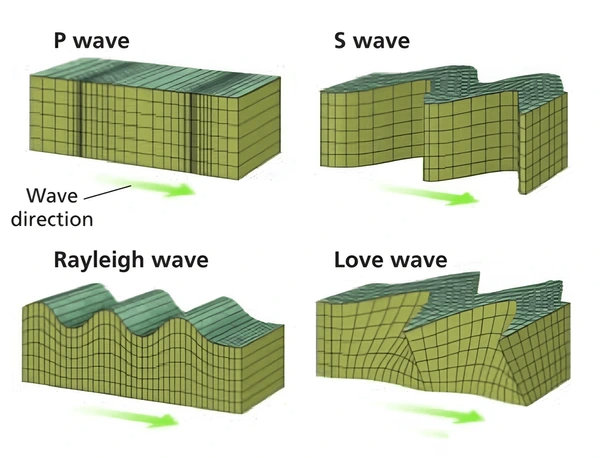
Primary waves, or P-waves, are compressional waves that travel through solids, liquids, and gases. They move in a push-pull motion, creating compressions and rarefactions as they pass through the medium. Known for their speed, P-waves are the fastest seismic waves and can traverse any elastic material, including fluids and gases. - Secondary Waves
Secondary waves, or S-waves, are shear waves that only travel through solids. They move perpendicular to their direction of propagation, causing the medium to shake sideways. S-waves travel slower than P-waves and cannot move through liquids or gases.
Velocity and Arrival Time
- P-Waves
P-waves travel faster than S-waves, making them the first to reach seismic stations after an earthquake. This is why they are referred to as “primary” waves. - S-Waves
S-waves, which travel more slowly, arrive after P-waves, giving them the name “secondary” waves.
Applications in Seismic Exploration
- P-Waves in Fluid Analysis
P-waves are highly sensitive to fluid types, such as gas, oil, and water, making them valuable for identifying reservoir contents. They also provide critical insights into the subsurface structure and fluid properties. - S-Waves in Rock Analysis
S-waves excel in assessing rock properties, including fracture density and orientation. They help determine the mechanical characteristics of subsurface rocks, aiding in geological and engineering studies.
Detection and Monitoring
- P-Wave Detection
P-waves are detected using sensors that can function in water or attach to the seabed. These sensors are crucial for early earthquake warnings, as P-waves arrive before the more destructive S-waves. - S-Wave Detection
S-waves require ground-coupled receivers, making their detection dependent on solid contact. They offer essential data for understanding earthquake impacts and subsurface conditions.
Data Processing and Imaging
- Separate Imaging
In seismic processing, P-waves and S-waves are imaged separately to minimize interference and enhance subsurface imaging quality. - Advanced Techniques
Sophisticated methods are employed to filter noise and accurately position seismic energy, improving the clarity and precision of geological imaging.
Applications of P Waves in Seismology
Earthquake Detection and Location
The fastest seismic waves are the first to reach detection stations after an earthquake. Their arrival times help calculate the distance to the source, aiding in pinpointing the epicenter. This process is essential for locating seismic activity.
Early Warning Systems
Analyzing seismic wave data in real-time enables early warnings for incoming ground motion. These alerts offer critical seconds to initiate emergency measures before stronger waves hit, reducing damage and saving lives.
Subsurface Imaging and Exploration
In reflection seismology, these waves help create images of underground formations. By studying their reflections and refractions, geologists can map subsurface structures, crucial for resource exploration and geological surveys.
Continuous Monitoring and Hazard Assessment
Tracking seismic wave activity helps detect and analyze events over time. This data supports hazard assessments, particularly in earthquake-prone areas, enabling better disaster planning and preparedness.
Advanced Imaging Techniques
Joint analysis of various seismic wave types allows for detailed imaging of the Earth’s crust and mantle. These high-resolution methods provide deeper insights into tectonic processes and structural formations.
Machine Learning in Seismology
Seismic data is used to train algorithms that distinguish earthquake signals from noise. This approach improves the accuracy of event detection and enhances real-time data processing for researchers.
Educational and Public Engagement
Interactive tools and applications utilizing seismic wave data educate the public about earthquake science. These resources help students and communities better understand seismic activity and Earth’s internal structure.
Application Cases
| Product/Project | Technical Outcomes | Application Scenarios |
|---|---|---|
| Seismic Reflection Technology University of Sultan Qaboos | Improved understanding of shear (S) waves complementing compressional (P) waves, leading to better discrimination of lithologies and fluids in complex subsurface formations. | Hydrocarbon exploration and reservoir characterization in the oil and gas industry. |
| Drill Bit Acoustic Signal Processing Saudi Arabian Oil Co. | Effectively estimates seismic impedance and density values of geologic layers during drilling by processing drill bit-generated acoustic signals and applying rock physics models. | Real-time data acquisition during drilling operations, addressing cost issues of existing logging-while-drilling (LWD) methods. |
| Earthquake Early Warning System Institute of Disaster Prevention | Utilizes Bayesian inference to estimate earthquake magnitude and peak ground motion velocity from initial P-wave data, enabling rapid hazard discrimination. | Earthquake early warning and hazard assessment, particularly in regions prone to seismic activity. |
| Shear-Wave (SS-wave) Exploration Seismology Geokinetics, Inc. | Demonstrates the generation of shear-wave (SS-wave) energy from P-wave sources, enabling pure-mode SS-wave exploration seismology for shallow velocity model building and residual statics estimation. | Enhancing PS-wave processing and prestack depth migration in exploration seismology, particularly in areas where S-wave data is limited. |
To get detailed scientific explanations of P waves, try Patsnap Eureka.
