


What is Shear Stress?
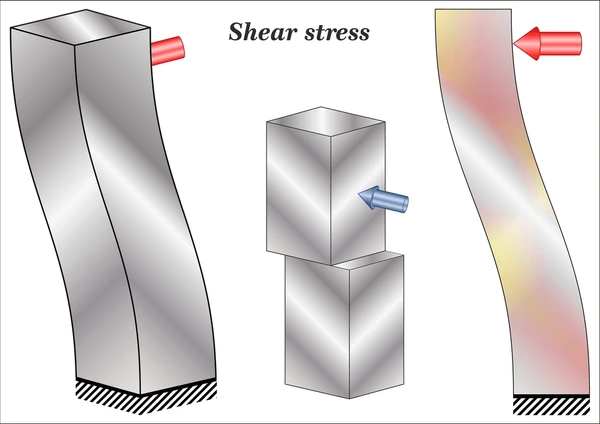
Shear stress is the force acting parallel to a material’s surface. It is defined as the force per unit area exerted by a fluid on a surface. Typically, shear stress is measured in Pascals (Pa) or dynes per square centimeter (dyn/cm²). In fluid dynamics, it results from a fluid’s viscosity and the velocity gradient near a surface. This stress is vital in fields like mechanical engineering, materials science, and biomedical engineering. Understanding the stress is essential for designing systems that involve fluid flow and surface interaction. This article will explore the concept of shear stress, its applications, and its significance in various industries.
How to Calculate Shear Stress
Basic Formula for Stress Calculation
The formula to calculate stress is:  where:
- τ is the stress (Pa or N/m²)
- F is the force applied parallel to the surface (N)
- A is the area over which the force acts (m²)
This formula helps determine how a force is distributed across a material’s surface.
Calculation Methods for Specific Scenarios
For beams under transverse loads, use the formula: where:
- V is the shear force at the section (N)
- Q is the first moment of the area above the point (m³)
- I is the moment of inertia of the entire cross-section (m⁴)
- b is the beam width at the calculation point (m)
This formula helps calculate stress in beams under bending forces.
For circular shafts under torsion, the stress formula is:  where:
- TT is the applied torque (N·m)
- rr is the radius of the shaft (m)
- JJ is the polar moment of inertia (m⁴), calculated as
 for a solid shaft
This formula is used to determine stress in rotating shafts subjected to twisting forces.
How Shear Stress Affects Structural Integrity
Mechanisms of Stress Impact on Structural Integrity
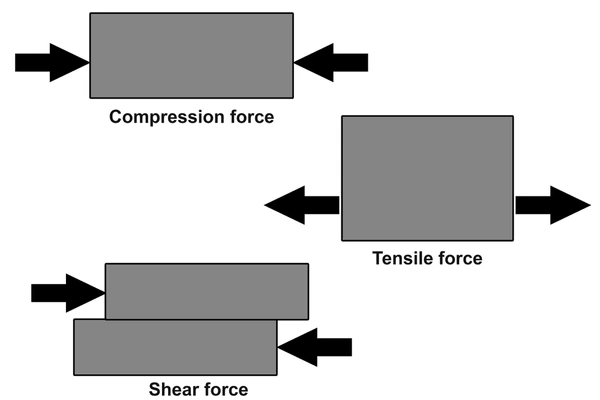
Stress acts parallel to a material’s surface, causing deformation. In structural engineering, stress can arise from seismic activity, high winds, or other forces. These forces can cause lateral movement, leading to structural damage or failure.
- Lateral Forces and Structural Damage
Seismic events or high winds create lateral forces that move the top portion of a wall. This can damage or collapse the wall, potentially causing building failure. - Residual Stresses
Residual stresses are locked-in stresses within a material. Some residual stresses enhance fatigue performance, but others may cause unexpected failures, compromising structural integrity.
Effects of Stress on Different Materials
Stress impacts various materials differently, such as light-framed constructions, polymers, and biological tissues.
- Light-Framed Constructions
In light-framed constructions, stress can cause lateral bracing systems to fail. These systems counteract lateral forces but can break down under repetitive loads. - Polymers
For materials like polypropylene, processing stress can alter structural and mechanical properties. Increased stress can reduce viscosity, affect crystallinity, and impact toughness and rigidity. - Biological Tissues
In vascular endothelial cells, blood flow-induced stress influences cellular functions. Low stress disrupts endothelial integrity, leading to cardiovascular diseases. Laminar stress promotes mitochondrial biogenesis, supporting endothelial health.
Mitigation Strategies for Stress
Different strategies can mitigate the negative effects of stress, depending on material and application.
- Lateral Bracing Systems
In light-framed constructions, advanced lateral bracing systems improve performance under lateral loads. Innovations like knife plates and buckling restraint blocks enhance system resilience. - Material Processing Techniques
In polymers, controlling stress during processing helps maintain desired properties. Optimizing stress levels and adding antioxidants improve structural and electrical performance. - Biological Interventions
Exercise can promote beneficial stress in vascular tissues, enhancing endothelial integrity. Targeting specific signaling pathways, like mTORC2, helps maintain endothelial health under low stress.
Applications of Shear Stress
Mechanical Engineering
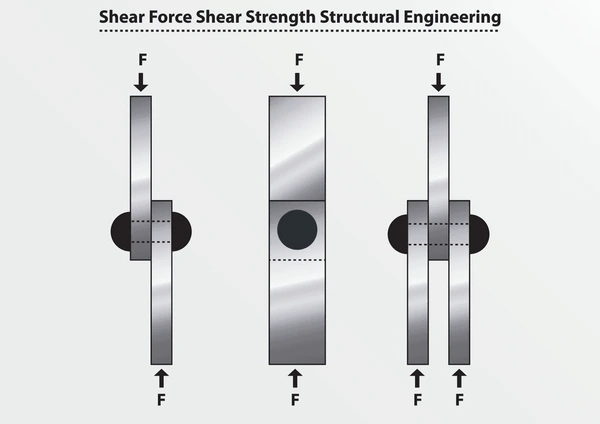
Shear stress is vital in mechanical engineering, especially for metal forming and machining. In unconventional metal forming, this stress appears at the die/workpiece interface during compression. This increases local strains, reduces press loads, and improves strain control. Engineers use it in torsional load designs, such as shrink-fit assemblies. It helps predict failure caused by fretting mechanisms, ensuring better durability.
Materials Science
In materials science, shear stress helps assess material behavior under extreme conditions. Techniques like the split-Hopkinson pressure bar (SHPB) measure material response at high strain rates, up to 10^7 s−1. Researchers use these results to select materials for high-speed impacts. Shear stress also enhances carrier mobility in semiconductors. Applying forces to high-stress materials like PECVD nitride achieves shear values between 100 MPa and 700 MPa.
Biotechnology and Medicine
Shear stress plays a crucial role in studying blood flow and vascular health. Vascular endothelial cells (ECs) detect shear stress from blood flow through mechanosensors. This activates signaling pathways that affect structural remodeling. Researchers use this process to explore atherosclerotic lesions and atherogenesis. Shear stress also aids in analyzing blood coagulation, specifically the breakdown of high molecular weight von Willebrand factor (VWF).
Cancer Research
In cancer research, shear stress isolates viable cancer cells. By exposing fluid preparations to shear forces, cancer cells develop resistance. This enables selective isolation of cancerous cells for further analysis. Researchers use this technique to study and develop treatments for cancer.
Engineering Failure Analysis
Shear stress concentrations play a key role in engineering failures. Models and simulations analyze stress distribution in shear bands. This helps engineers understand material damage and failure mechanisms. Geotechnical engineers use these insights to design stable structures and prevent shear-induced failures.
Flow Control and Process Engineering
In process engineering, shear stress creates controllable environments for liquid interactions. It is essential in bioreactors for studying cell growth and cell death. Devices generating uniform shear stress planes ensure reliable and consistent results.
To get detailed scientific explanations of Shear Stress, try Patsnap Eureka.
