


Total internal reflection (TIR) is a fascinating optical phenomenon that occurs when a light ray traveling through a medium hits a boundary with a less optically dense medium at a steep angle — and reflects entirely back into the original medium instead of refracting through. This principle is not only elegant in theory but also highly useful in practice, forming the backbone of technologies like fiber optics, prisms, and optical sensors.
What is total internal reflection? Eureka Technical Q&A explains that total internal reflection occurs when light traveling through a denser medium hits the boundary at an angle greater than the critical angle, causing it to reflect entirely back into the medium—used in fiber optics and optical devices.

This article explains what total internal reflection is, the conditions for it to occur, and where it’s used in real-world applications.
What Is Total Internal Reflection?
Total internal reflection occurs when a light ray traveling in a more optically dense medium (e.g., glass or water) strikes the boundary with a less dense medium (e.g., air) at an angle greater than a specific threshold called the critical angle. Instead of bending out into the second medium, the light reflects entirely within the first medium.
Conditions for Total Internal Reflection
For TIR to occur, two essential conditions must be met:
- Light must travel from a higher to a lower refractive index (e.g., from water to air).
- The angle of incidence must be greater than the critical angle.
Critical Angle (θₖ):
The angle at which the refracted ray skims along the boundary, i.e., the angle of refraction is 90°.
Formula:
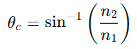
Where:
- n1 = refractive index of the denser medium
- n2 = refractive index of the less dense medium
Example: For light traveling from glass (n = 1.5) to air (n = 1.0):

Explanation Using Snell’s Law
Snell’s Law relates the angle of incidence and refraction: 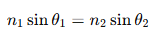
When θ1 increases such that  , light no longer refracts — it reflects entirely within the medium. Beyond this point, Snell’s Law doesn’t yield real values for θ2, confirming total reflection.
Examples of Total Internal Reflection
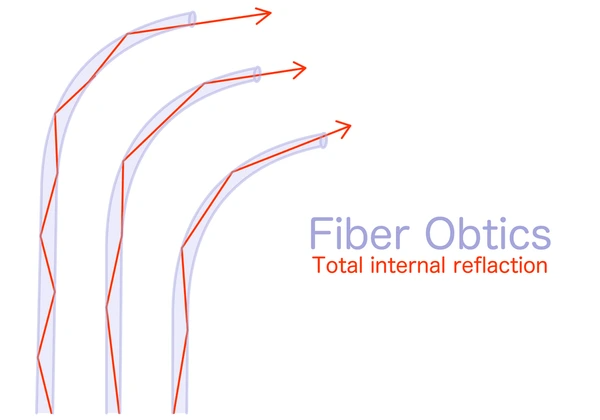
1. Optical Fibers
- Light signals bounce within the fiber core via TIR.
- Allows high-speed data transmission over long distances with minimal loss.
2. Diamond Sparkle
- Diamonds have a high refractive index (~2.4), so their critical angle is very small.
- Light entering a diamond undergoes multiple internal reflections, creating intense brilliance.
3. Mirage Formation
- In hot conditions, warm air layers near the ground have a lower refractive index.
- Light from the sky bends and reflects internally at the boundary, appearing as water.
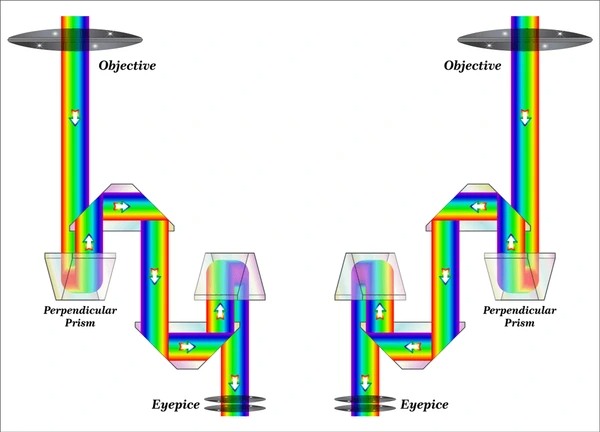
4. Periscopes and Prisms
- Right-angle prisms use TIR to reflect light at 90° or 180°, more efficiently than mirrors.
- Used in cameras, binoculars, and periscopes.
5. Endoscopes
- Medical instruments use bundles of optical fibers that transmit light via TIR to visualize internal organs.
Differences Between Reflection and Total Internal Reflection
Conditions for Occurrence
Reflection happens when light strikes a surface and bounces back without crossing into another medium. It can occur at any incident angle.
TIR occurs only when light moves from a denser medium to a rarer one and the angle of incidence exceeds the critical angle.
Angle of Incidence
Reflection works at all incident angles.
TIR occurs only if the incident angle is greater than the critical angle. Otherwise, light refracts into the second medium.
Energy and Light Behavior
Reflection reflects part of the light and may transmit some energy into the second medium.
TIR reflects all the light back into the denser medium, with no energy transmitted into the second medium.
Applications
Reflection is used in mirrors, optical lenses, and everyday imaging tools that rely on redirection of light.
TIR powers technologies like optical fibers and TIRF microscopy, where low-loss light travel or surface-level imaging is essential.
| Feature | Regular Reflection | Total Internal Reflection |
|---|---|---|
| Occurs in all media? | Yes | Only when light moves from denser to rarer medium |
| Reflects all light? | No (some light is refracted) | Yes (100% reflection) |
| Depends on angle? | No | Yes, must be > critical angle |
| Energy loss? | Some | Minimal |
Advantages of Using Total Internal Reflection
- No energy loss: Unlike mirrors, no absorption occurs.
- Compact design: Enables flexible, lightweight optical systems.
- High efficiency: Ideal for low-loss transmission of light.
Real-World Applications of Total Internal Reflection
Optical Devices and Displays
Engineers use total internal reflection (TIR) in AR eyewear to redirect images directly into the eye. TIR also enhances planar display designs in virtual and wearable display systems using diffraction gratings.
Sensing and Imaging
TIR creates evanescent waves ideal for surface-level excitation in imaging. Researchers rely on this effect in TIR fluorescence microscopy (TIRFM) to study molecular behavior near substrates with excellent signal clarity.
Advanced Microscopy
Microscopy techniques use TIR to improve visualization of biological structures. Holographic TIR microscopy enables phase imaging, while position-based TIR combined with optical tweezers supports surface force analysis.
Lighting Applications
Lighting designers integrate TIR to shape and control light distribution. These systems direct light precisely, improving efficiency and producing specific brightness patterns for architectural and commercial lighting.
Photonic Circuits
TIR mirrors inside photonic integrated circuits help bend light efficiently with minimal loss. These components enable broadband, polarization-independent performance in compact optical chips.
Laser Technologies
Developers utilize TIR in novel laser systems that operate without traditional cavities. These designs lower lasing thresholds and allow angle-free emission for use in cutting-edge optoelectronic devices.
Interactive Displays
TIR powers interactive surfaces through frustrated total internal reflection (FTIR). Touchscreens and tabletop systems use this method to detect user inputs with high accuracy and real-time responsiveness.
Optical Sensors and Switches
Sensor systems employ TIR to extend optical path lengths, improving responsiveness in photoconductive switches. Touch interfaces also use changes in TIR patterns to detect user contact effectively.
Application Cases
| Product/Project | Technical Outcomes | Application Scenarios |
|---|---|---|
| Total Internal Reflection Microscope Evident Corp. | Dual-mirror system with light trap isolates return light and adjusts incidence angles, improving fluorescence imaging quality and operational efficiency. | High-resolution fluorescence microscopy for biological and chemical research. |
| Multi-Axis Electro-Optic Modulator Xerox Holdings Corp. | Distributed electrode array and diamond-shaped non-electroded area achieve multiple axis and asymmetrical optical beam profile modulation. | Real-time control of beam profiles in laser printing and optical communications. |
| TIR-based Touchscreen Hewlett-Packard Development Co. LP | Detects screen contact by measuring disturbances in total internal reflection, enabling precise touch location determination. | Interactive displays and touch-sensitive interfaces for computers and mobile devices. |
| Temperature-Controlled TIRF Microscope Hitachi High-Tech America, Inc. | Openings in temperature controller for light paths and low-fluorescence materials enhance precision and sensitivity of temperature control. | High-throughput DNA sequencing and temperature-sensitive biological imaging. |
| Waveguide Display for AR Headsets Lumus Ltd. | Patterned interface in compact light-guide optical element increases field-of-view and reduces movement sensitivity. | Augmented reality head-mounted displays for industrial and consumer applications. |
Conclusion
Total internal reflection is a powerful principle that governs how light behaves at boundaries between transparent materials. When the conditions are right, it allows 100% reflection without loss, making it invaluable in fiber optics, imaging systems, and optical technologies. As light-based systems evolve, TIR continues to be a cornerstone in high-performance optics, communication, and precision instruments.
FAQs
It’s the complete reflection of light within a medium when it strikes the boundary with a less dense medium at an angle greater than the critical angle.
It occurs when light cannot exit a denser medium because the angle of incidence is too steep, forcing it to reflect internally.
The minimum angle of incidence at which total internal reflection occurs.
No. TIR requires light to travel from a denser to a rarer medium, so air must be the less dense medium.
It involves no surface coating, no energy loss, and offers more durability and efficiency in optical designs.
To get detailed scientific explanations of Total Internal Reflection, try Patsnap Eureka.
