


What is Laminar Flow?
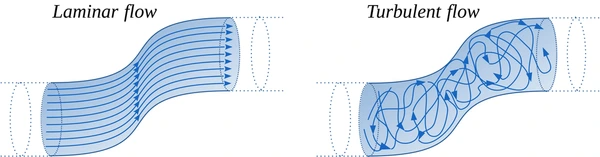
Laminar flow is a fundamental concept in fluid dynamics, characterized by fluid particles moving in smooth, parallel layers with minimal mixing between them. This type of flow is highly ordered, with fluid particles traveling in straight lines parallel to the surface they are moving past. The absence of cross-currents, eddies, or swirls distinguishes laminar flow from turbulent flow, where chaotic fluid motion and mixing occur.
Characteristics of Laminar Flow
- Smooth Paths: Fluid particles follow smooth, non-intersecting paths.
- Layered Movement: Each layer of fluid moves smoothly past adjacent layers with little to no mixing.
- Orderly Motion: Particles close to a solid surface move in straight lines parallel to that surface.
- Low Reynolds Number: Laminar flow typically occurs at low velocities, characterized by a Reynolds number (Re) below a critical threshold (approximately Re < 2000 – 2300 for flow in a pipe).
How Laminar Flow is Achieved
- Velocity and Viscosity: Maintaining low fluid velocities and using fluids with higher viscosities can promote laminar flow. The Reynolds number, which depends on velocity, viscosity, and characteristic length (such as pipe diameter), must be kept below the critical threshold for laminar flow.
- Smooth Surfaces: Ensuring that the surfaces in contact with the fluid are smooth can reduce disturbances that might lead to turbulence.
- Flow Channel Design: Designing flow channels with gradual changes in cross-section and avoiding sharp bends can help maintain laminar flow. For example, laminar flow elements in gas flow measurement use multiple small passages to convert turbulent flow into laminar flow, resulting in a linear relationship between pressure differential and flow rate.
- Nozzle Design: Appropriately shaped nozzles can produce laminar flow by minimizing disturbances at the fluid entry point.
Laminar Flow vs. Turbulent Flow
Fundamental Characteristics
Laminar Flow
- Streamlined and Predictable: Laminar flow features smooth, parallel fluid layers moving orderly, with a parabolic velocity profile in cylindrical channels. The maximum velocity is at the center, and zero at the walls, allowing deterministic and predictable flow given initial conditions.
- Low Reynolds Number: Laminar flow usually occurs at Reynolds numbers below 2100, where viscous forces dominate over inertial forces.
Turbulent Flow:
- Chaotic and Unpredictable: Turbulent flow is characterized by irregular fluctuations and mixing. The velocity profile is flatter compared to laminar flow, and the flow contains eddies and vortices. This flow is non-deterministic, meaning small changes in initial conditions can lead to significant differences in flow behavior.
- High Reynolds Number: Generally occurs at Reynolds numbers greater than 4000. Inertial forces dominate over viscous forces, leading to chaotic motion.
Practical Applications
Laminar Flow Applications:
- Microfluidics: Used in lab-on-a-chip devices where precise control of fluid flow is required. The predictable nature of laminar flow is ideal for applications such as biosensors and chemical analysis.
- Blood Flow in Vessels: Laminar flow conditions are common in small blood vessels, where the flow is steady and smooth, aiding in efficient nutrient and oxygen transport.
Turbulent Flow Applications:
- Mixing and Combustion: Turbulent flow enhances mixing and is crucial in applications such as combustion engines, chemical reactors, and industrial mixers. The chaotic nature of turbulent flow ensures thorough mixing of reactants.
- Aerospace and Automotive: Turbulent flow is exploited to reduce drag and improve aerodynamic performance. For example, the dimples on a golf ball trip the boundary layer to turbulent flow, reducing drag and increasing travel distance.
Transition Criteria
Reynolds Number:
- Fully Developed Flow: In a fully developed flow, the velocity profile does not change along the length of the pipe. For laminar flow, this is achieved when the flow is driven by a balance of pressure and viscous forces. For turbulent flow, it involves a balance of inertial and viscous forces.
- Laminar to Turbulent Transition: The transition from laminar to turbulent flow occurs at a critical Reynolds number, typically around 2300 to 4000. Factors such as surface roughness and flow disturbances can influence this transition.
Common Misconceptions About Laminar Flow
Smoothness and Orderliness
One common misconception is that laminar flow is always smooth and orderly. While it is true that laminar flow is characterized by smooth, parallel flow layers with minimal mixing between layers, it is not always smooth in the sense of being free from disturbances. In reality, laminar flow can be affected by external factors such as surface roughness or obstacles, which can introduce small-scale disturbances.
Lack of Mixing
Another misconception is that laminar flow implies a complete lack of mixing between fluid layers. While it is true that mixing in laminar flow is primarily molecular, meaning it occurs on a very small scale, there can still be some mixing due to diffusion and other mechanisms.
Slower Flow Rates
Some people believe that laminar flow only occurs at very low flow rates. While it is true that laminar flow typically occurs at lower velocities than turbulent flow, the transition between the two flow regimes depends on various factors such as the fluid’s viscosity, density, and the pipe diameter, as characterized by the Reynolds number.
Constant Velocity
There is a misconception that the velocity in laminar flow is constant throughout the flow field. In reality, the velocity profile in laminar flow is typically parabolic in pipe flow, with zero velocity at the wall and maximum velocity at the center.
Laminar Flow is Exceptional
Some believe that laminar flow is an exception in everyday life, as turbulent flow is more common. However, laminar flow is indeed common in certain situations, such as in microfluidic devices or in flows with very low Reynolds numbers.
No Eddies or Swirls
A common misconception is that laminar flow does not have eddies or swirls. While it is true that laminar flow does not have large-scale eddies like turbulent flow, there can still be small-scale vortical structures.
Simplistic Flow Patterns
Some people think that laminar flow results in simple, predictable flow patterns. While laminar flow can exhibit regular patterns, such as in pipe flow, it can also be influenced by complex geometries and boundary conditions, leading to more complex flow patterns.
How to Monitor Laminar Flow
- Optical Monitoring: Utilizing light scattering and detection techniques to monitor the flow characteristics. For instance, in microparticle measurement devices, laminar flow can be monitored by irradiating the flow with light and analyzing the scattered light to determine flow state.
- Pressure Differential Measurement: Using laminar flow elements (LFEs) to measure gas flow rates. LFEs create a linear relationship between differential pressure and flow rate, allowing for accurate monitoring over a wide range of flow rates.
- Image Processing: Optical sensors and image processing systems can monitor aircraft surfaces to observe and compare laminar flow regions. This aids in optimizing surfaces and detecting any reduction in flow efficiency.
Applications of Laminar Flow
Heat Transfer and Thermal Management
Laminar flow is widely utilized in heat exchangers, where it enhances thermal efficiency by reducing thermodynamic and hydrodynamic irreversibilities. This results in longer life and greater reliability of the heat exchangers, as they are free from turbulence-induced vibrations common in conventional designs. Laminar flow heat exchangers are particularly beneficial in compact thermal systems such as solar energy collectors, boilers, and nuclear reactors.
Aerodynamics and Drag Reduction
In aerospace, laminar flow control helps reduce friction drag, a major contributor to aircraft drag. Techniques like natural, hybrid, and fully laminar flow control extend laminar regions on aircraft surfaces, enhancing performance and cutting costs. Examples include the X-21A slotted suction tests and Boeing 757 HLFC tests.
Cleanroom and Contamination Control
Laminar flow principles are essential in the design of cleanrooms and laminar flow workbenches, which are used to control airborne particulate contamination. These devices maintain high levels of air cleanliness, such as Class 100 or Class 10,000, by ensuring a consistent laminar airflow that effectively removes both viable and nonviable particulate matter. Applications span across industries like pharmaceuticals, biotechnology, and electronics manufacturing.
Microfluidics and Chemical/Biological Analysis
In microfluidic systems, laminar flow allows precise fluid control at the microscale. Two-phase laminar flow enables chemical and biological sample separation, ensuring high reproducibility, biocompatibility, and selectivity. This technology is crucial for applications like nano-drug delivery, bone cancer treatment, and cryopreservation.
Industrial Processes and Manufacturing
Laminar flow improves mixing and heat/mass transfer in many industrial processes. In plastic sheet manufacturing, cooling of metallic plates, and liquid film condensation, it ensures uniform temperature and efficient cooling. Laminar flow is also used in firefighting nozzle design, where smooth water jets reach greater heights than turbulent ones.
Fluid Dynamics and Medical Engineering
Laminar flow plays a significant role in medical engineering, particularly in the design of devices such as artificial lungs and kidney filtration systems. The controlled flow of biological fluids through porous media ensures efficient filtration and reduces the risk of turbulence-induced damage to biological tissues. Moreover, laminar flow reactors are used to cultivate biological matter with minimal shear forces, promoting cell growth and differentiation.
Lithographic and Chemical Deposition Processes
In lithographic apparatus and chemical vapor deposition (CVD) processes, maintaining laminar flow conditions is crucial for achieving high-quality film deposition with uniform thickness. Laminar flow minimizes vorticity and ensures efficient removal of precursor chemicals, thereby speeding up the production process and improving the quality of the deposited films.
Fluid Sensing and Measurement
Laminar flow is key in fluid sensing, maintaining stable electro-optical properties. In optical sensors, laminar flow acts as a light pipe, enabling precise detection of fluid changes when objects interact with the flow. This principle is used in sensing tech like capacitive proximity sensors.
Application Cases
| Product/Project | Technical Outcomes | Application Scenarios |
|---|---|---|
| Laminar Flow Heat Exchanger | Enhances thermal efficiency by reducing thermodynamic and hydrodynamic irreversibilities, leading to longer life and greater reliability. | Compact thermal systems such as solar energy collectors, boilers, and nuclear reactors. |
| Laminar Flow Control Technology | Reduces friction drag, improving performance and reducing operational costs of aircraft. | Aerospace industry, particularly in aircraft design and performance enhancement. |
| Laminar Flow Devices | Effective in reducing and controlling both viable and nonviable particulate matter. | Clean rooms, clean work benches, and other contamination control environments in industry and medical fields. |
| Microfluidic Extraction System | High reproducibility, biocompatibility, and selectivity in chemical and biological sample separation. | Chemical and biological applications requiring precise sample separation. |
| Hybrid Laminar Flow Control (HLFC) Wind Tunnel Model | Delays boundary layer transitions, improving aerodynamic efficiency. | Aerospace research and development, particularly in transonic swept wing experiments. |
Latest Technical Innovations in Laminar Flow
Laminar Flow Control Technologies
Recent advancements in laminar flow control technologies include natural laminar flow (NLF), hybrid laminar flow control (HLFC), and fully laminar flow control (FLFC). These technologies aim to reduce friction drag, which is a significant component of total drag in transportation systems. For instance, HLFC systems have been tested on aircraft such as the Boeing 757, demonstrating significant drag reduction and fuel efficiency improvements.
Microfluidic Systems
Innovations in microfluidic systems utilizing laminar flow have led to enhanced chemical and biological sample processing. Two-phase laminar flow in microfluidic extraction systems offers high reproducibility, biocompatibility, and selectivity, making it advantageous for chemical and biological applications.
Heat Exchangers
Laminar flow heat exchangers have been designed to decrease thermodynamic and hydrodynamic irreversibilities, thereby increasing system efficiency. These heat exchangers are free from turbulence-induced vibrations, offering longer life and greater reliability.
Nanofluid Applications
The use of nanofluids in laminar flow applications has gained traction, particularly in enhancing heat transfer properties. Nanofluids are used in electric cooling systems, heat exchangers, and various medical engineering applications such as kidney filtration and artificial lungs.
Low Surface Energy Coatings
Researchers have developed low surface energy micro-nano coatings to extend the laminar flow region on aircraft surfaces, which helps reduce drag and boost fuel efficiency. Tests have shown that these coatings shift the boundary layer transition backward, leading to significant reductions in drag coefficients.
FAQs on Laminar Flow
- What are practical examples of laminar flow?
Laminar flow is commonly observed in smooth water currents, blood flow in small vessels, and air movement in streamlined car designs. It’s also used in industries like pharmaceuticals and electronics to create sterile environments. - Why is laminar flow important in engineering?
Laminar flow ensures efficiency, reduces energy loss, and minimizes wear and tear in systems like pipelines, HVAC systems, and aircraft design. It’s critical for precision in fluid control. - How does laminar flow differ from turbulent flow?
Laminar flow features smooth, orderly layers of fluid, whereas turbulent flow is chaotic and mixed. Laminar flow occurs at a lower Reynolds number, while turbulent flow arises at higher numbers. - What is Reynolds number, and how does it relate to laminar flow?
The Reynolds number is a dimensionless quantity used to predict flow patterns in fluid dynamics. Laminar flow typically occurs at Reynolds numbers below 2,000, indicating smooth, orderly motion. - What industries rely heavily on laminar flow?
Key industries include healthcare (operating rooms, sterile drug production), aerospace (aerodynamics), and electronics (dust-free environments for manufacturing chips).
To get detailed scientific explanations of laminar flow, try Patsnap Eureka.
