


Optical density is a critical concept in physics, engineering, and biological sciences, referring to a material’s ability to absorb or attenuate light as it passes through. It plays a crucial role in fields such as spectroscopy, microbiology, and fiber optics, helping researchers and engineers measure light interactions with different substances. This article explores the definition, measurement, importance, and real-world applications of optical density, along with how it differs from related concepts like absorbance and transmittance.
What Is Optical Density?
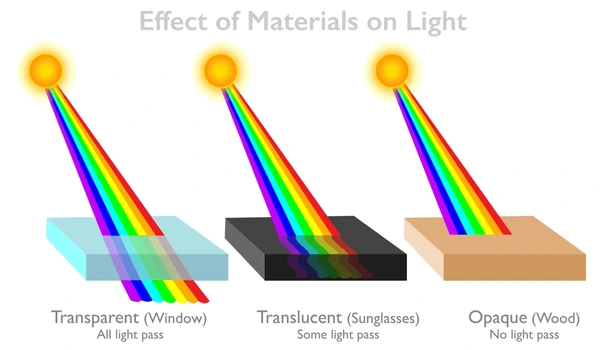
Optical density (OD) is a measure of how much light is absorbed or attenuated when it passes through a medium. The higher the Opacity level, the more the material restricts the transmission of light. Unlike physical density, which refers to mass per unit volume, Opacity level focuses on the material’s interaction with light.
What is optical density? Eureka Technical Q&A explains its significance in measuring light absorption, its applications in spectroscopy, and its role in scientific and industrial fields.

Key Characteristics of Optical Density
- Represents light attenuation due to absorption and scattering
- Used to quantify the concentration of substances in a sample
- Inversely related to transmittance, meaning higher OD results in lower light transmission
- Measured in optical instruments such as spectrophotometers and densitometers
Mathematically,it is given by:
OD = -log(T)
where T is transmittance, defined as the fraction of light that passes through the material.
Optical Density vs. Absorbance vs. Transmission
| Property | Optical Density | Absorbance | Transmittance |
|---|---|---|---|
| Definition | Light attenuation in a material | Light absorbed by a substance | Percentage of light that passes through |
| Value Range | Can be greater than absorbance | Directly proportional to concentration | Inversely related to OD and absorbance |
| Units | No units | No units | Expressed as a fraction or percentage |
| Relation | OD = -log(T) | Absorbance = log(1/T) | T = 10^(-OD) |
OD and absorbance are often used interchangeably in some fields, but OD generally accounts for both absorption and scattering, while absorbance focuses purely on light absorption.
Measurement of Optical Density
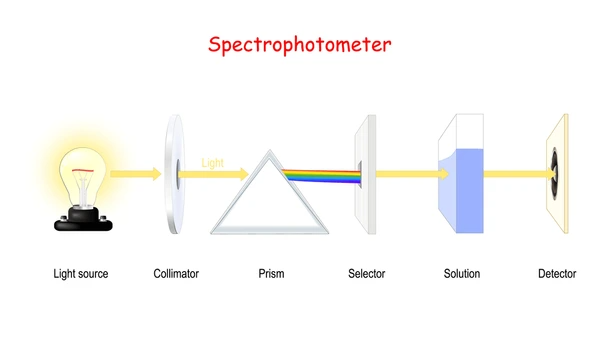
Optical density is measured using instruments that analyze the interaction of light with a material. Common measurement techniques include:
Spectrophotometry
- A spectrophotometer directs light of a specific wavelength through a sample and measures the intensity of transmitted light.
- OD values help determine the concentration of biological and chemical substances, such as bacterial cultures in microbiology.
Densitometry
- Used in imaging and printing industries to measure the optical density of photographic films, printing inks, and coatings.
Fiber Optic Analysis
- In telecommunications, OD is used to evaluate signal loss in fiber optic cables, ensuring efficient data transmission.
Applications of Optical Density
Microbiology and Biotechnology
- OD is widely used in microbiology to measure bacterial growth in liquid cultures. OD at 600 nm (OD600) is a standard parameter for estimating bacterial concentration in a sample.
- Helps in monitoring the effectiveness of antibiotics and assessing microbial metabolism.
Spectroscopy and Chemical Analysis
- OD is crucial in UV-visible spectroscopy to analyze the concentration of chemicals and proteins.
- Beer-Lambert Law relates absorbance and OD to the concentration of a solute, enabling precise quantitative analysis.
Optical and Photonic Systems
- In optics, OD determines the effectiveness of filters and lenses in reducing glare and controlling light exposure.
- Used in laser safety glasses and protective films to regulate light transmission and prevent eye damage.
Printing and Photography
- The printing industry applies densitometry to measure ink opacity and ensure high-quality imaging.
- Photographers use OD values to evaluate film negatives and optimize image contrast.
Application Cases
| Product/Project | Technical Outcomes | Application Scenarios |
|---|---|---|
| Handheld Optical Density Instrument bioMérieux, Inc. | Enables continuous, accurate measurement through a handheld unit with an optical test platform and illumination | Enhancing safety and efficiency in microbiology labs |
| OCT-based OD Analysis System The Chinese University of Hong Kong | Provides 2D or 3D information and embodies tiny changes of tissue systematically | Diagnostic and prognostic analysis in ophthalmology |
| Reconfigurable Optical Path System EMD Millipore Corp. | Adjusts path length and uses vacuum to remove bubbles for accurate in-situ optical density measurements | Online monitoring in challenging environments like bioreactors |
| PVD Coating Thickness Analyzer Fraunhofer-Institut für Verfahrenstechnik und Verpackung IVV | Combines quartz micro balances and optical density for monitoring thickness homogeneity | Quality control in barrier packaging material production |
| Double-beam Optical Density Measuring Apparatus KURABO INDUSTRIES LTD. | Uses a collimator lens and integrated cell housing to maintain light path homogeneity and spectroscopic uniformity | High-accuracy measurements in spectroscopy with reduced recalibration needs |
Factors Affecting Optical Density
Wavelength of Light
- OD varies depending on the wavelength of light used in measurement. Different materials absorb different wavelengths more effectively.
Concentration of the Material
- Higher concentrations of solutes or suspended particles lead to increased OD readings. This principle is used in spectrophotometric analysis of chemical solutions.
Path Length
- The thickness of the material through which light travels impacts OD values, following the Beer-Lambert Law, which states that OD increases with path length.
FAQs
What is the significance of OD600 in microbiology?
OD600 measures bacterial cell density in liquid cultures, providing a quick estimate of bacterial growth and concentration without requiring direct cell counting.
How is optical density related to absorbance?
OD and absorbance are similar, but OD considers both absorption and scattering, whereas absorbance focuses solely on light absorption.
Can optical density be negative?
No, OD values are typically positive because they are based on a logarithmic scale. A negative OD would indicate more transmitted light than the reference, which is not physically meaningful.
Why do different wavelengths give different OD readings?
Different substances absorb light at specific wavelengths, so the OD varies depending on the wavelength used in measurement. This principle is fundamental in spectrophotometry.
How does OD affect laser safety filters?
Higher OD values in laser safety filters indicate greater protection, as they reduce the intensity of harmful laser beams, preventing eye and skin damage.
Conclusion
OD is an essential parameter in various scientific and industrial applications, from microbiology and spectroscopy to optics and printing. It provides valuable insights into light absorption, material properties, and concentration analysis. Understanding how to measure and interpret OD values is crucial for researchers, engineers, and technicians working with light-based systems.
To get detailed scientific explanations of optical density, try Patsnap Eureka.
