


When conducting research, ensuring that results are both accurate and applicable is critical. Two key concepts that determine the credibility and generalizability of a study are internal validity vs. external validity.
- Internal validity ensures that the study accurately measures cause-and-effect relationships without interference from external factors.
- External validity determines how well the study’s findings can be generalized to other settings, populations, or conditions.
Understanding the difference between internal and external validity is essential for researchers, as striking the right balance enhances study reliability and real-world applicability. With the rise of AI-powered research tools like Eureka, researchers can now analyze patterns, validate methodologies, and optimize study designs more efficiently. This guide explores the definitions, key differences, challenges, and practical applications of internal and external validity, while also demonstrating how Eureka accelerates research validation and innovation.
What is Internal Validity?

🔹 Definition
Internal validity refers to the extent to which a study accurately measures the causal relationship between variables without interference from confounding factors.
🔹 Key Characteristics of Internal Validity
- Controlled variables – Minimizing the influence of external factors.
- Randomization – Ensuring unbiased participant selection.
- Clear causal inference – A direct relationship between the independent and dependent variable.
- Replication feasibility – Study findings remain consistent under similar controlled conditions.
🔹 Example of Internal Validity in Research
📌 Medical Study on Drug Efficacy:
A pharmaceutical trial tests the effectiveness of a new drug. Researchers control external influences (e.g., patient lifestyle, diet) and use randomized controlled trials (RCTs) to ensure that improvements are solely due to the drug.
🔍 How Eureka Helps Enhance Internal Validity

With Eureka’s AI-powered research tools, scientists can:
- Identify and control confounding variables using data-driven risk analysis.
- Use real-time patent and publication insights to refine experimental design.
- Benchmark findings against global research databases for consistency.
What is External Validity?

🔹 Definition
External validity determines whether the results of a study can be applied to other populations, locations, or conditions.
🔹 Key Characteristics of External Validity
- Generalizability – Findings apply to real-world settings.
- Population validity – Results hold true across different demographics.
- Ecological validity – The study applies to natural conditions beyond the laboratory.
- Temporal validity – Findings remain relevant over time.
🔹 Example of External Validity in Research
📌 Education Study on Teaching Methods:
A researcher studies whether interactive learning improves student performance. If the study is conducted only in one school district, its external validity is low. To improve it, the researcher must test multiple schools with diverse demographics.
🔍 How Eureka Helps Enhance External Validity
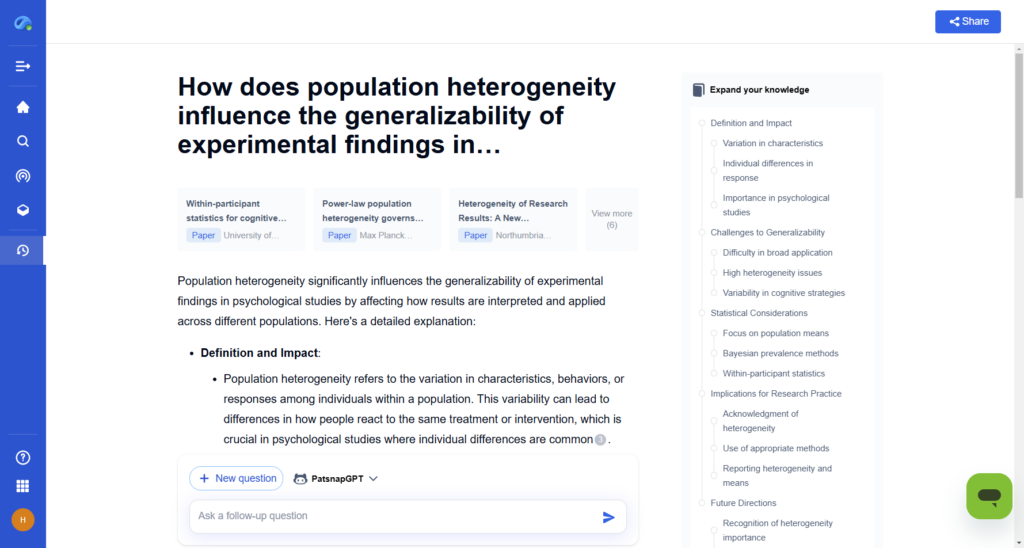
With Eureka’s AI-powered insights, researchers can:
- Compare multi-region studies to validate whether findings apply globally.
- Analyze historical data and market trends to assess temporal validity.
- Simulate different environmental conditions to test research adaptability.
Internal Validity vs. External Validity: Key Differences
| Factor | Internal Validity | External Validity |
|---|---|---|
| Definition | Ensures a study accurately measures cause-and-effect relationships. | Determines whether findings can be generalized to real-world settings. |
| Focus | Controlling confounding variables and ensuring causal inference. | Testing how findings apply across different populations and settings. |
| Key Threats | Bias, confounding variables, selection effects. | Limited sample diversity, artificial study conditions. |
| Improvement Methods | Randomization, controlled environments, pre-tests. | Diverse samples, real-world replications, long-term studies. |
🔹 Example Comparison:
- A highly controlled laboratory experiment may have strong internal validity but low external validity if it does not represent real-world conditions.
- A field study with diverse participants may have strong external validity but low internal validity if confounding factors are not controlled.
Threats to Internal and External Validity (and How to Overcome Them)
🔹 Threats to Internal Validity
- Selection Bias – Non-random participant selection skews results.
- Solution: Use randomized controlled trials (RCTs) to ensure equal representation.
- History Effects – Events outside the study influence participant responses.
- Solution: Control for external variables and use Eureka’s predictive analytics to adjust for historical trends.
🔹 Threats to External Validity
- Population Bias – The sample does not represent a larger population.
- Solution: Conduct research in multiple locations and analyze cross-demographic studies using Eureka’s AI-driven data validation.
- Artificial Experimentation – Unrealistic lab settings reduce applicability.
- Solution: Use field experiments and Eureka’s real-world data modeling to test practical applications.
How to Balance Internal and External Validity in Research
- Start with Strong Internal Validity: Ensure findings are scientifically accurate before applying them to larger populations.
- Expand Generalizability Over Time: Use pilot studies before scaling up research.
- Leverage AI for Data Validation: Tools like Eureka analyze global datasets to validate findings across multiple contexts.
- Use Mixed-Methods Approaches: Combining quantitative experiments with qualitative field studies enhances both validity types.
Eureka’s Role in Improving Research Validity
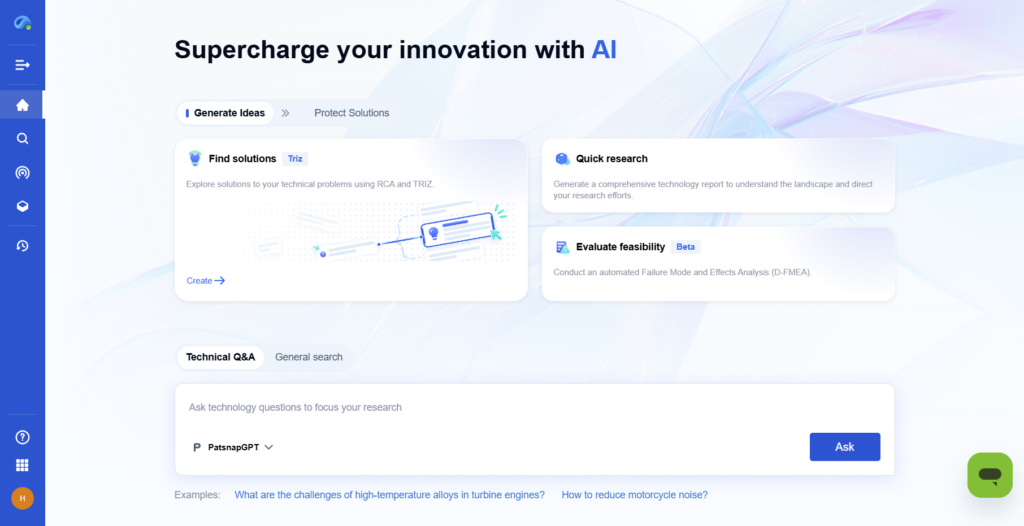
🔹 What is Eureka?
Eureka by PatSnap is an AI-powered innovation intelligence platform that helps researchers:
- Access global patents and publications for comparative research.
- Identify confounding variables and optimize study design.
- Test research applicability in different settings using real-world data analytics.
🔹 How Eureka Enhances Internal and External Validity
For Internal Validity:
- AI-driven data screening reduces confounding factors.
- Patent analysis ensures methodologies are aligned with existing best practices.
For External Validity:
- Comparative market research tests generalizability.
- Real-world simulations provide ecological validation.
💡 Example:
A pharmaceutical company using Eureka can:
1️⃣ Enhance internal validity by ensuring drug trials control for confounding variables.
2️⃣ Improve external validity by analyzing multi-region patient response data.
Conclusion
Understanding the differences between internal and external validity is crucial for designing credible and applicable research. While internal validity ensures accuracy, external validity confirms real-world relevance.
By integrating Eureka’s AI-powered research tools, scientists, academics, and industry professionals can optimize study designs, validate results, and improve the generalizability of findings.
🚀 Enhance your research with AI-driven insights—explore Eureka today!
FAQs
1️⃣ What is the main difference between internal and external validity?
Internal validity ensures cause-and-effect relationships are accurate, while external validity ensures findings are generalizable to real-world settings.
2️⃣ How can I improve both internal and external validity?
Use randomization and controls to strengthen internal validity, and diverse sampling to enhance external validity.
3️⃣ Why is balancing both validity types important?
Too much focus on internal validity may make research too artificial, while too much external validity may reduce experimental accuracy.
4️⃣ How does Eureka help in research validity?
Eureka provides data-driven risk analysis, cross-disciplinary insights, and AI-powered simulations to refine both internal and external validity.
5️⃣ Can AI tools like Eureka replace traditional research methods?
No, but they enhance efficiency, validation, and scalability by providing real-time data analysis and global comparisons.
To get detailed scientific explanations of Internal Validity vs External Validity, try Patsnap Eureka.
