


Technical Background and Objectives
Background
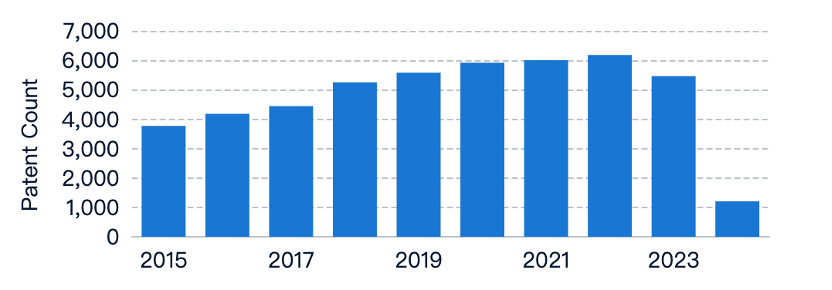
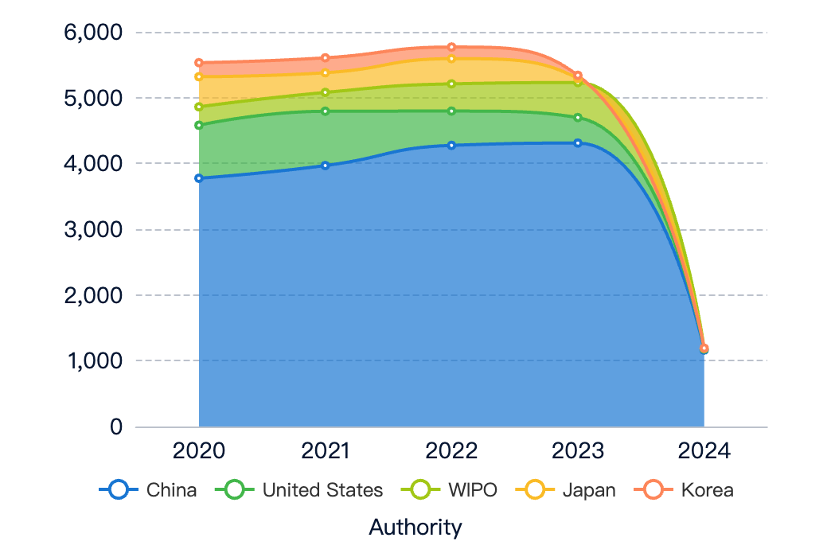
Spot welding is widely used in the automotive and manufacturing sectors. Ensuring a stable and reliable spot welding process is crucial for maintaining product quality and efficiency. The data shows a consistent upward trend in patent applications related to stable spot welding processes, indicating growing interest and investment in developing and improving these techniques. The peak in patent applications followed by a decline suggests a potential saturation or shift in focus within the field. In contrast, the trend in literature publications fluctuates, remaining relatively low compared to patent applications, indicating that academic research may be less extensive than industrial efforts.
Objectives
The primary objective is to develop a stable and reliable spot welding process that can consistently produce high-quality welds with minimal defects. This research aims to address the challenges associated with material properties, electrode wear, and process parameters, providing a comprehensive solution for enhancing the stability and quality of the spot welding process.
To get a detailed scientific explanations of Spot welding, try Eureka.
Technical Current Status Analysis
Spot Welding Overview
Spot welding is essential in automotive, aerospace, and construction industries for joining body panels, structural components, and metal assemblies. The quality of spot welds directly impacts the structural integrity, safety, and durability of the final products.
Applications and Impact:
- Automotive: Ensuring rigidity and strength of vehicle bodies.
- Aerospace: Joining aircraft structures and critical assemblies.
- Construction: Joining metal structures like steel frames and reinforcements.
Technical Characteristics and Challenges:
- Material Properties: Thickness, coatings, and alloy composition impact weld quality.
- Surface Conditions: Contaminants and oxides affect weld formation and quality.
- Electrode Wear and Maintenance: Proper maintenance is crucial for consistent weld quality.
- Process Parameters: Current, electrode force, weld time, and cooling rate need optimization.
- Weld Monitoring and Quality Control: Effective systems are necessary to detect and prevent weld defects.
- Operator Skill and Training: Skilled operators and proper training are essential.
Technological Paths:
- Advanced Materials and Surface Engineering: New materials and surface treatments for better weldability.
- Intelligent Process Control and Monitoring: Advanced control systems using machine learning and AI.
- Electrode Design and Maintenance Strategies: Innovative designs and maintenance protocols.
- Weld Quality Inspection and Testing: Advanced non-destructive testing techniques.
- Simulation and Modeling: Computational tools for optimizing parameters and predicting quality.
- Training and Skill Development: Comprehensive training programs and standardized procedures.
Research Content
Research Objectives
Enhance spot welding quality by developing innovative techniques and methodologies to minimize defects and achieve stronger, more consistent welds.
Research Direction and Focus
Material Characterization and Selection
- Investigate the influence of material composition, surface conditions, and microstructure on weldability.
- Use advanced characterization techniques like electron microscopy and spectroscopy.
Process Parameter Optimization
- Identify optimal parameter settings for different materials and joint configurations using experimental design and statistical analysis.
- Develop advanced monitoring and control systems for consistent process parameters.
Electrode Degradation and Maintenance
- Study electrode degradation mechanisms and develop strategies to minimize wear and extend electrode life.
- Explore new electrode materials, coatings, and surface treatments.
Weld Quality Monitoring and Control
- Implement advanced in-process weld quality monitoring systems to detect and prevent defects in real-time.
- Use machine learning algorithms and data analytics for predictive models of weld quality control.
Process Automation and Integration
- Develop automated welding systems, including robotic welding cells and integrated quality control systems.
- Ensure seamless integration with other manufacturing operations like material handling and assembly.
Technical Development Roadmap
Key Areas of Advancement
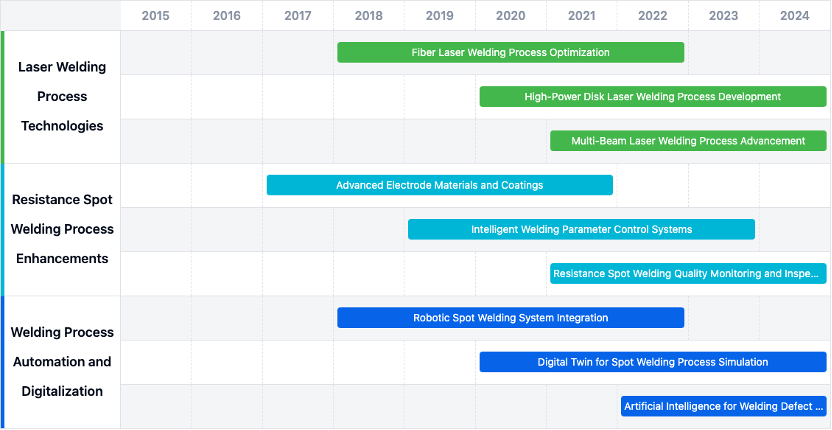
- Laser Welding Process Technologies: Optimizing fiber laser welding, high-power disk laser welding, and multi-beam laser welding.
- Resistance Spot Welding Process Enhancements: Improving electrode materials and coatings, intelligent welding parameter control systems, and quality monitoring.
- Welding Process Automation and Digitalization: Integrating robotic spot welding, developing digital twins for simulation, and leveraging AI for defect detection.
Main Player Analysis
Key Players and Focus
- Matsushita Electronics Corp.: 1378 patents on advanced control systems, monitoring techniques, and adaptive algorithms for stable spot welding.
- Osaka University: 13 publications on laser-based welding techniques and adaptive control strategies.
- Harbin Institute of Technology: Research on electrode wear monitoring, material behavior, and process control.
- NIPPON STEEL CORP.: 1759 patents on advanced welding techniques and process optimization.
- Daiichi Shokai Co. Ltd.: 1546 patents on welding equipment design, process optimization, and quality control.
Current Technical Solution Overview
Spot Welding Methods and Techniques
- Resistance Spot Welding: Controlling parameters like welding current, electrode force, and welding time for high-quality welds.
- Monitoring and Inspection: Using electrical signals, ultrasonic techniques, and thermal monitoring to assess weld quality.
- Spot Welding of Dissimilar Materials: Specialized welding parameters and surface treatments for materials like aluminum and steel.
- Laser Spot Welding: High-energy laser beams for minimal distortion and heat-affected zones.
- Spot Welding Joint Design: Predicting strength and behavior, optimizing joint designs.
Monitoring and Control Systems
- Real-Time Monitoring: Sensors and cameras capturing data during welding.
- Control Systems: Automatically adjusting welding parameters for stable processes.
- Weld Quality Assessment: Techniques like thermal analysis and visual inspection.
- Data Management: Tracking weld data across multiple stations for analysis.
Electrode and Tip Management
- Electrode Design: Optimizing shape, material, and surface properties.
- Maintenance and Dressing: Cleaning, reshaping, and reconditioning electrodes.
- Replacement Mechanisms: Automated systems for replacing electrode tips.
- Monitoring Quality: Evaluating wear resistance and temperature.
Specialized Spot Welding Methods
- Material Combinations: Optimizing parameters for specific materials like aluminum-to-steel.
- Monitoring Techniques: Ultrasonic waves, temperature measurements for quality.
- Resistance Spot Welding Apparatus: Optimizing parameters for different applications.
- Dissimilar Material Welding: Techniques for strong welds between different metals.
- Joint Design and Manufacturing: Improving strength, fatigue, and corrosion resistance.
Fixtures and Equipment
- Fixture Design: Positioning and holding workpieces during welding.
- Process Control and Monitoring: Evaluating weld quality and nugget diameter.
- Resistance Spot Welding Equipment: Cover plates and specific electrode configurations.
- Joint Design and Evaluation: Producing and testing strong weld joints.
Key Patent Interpretation
Patent Highlights
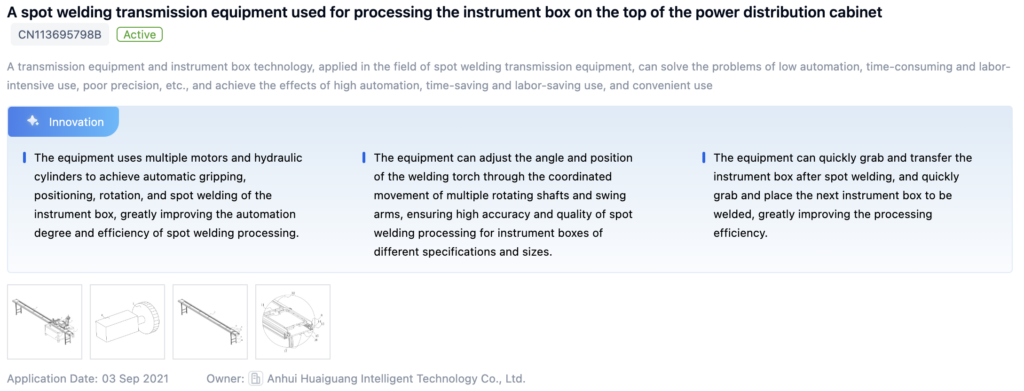
Patent 1: Spot Welding Transmission Equipment
- Core Invention Points:
- Uses multiple motors and hydraulic cylinders for automatic gripping, positioning, and welding.
- Adjustable angle and position for high accuracy.
- Quick transfer and placement of instrument boxes for improved efficiency.
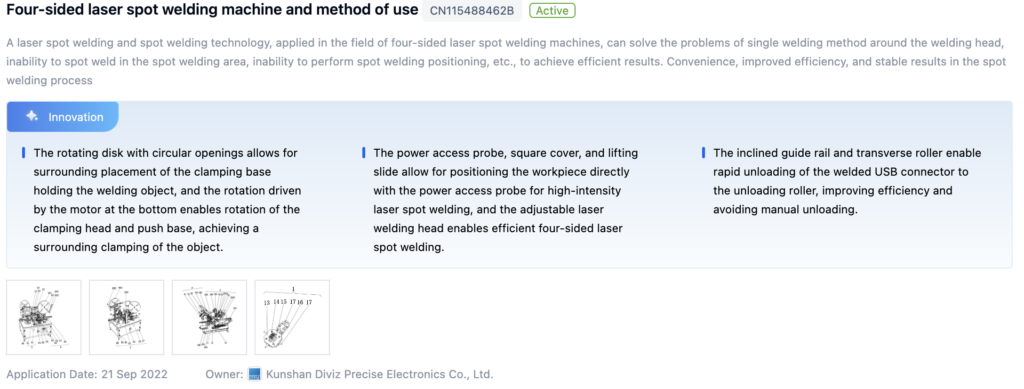
Patent 2: Four-Sided Laser Spot Welding Machine
- Core Invention Points:
- Surrounding placement of clamping base for efficient four-sided welding.
- High-intensity laser spot welding with adjustable welding head.
- Rapid unloading mechanism for efficiency.
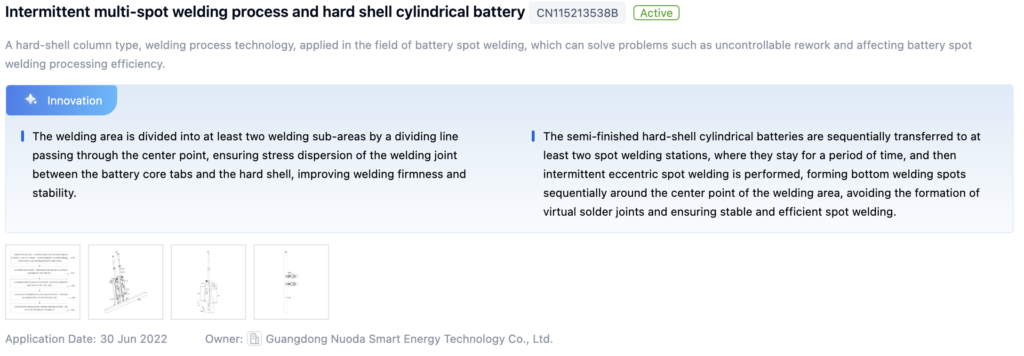
Patent 3: Intermittent Multi-Spot Welding Process
- Core Invention Points:
- Divides welding area for stress dispersion and stability.
- Intermittent eccentric spot welding for strong joints.
- Sequential processing for stable and efficient welding.
Possible Research Directions
- Monitoring and Controlling Spot Welding Process: Techniques for real-time monitoring and feedback control.
- Resistance Spot Welding Methods and Apparatus: Controlling electrode pressure and welding sequence.
- Spot Welding Quality Evaluation and Improvement: Non-destructive testing and defect prevention methods.
- Laser-Assisted and Arc Spot Welding Processes: Combining laser or arc welding for improved quality.
If you want an in-depth research or a technical report, you can always get what you want in Eureka Technical Research. Try now!
