


What Is an Anemometer?
An anemometer is a crucial instrument for measuring wind speed and direction, widely used in weather forecasting, environmental studies, and various industries. The most common type, the cup anemometer, features three or more cups mounted on a vertical shaft. As the wind blows, the cups spin, and the rotational speed provides an accurate measurement of wind speed. This article explores the types, functionality, and applications of anemometers, highlighting their importance in understanding wind dynamics and optimizing operations in fields like meteorology, aviation, and renewable energy.
Types of Anemometers
Cup Anemometers
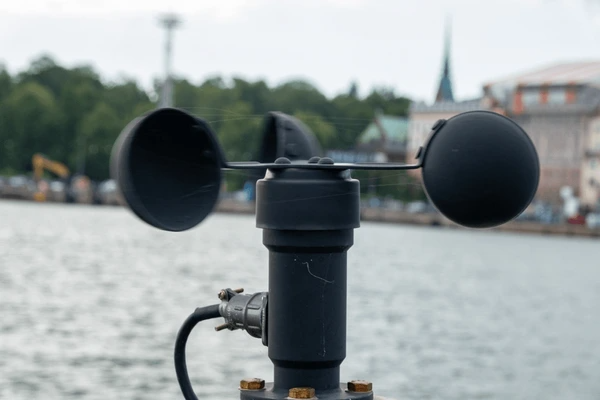
Cup anemometers have a rotor with three or four cups attached to a vertical shaft. The wind causes the cups to spin, and the rotational speed corresponds to the wind speed. These anemometers are popular due to their simplicity and affordability. However, they have a threshold wind speed, typically around 4 m/s, below which they may not provide accurate measurements.
Vane Anemometers
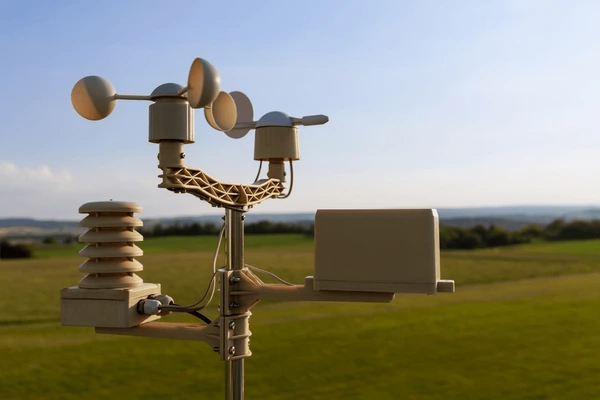
Vane anemometers, also known as wind vanes, include a fin or vane that aligns itself with the wind direction. Often combined with cup anemometers, these instruments measure both wind speed and direction. Their versatility makes them a common choice for meteorological and environmental studies.
Hot-Wire Anemometers
Hot-wire anemometers use a heated wire or film exposed to the wind. The wind cools the wire, and the cooling effect is measured to determine wind speed. These devices are highly sensitive, capable of measuring low wind speeds. However, they are delicate and may be affected by factors like temperature and humidity, requiring careful handling.
Ultrasonic Anemometers
Ultrasonic anemometers measure the time it takes for ultrasonic pulses to travel between multiple transducers. Differences in transit times are used to calculate wind speed and direction. These anemometers are robust, have no moving parts, and can measure wind in three dimensions. While highly accurate, they are more expensive than other types, such as cup anemometers.
Applications of Anemometers in Weather and Industry
Applications in Meteorology and Air Quality
- Trace Gas Measurement Interpretation
Wind speed and direction data are crucial for interpreting trace gas measurements and improving emission inventories. These insights help researchers understand air quality and pollutant distribution. - Quantifying Emissions
Using models like Gaussian plume or mass balance methods, anemometers help estimate point source emissions. Since emission magnitude scales linearly with wind speed, precise measurements are vital. - Mobile Weather Observations
Vehicle-mounted anemometers allow researchers to study micro- and mesoscale meteorology, as well as air quality in real-time. These mobile setups are particularly useful for capturing localized weather patterns. - Turbulence Measurements
Ultrasonic anemometers are widely used for turbulence studies due to their quick response times, minimal maintenance, and lack of moving parts. They are also effective in vehicle-mounted systems for analyzing mean wind and turbulent flow characteristics.
Industrial Applications
- Wind Energy Site Assessment
Anemometers measure wind speeds in the atmospheric boundary layer, providing valuable data for assessing potential wind energy sites. - Monitoring Fluid Flow
In industries like aviation, anemometers monitor airflow over aircraft wings for boundary layer control, ensuring optimal performance and safety. - Process Monitoring and Control
Accurate wind speed measurements are essential for various industrial processes, helping maintain efficiency and safety in operations.
Application Cases
| Product/Project | Technical Outcomes | Application Scenarios |
|---|---|---|
| Mobile Air Quality Monitoring Platform | Enables accurate wind measurements from moving vehicles by accounting for platform motion, improving interpretation of pollutant measurements and emission flux calculations. | Environmental monitoring, atmospheric chemistry studies, emission source mapping. |
| Automated Wind Measurement Tower Sichuan Zhongshang Shengchuang Technology Co., Ltd. | Incorporates mechanisms for automatic transportation and fixation of anemometers, enhancing replacement efficiency and safety. | Wind resource assessment, meteorological monitoring at remote sites. |
| Cup Anemometer Dynamics Characterization | Investigates the asymmetric response of cup anemometers to accelerating and decelerating winds, enabling post-processing to correct for over-speeding errors in turbulent conditions. | Wind resource assessment, site characterization for wind energy projects. |
| Infrared-Reflective Thermal Anemometer Soken Co., Ltd. | Incorporates an infrared reflective member to reduce disturbance from surrounding heat sources, improving wind speed and direction measurement accuracy. | Meteorological monitoring, industrial process control, HVAC systems. |
Future Trends and Innovations in Anemometer Technology
1. Advanced Sensor Technologies
The integration of modern sensors, such as MEMS (Microelectromechanical Systems) and ultrasonic sensors, has significantly improved measurement accuracy and durability. These advanced sensors outperform traditional mechanical designs by offering enhanced reliability and precision, even in challenging conditions.
2. IoT Integration for Real-Time Monitoring
Modern systems are increasingly designed to integrate seamlessly with IoT networks. This allows real-time data transmission and remote monitoring, making data collection and analysis more efficient. Applications like weather tracking, wind energy optimization, and aviation safety greatly benefit from these capabilities.
3. Compact and Durable Designs
Demand for compact, robust designs is growing, especially for deployment in harsh environments. These tools are engineered to require minimal maintenance, making them cost-effective solutions for remote or difficult-to-access locations.
4. CFD Simulations for Optimization
The use of Computational Fluid Dynamics (CFD) simulations has become essential for designing and optimizing these instruments. CFD helps model airflow patterns, refine sensor placement, and improve overall measurement accuracy and performance.
5. Renewable Energy Applications
As renewable energy gains momentum, wind power remains a key focus area. Precise wind measurement tools are critical for optimizing turbine performance and selecting ideal site locations. These innovations help maximize energy output while reducing operational costs.
6. Multifunctional Capabilities
New designs now incorporate multifunctional features, such as measuring wind direction, temperature, and humidity. This trend supports comprehensive data collection, making these devices invaluable for meteorology, environmental studies, and aviation applications.
7. AI and Machine Learning Integration
The adoption of AI and ML algorithms has enhanced data processing and predictive capabilities. These technologies enable improved wind forecasting, sensor calibration, and advanced analytics, driving smarter decision-making and better performance in various applications.
To get detailed scientific explanations of anemometers, try Patsnap Eureka.
