


Introduction to Hypodermic Needles
Hypodermic needles are slender, hollow tubes with sharp tips designed for subcutaneous or intravenous injection of fluids or extraction of bodily fluids. It is a crucial component in modern medical care and research.
History and Development of Hypodermic Needles
The hypodermic needle, a fundamental medical tool, has undergone significant advancements since its inception. Its origins can be traced back to the early 19th century, when pioneers like Francis Rynd and Alexander Wood experimented with hollow needles for injecting substances into the body.
Early Developments
In the 1850s, Charles Pravaz and Alexander Wood independently developed the first practical hypodermic needles and syringes, enabling the subcutaneous injection of drugs. These early needles were made of metal, such as steel or silver, and were relatively large in diameter, causing significant discomfort during use.
Advancements in Design and Materials
Over time, hypodermic needles underwent improvements in design and materials. The introduction of stainless steel and nickel-chromium alloys in the early 20th century improved durability and corrosion resistance. The development of smaller-gauge needles and beveled tips enhanced patient comfort and ease of penetration.
Disposable Needles and Safety Features
A major milestone was the introduction of disposable hypodermic needles in the 1950s, addressing concerns about cross-contamination and infection. This was followed by the development of safety features, such as retractable needles and needle shields, to protect healthcare workers from accidental needlestick injuries.
Recent Advancements
Recent advancements in hypodermic needles have focused on improving patient comfort and exploring alternative delivery methods. Microneedles, which are arrays of microscopic needles, have been developed for minimally invasive drug delivery through the skin. Additionally, needle-free jet injectors have emerged as an alternative to traditional hypodermic needles, enabling the delivery of macromolecules and vaccines without piercing the skin
Key Components of a Hypodermic Needle

Needle Barrel
The needle barrel is the hollow cylindrical body that forms the main structure of the needle. It is typically made of stainless steel or other rigid materials.
- Lumen: The internal channel that allows fluid passage.
- Apertures: Small openings along the barrel length to facilitate fluid delivery.
- Closed distal end: The tip end is sealed to prevent coring of tissue during insertion.
Needle Tip
The needle tip is the sharpened end designed for penetrating the skin.
- Bevel: The slanted, angled surface that cuts through tissue to minimize pain and trauma
- Tip geometry: Optimized for smooth insertion and minimal coring/deflection
Hub
The hub connects the needle to the fluid delivery device (e.g. syringe).
- Transition cavity: Gradually decreasing diameter to enhance fluid dynamics
- Luer lock/slip connectors: Standard fittings to securely attach syringes/tubing
Safety Mechanisms
To improve safety and reduce infection risk, some needles incorporate:
- Spring-loaded inner cannula: Detects entry into vessels/cavities
- Sheath/guard: Covers non-patient end to prevent accidental needlesticks
The materials, dimensions, and specific design aspects are optimized based on the intended application (e.g. injections, blood sampling, catheter insertion) to ensure precise fluid delivery, ease of use, and patient comfort and safety
Types of Hypodermic Needles
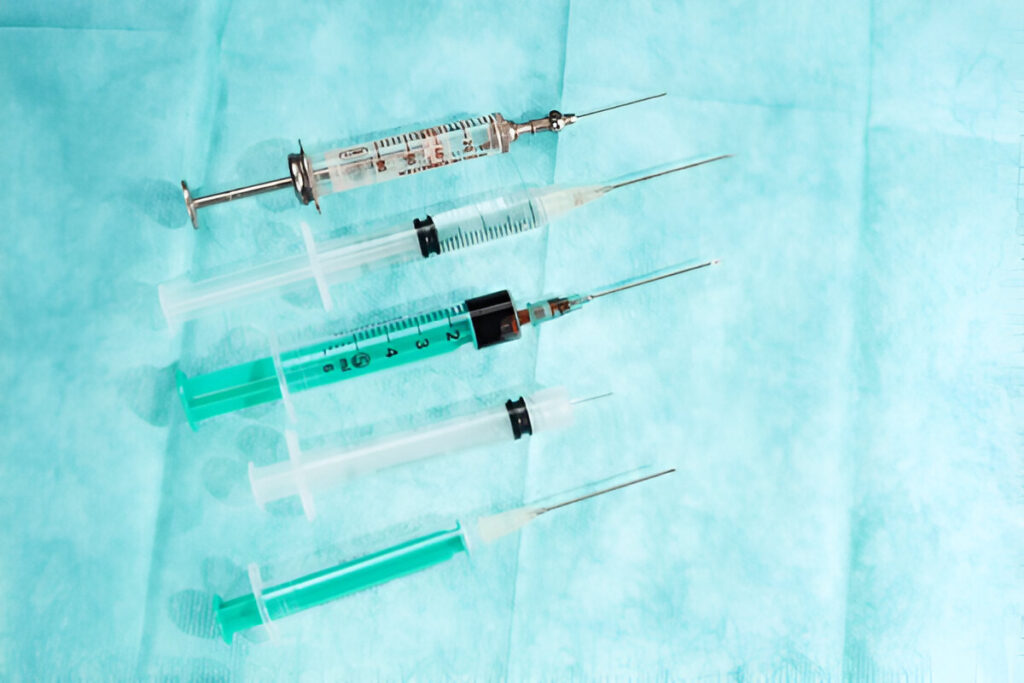
Needle Gauge and Length
Hypodermic needles come in various gauges (outer diameters) and lengths to suit different applications. For instance, common gauges range from 30G (0.3 mm) for insulin injections to 14G (2.1 mm) for drawing blood or delivering viscous substances. Additionally, lengths typically range from 1/2 inch (12.7 mm) to 1 1/2 inches (38.1 mm), depending on the intended use.
Needle Tip Geometry
The needle tip geometry plays a crucial role in reducing penetration force and patient discomfort.
- Beveled tips have angled cutting surfaces for easier penetration.
- Multi-beveled tips (3-5 bevels) provide a smoother transition and reduced penetration force.
- Deflected tips are bent slightly off the needle axis for improved control in certain procedures.
Needle Cannula Material
- Stainless steel is the most common material for its strength, durability, and ease of sterilization.
- Plastic/polymer needles are being developed as a cheaper, disposable alternative with reduced risk of needle-stick injuries.
Specialized Needle Types
- Safety needles have sheaths or retraction mechanisms to prevent accidental needlesticks.
- Hypodermic-needle-like (HNL) microneedles mimic conventional needles but are microscopic for painless drug delivery 1920.
- Catheter needles have a plastic catheter that remains in the vein after needle removal for IV access.
- Deflected/curved needles improve access in certain procedures, like epidurals.
The choice of needle depends on factors like injection site, substance viscosity, patient comfort, and procedural requirements, making a diverse range of hypodermic needles essential in modern healthcare.
Safety Practices for Handling Hypodermic Needles
Hypodermic needles are widely used in various medical procedures, including fluid sampling, medication injection, and intravenous therapy. However, their use poses significant risks of needlestick injuries and exposure to blood-borne pathogens, such as HIV, hepatitis B, and hepatitis C. 123 To mitigate these risks, it is crucial to follow proper safety practices when handling hypodermic needles:
Proper Disposal
Used needles should be immediately disposed of in puncture-resistant sharps containers. 6 Never attempt to recap, bend, or break needles, as these actions increase the risk of accidental needlestick injuries.
Needle Safety Devices
Utilize safety-engineered needles and devices equipped with retractable sheaths or shields to cover the needle tip after use. These devices significantly reduce the risk of accidental needlesticks.
Safe Handling Techniques
Avoid hand-to-hand transfer of contaminated needles and maintain a neutral zone around the patient during procedures. Use proper techniques for needle insertion and removal, and never leave exposed needles unattended.
Personal Protective Equipment (PPE)
Wear appropriate PPE, such as gloves, gowns, and eye protection, to prevent exposure to blood and other potentially infectious materials.
Training and Education
Ensure that all healthcare workers receive comprehensive training on safe needle handling practices, proper use of safety devices, and protocols for managing needlestick injuries.
Sharps Injury Prevention Program
Implement a comprehensive sharps injury prevention program that includes exposure control plans, engineering controls, work practice controls, and post-exposure management procedures.
By adhering to these safety practices, healthcare professionals can significantly reduce the risk of needlestick injuries and potential exposure to life-threatening infections. Continuous education, proper disposal methods, and the use of safety-engineered devices are crucial in creating a safer healthcare environment for both patients and healthcare workers.
Proper Disposal and Environmental Considerations
Waste Management Strategies
Effective waste management involves a multi-faceted approach, including:
- Waste minimization: Reducing waste generation at the source through product design, process optimization, and responsible consumption.
- Waste segregation: Separating different types of waste (e.g., recyclables, hazardous materials) to facilitate appropriate handling and treatment.
- Recycling and reuse: Implementing programs to recover valuable materials and repurpose them, reducing the demand for virgin resources.
- Safe disposal: Employing environmentally sound disposal methods for non-recyclable waste, such as sanitary landfills or incineration with proper emission controls.
Environmental Considerations in Product Design
Manufacturers are increasingly incorporating environmental considerations into product design to facilitate proper disposal and recycling. This includes:
- Using recyclable or biodegradable materials.
- Designing products for disassembly and material separation.
- Minimizing packaging waste and using eco-friendly packaging.
- Considering the entire product life cycle, from raw material extraction to end-of-life disposal.
Applications of Hypodermic Needles
Medical Applications
- Drug Delivery: Hypodermic needles are widely used for administering medications, vaccines, and other therapeutic agents directly into the body via intramuscular, subcutaneous, or intravenous routes. This allows for precise dosing and rapid onset of action.
- Blood Sampling: They are employed for drawing blood samples for diagnostic tests, such as blood glucose monitoring or complete blood count analysis.
- Insulin Administration: Patients with diabetes often self-administer insulin using pen injectors or syringes with hypodermic needles.
Non-Medical Applications
- Scientific Research: Hypodermic needles are essential tools in various scientific fields, including biology, chemistry, and material science, for injecting or extracting fluids from samples or experimental setups.
- Veterinary Medicine: They are used for administering medications, vaccines, and collecting blood samples in animals.
- Biotechnology: Hypodermic needles play a role in processes like cell culture, DNA/RNA extraction, and microinjection techniques.
Application Cases
| Product/Project | Technical Outcomes | Application Scenarios |
|---|---|---|
| Safety Needle Assembly | Prevents accidental needle sticks before and after injection, with a locking collar mechanism for enhanced safety. | Medical environments requiring safe injection practices to prevent needlestick injuries. |
| Pen Needle and Safety Shield System | Eliminates rotational movement and complex track systems, ensuring reliable operation and additional resiliency. | Diabetes management for patients requiring frequent insulin injections. |
| Hypodermic Needle Assembly | Enhances fluid dynamics and microsphere injectability with a transition hub. | Drug delivery systems requiring precise and efficient administration of microsphere drugs. |
| Spring Launched Needle Safety Clip | Automatically launches a spring clip to block the needle tip, preventing removal and ensuring safety. | Healthcare settings where needle safety and prevention of sharps injuries are critical. |
| Hypodermic Needle Destruction | Processes needles by softening and compressing them, ensuring safe disposal. | Medical waste management systems requiring safe and efficient disposal of used needles. |
Latest Technical Innovations in Hypodermic Needles
Microneedle Arrays for Transdermal Drug Delivery
Microneedle arrays are an innovative approach to transdermal drug delivery, offering a minimally invasive alternative to hypodermic needles. These micron-scale needles can penetrate the outer layers of the skin, allowing drugs to be delivered into the dermis without reaching nerve endings, reducing pain and discomfort.
Atmospheric Plasma Treatment for Enhanced Skin Permeability
Atmospheric plasma treatment has increasingly shown potential for enhancing percutaneous absorption of drugs, thus offering an alternative to hypodermic needles for transdermal delivery of large molecules. Specifically, plasma irradiation can physically and chemically modify the stratum corneum, the outermost skin layer, thereby increasing its permeability. Furthermore, techniques like atmospheric microplasma and plasma jets have been studied extensively for their ability to disrupt the skin barrier and consequently improve transdermal drug delivery without the need for needles.
Needle Design Innovations
While microneedles and plasma treatment offer needle-free alternatives, innovations in hypodermic needle design continue to improve safety and performance. These include:
- Integral skin plug retainers to prevent coring of the skin during needle insertion
- Ergonomic design improvements for reduced discomfort and improved usability
- Advanced coatings and materials for enhanced durability and biocompatibility
Overall, the latest innovations in hypodermic needles aim to improve safety, reduce pain and discomfort, and provide alternative delivery methods for transdermal and intradermal drug administration.
To get detailed scientific explanations of Hypodermic Needles, try Patsnap Eureka.
