


Introduction: The Strategic Role of Patent Drafting
In the fast-paced world of innovation, patent drafting has become a cornerstone of intellectual property (IP) strategy. A well-drafted patent not only protects inventions from infringement but also serves as a critical asset for licensing, fundraising, and market positioning. However, the complexity of drafting—ranging from technical articulation to legal compliance—often leads to delays, inconsistencies, and costly errors.
This article explores how the next generation of AI-powered patent drafting tools—led by PatSnap’s Eureka Patent Drafting AI Agent—is revolutionizing the industry. Most importantly, it highlights how PatSnap offers the world’s only 100% data-secure patent drafting model, setting a global standard for trust and compliance.
The Traditional Process: Complexity and Manual Bottlenecks
Patent drafting is a meticulous process. It involves translating complex technical disclosures into clear, enforceable legal language while adhering to jurisdiction-specific guidelines, such as those set by the USPTO or CNIPA. Practitioners must structure claims, prepare diagrams, conduct prior art research, and draft implementation examples that anticipate examiner objections.
Data shows that preparing one high-quality implementation example can take over 10 hours, consuming up to 70% of the drafting workload. Adding technical diagrams and explanatory annotations takes another 2 hours on average. Supplementing prior art for background disclosure may take 5 hours or more. These tasks require both legal acumen and deep domain knowledge, making the traditional workflow inefficient and prone to error.
PatSnap’s Patent Drafting AI Agent: Streamlining the Workflow
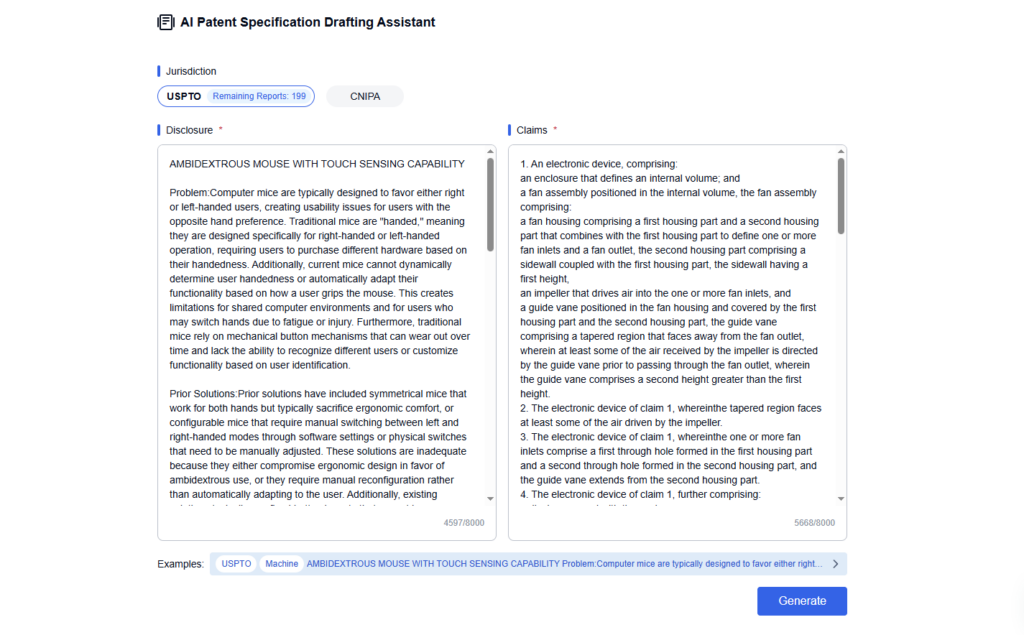
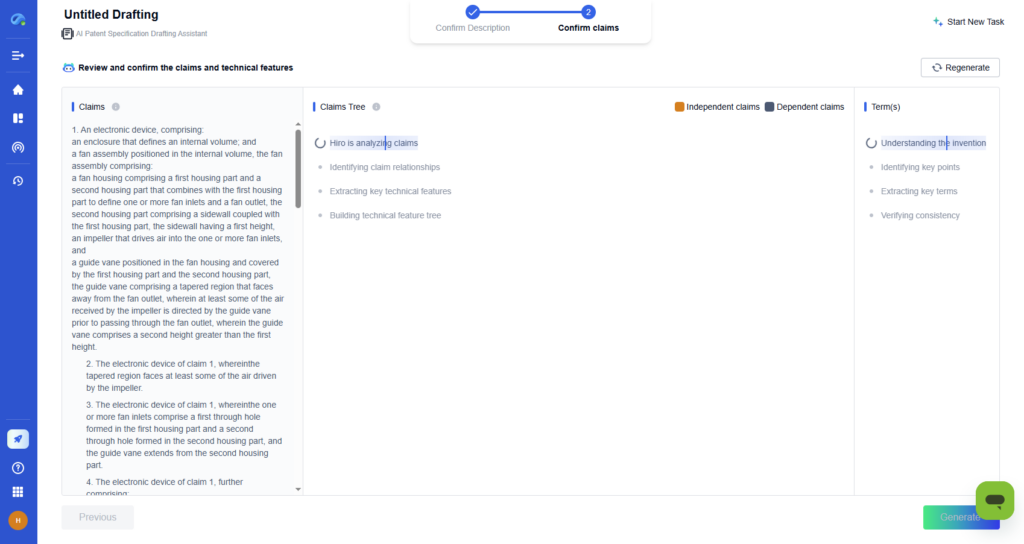
PatSnap’s Patent Drafting AI Agent transforms the traditional process through automation and intelligence. The system guides users through a simple three-step process:
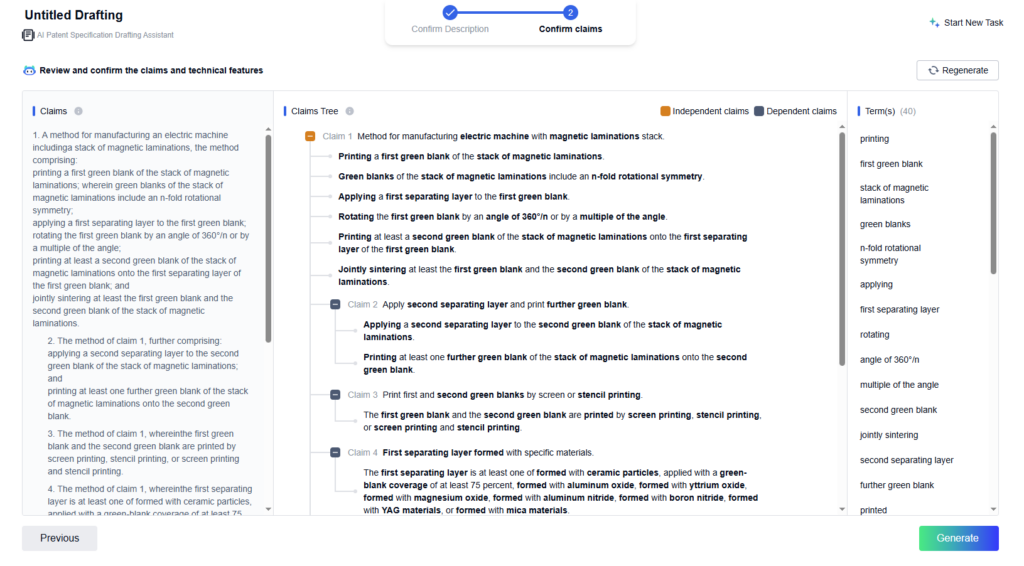
First, users upload their invention disclosure and any initial claim requirements. Then, they refine technical features and terminology using the platform’s AI-assisted interface. Finally, the system generates a complete, jurisdiction-compliant patent specification in minutes—ready for immediate review or filing.
The AI handles both structural and linguistic formatting based on the latest USPTO and CNIPA standards. It automatically identifies invention components, organizes them into claims, and produces logically sequenced, high-quality implementation examples. For patent professionals, this eliminates hours of manual drafting and significantly improves throughput.
Industry-Leading Data Security: A Global First
What truly sets PatSnap apart is its data protection architecture. It is currently the only AI patent drafting model that guarantees 100% user data safety. Unlike many large language models, PatSnap never uses user data for training or optimization. Every input, whether a disclosure document or an annotated claim, remains fully owned and protected by the user.
All data is encrypted both in transit and at rest. The system operates within a secure SaaS environment, using eight layers of protection to prevent unauthorized access or leaks. PatSnap’s AI model has also passed official government-level compliance certification in China and adheres to international best practices in enterprise-grade data security.
This means patent professionals can confidently draft sensitive materials without fear of intellectual property exposure or misuse.
Domain-Specific Intelligence: Built for Patent Excellence
The effectiveness of PatSnap’s AI model stems from its unique training dataset. Unlike generic models, it is trained on over 400 billion tokens of highly specialized IP content, including patent documents, examination reports, claim charts, legal rulings, and technical papers. Nearly half of its training data comes from patent filings, ensuring its understanding is tuned to the structure, tone, and formatting of real-world patent documentation.
This domain focus results in remarkable accuracy. The model achieves over 95% precision in claim structure recognition and over 85% accuracy in identifying technical terms. It understands the logic behind invention disclosure—from functional relationships to component hierarchies—and reflects that understanding in both claims and implementation narratives.
Legal and Technical Compliance, Built-In
The PatSnap AI Agent is designed to comply with the exact requirements of major IP offices. For example, it enforces USPTO guidelines such as the 150-word limit for abstracts and prohibits promotional or vague language. It also adapts formatting styles, language conventions, and diagram labeling standards based on the destination office’s rules.
The platform supports both English and Chinese outputs, making it suitable for dual-jurisdiction filings. It also generates bilingual technical terms, reference labels, and consistent feature descriptions to reduce examiner objections and improve clarity.
Real-World Application: From Concept to Filing in Minutes
To illustrate its impact, imagine an automotive engineer uploading a disclosure for a new vehicle cooling system. The AI automatically identifies components such as air intake mechanisms and thermal control elements. It builds out claims around functional relationships and suggests multiple implementation cases for broader protection.
The result is a full patent draft, complete with formatted claims, background summary, annotated diagrams, and citations—produced in under five minutes. Compared to traditional methods, this approach saves more than 90% of drafting time while maintaining legal precision.
Benchmark Performance: Surpassing Others
Independent evaluations confirm PatSnap’s superiority over other AI tools, including GPT-4. In tests simulating patent agent exams, PatSnap’s AI scored higher on metrics such as implementation diversity, logical consistency, and claim structure alignment.
While general-purpose models often fail in technical accuracy or introduce hallucinations, PatSnap delivers tightly focused, legally grounded outputs. Its model even outperforms other patent-specific LLMs in categories like claim mapping, background art synthesis, and examiner-style terminology.
One-Click Output and PTO Format Support
Once a draft is complete, users can export the full specification in Word format, ready for filing. The system ensures all structural elements—abstract, claims, background, and diagrams—conform to official CNIPA and USPTO templates. This reduces pre-submission formatting time and eliminates the need for manual corrections before filing.
By aligning output with regulatory standards, PatSnap helps IP professionals meet tight deadlines without sacrificing quality.

Conclusion: Patent Drafting Reinvented with Secure AI
Patent drafting is no longer a task reserved for highly specialized legal experts. With AI tools like PatSnap’s Patent Drafting AI Agent, anyone with technical know-how can now produce high-quality, jurisdiction-compliant patent applications with speed, accuracy, and confidence.
More importantly, PatSnap leads the industry in securing user data—ensuring that even the most sensitive inventions remain protected throughout the drafting process. For IP teams, law firms, and R&D organizations, this represents a new era of patent creation—faster, safer, and smarter than ever before.
To get detailed scientific explanations of patent drafting, try Patsnap Eureka.
