


Overview of Buoyant Force
Buoyant force, or buoyancy, plays a crucial role in fluid mechanics. It is the upward force that a fluid exerts on an object that is partially or fully submerged. This force occurs because of the pressure difference between the top and bottom of the object, which is caused by the weight of the displaced fluid. Understanding buoyant force is key to explaining why objects float or sink in water and other fluids. In this article, we’ll break down the concept of buoyancy and explore its importance in various real-world applications.

How Buoyant Force is Created in Fluids
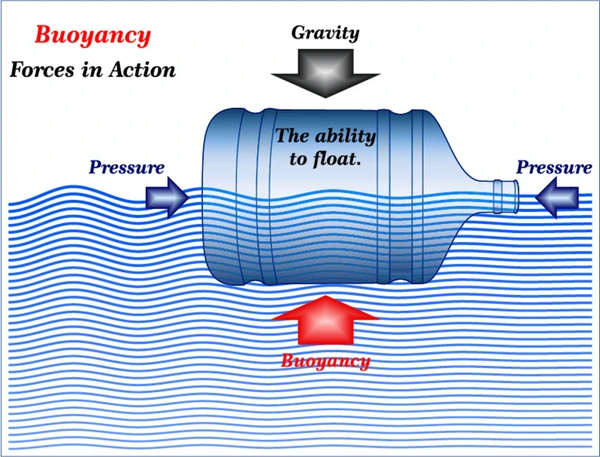
Buoyant force occurs in fluids due to pressure differences on an object immersed in the fluid. When you place an object in a fluid, the fluid exerts an upward force on it. This force arises from the pressure difference between the top and bottom of the object.
As the object enters the fluid, it displaces some of the fluid. The displaced fluid applies a downward force on the object, equal to the weight of the fluid displaced. Meanwhile, the pressure difference between the object’s top and bottom creates an upward force. The net force is the difference between these opposing forces.
The Relationship Between Buoyant Force and Object Density
Definition: Buoyant force is the upward force exerted by a fluid that counteracts an object’s weight. It is equal to the weight of the fluid displaced by the object.
Mathematical Relationship: You can calculate buoyant force (Fb) using the formula: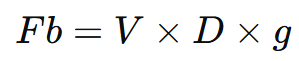
Here, V is the volume of the submerged object, D is the fluid’s density, and g is the acceleration due to gravity.
Density and Buoyancy: Density (ρ) is the mass (m) of an object divided by its volume (V), expressed as: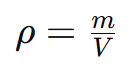
The buoyant force is directly proportional to the fluid’s density and the volume of the submerged object.
Comparison of Densities: The ratio of an object’s weight to the buoyant force equals the ratio of its density to the fluid’s density. This means:
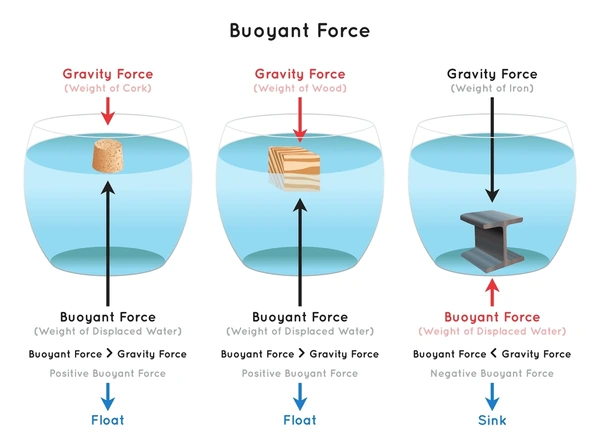
Buoyancy and Floating: An object floats if its density is lower than the fluid’s density. It sinks if its density is higher. The greater the object’s density compared to the fluid, the smaller the buoyant force, and vice versa.

Buoyant Force in Water vs. Air
Buoyant Force in Water: When an object is submerged in water, the upward force it experiences equals the weight of the displaced water. This force determines whether the object will float or sink. For example, a ship floats because the upward force from the displaced water is greater than the ship’s weight. The magnitude of this force depends on the volume of water displaced and the fluid’s density, which is higher in water than in air.
Buoyancy in Air: In contrast, the force in air is much smaller because air has a much lower density. The difference in density between air and water makes this force nearly negligible in air for most objects. As a result, objects do not feel a significant upward push when they are in the air.
Comparison and Applications: The difference between water and air has practical implications in various fields. In water safety clothing, the upward force is crucial for its effectiveness. In engineering, understanding how objects interact with fluids is essential for designing vessels and structures that operate efficiently in aquatic environments.
Practical Examples of Buoyant Force in Nature
- Ships Floating on Water: Ships float because the upward force from the displaced water balances the ship’s weight. This force keeps the ship afloat.
- Fish Swimming in Water: Fish adjust their swim bladders to control buoyancy. This lets them float, sink, or maintain a steady depth.
- Balloons Floating in the Air: Balloons filled with helium or hydrogen float because the force from displaced air is greater than the balloon’s weight.
- Submarines Diving and Surfacing: Submarines control their depth by changing the amount of water they displace. This lets them dive or surface.
- Rising Hot Air Balloons: Hot air balloons rise as warm air inside becomes less dense than the cooler surrounding air. The cooler air lifts the balloon.
Application Cases
| Product/Project | Technical Outcomes | Application Scenarios |
|---|---|---|
| Buoyancy of ships | The weight of ships is counterbalanced by the buoyant force exerted by the displaced water, allowing them to float. | Marine transportation and navigation |
| Buoyancy of fish | Fish can adjust their buoyancy by changing the amount of air in their swim bladders, allowing them to float, sink, or maintain a steady position in water. | Aquatic habitats and marine ecosystems |
| Buoyancy of balloons | Balloons filled with helium or hydrogen float in the air because the buoyant force exerted by the displaced air is greater than the weight of the balloon and its contents. | Recreational activities, scientific experiments, and advertising |
| Buoyancy of submarines | Submarines use buoyant force to control their depth by adjusting the amount of water displaced inside, allowing them to dive or surface. | Underwater exploration, military operations, and scientific research |
To get detailed scientific explanations of Buoyant Force, try Patsnap Eureka.
