


What is a Notch Filter?
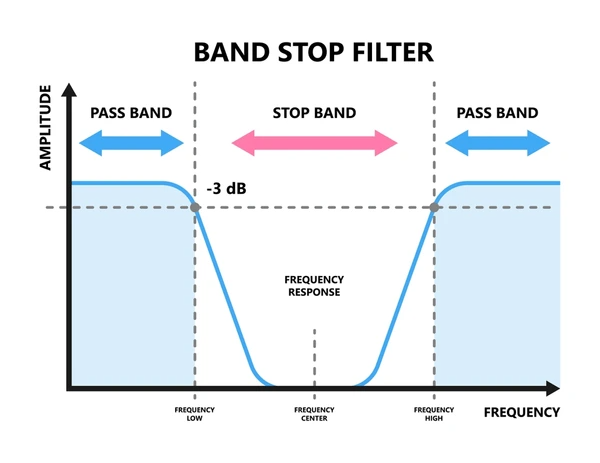
A notch filter is a type of band-stop filter that is an essential electronic component used to selectively remove or attenuate specific frequencies from a signal while allowing other frequencies to pass through with minimal interference. This specialized filter is particularly effective for eliminating unwanted noise or interference in various applications, from audio systems to communication devices. In this article, we will explore how notch filters work, their key features, and their practical applications across different industries.
How a Notch Filter Works
A notch filter works by significantly attenuating a specific frequency, known as the stop band, while maintaining a flat response at all other frequencies. The “notch” represents the deep reduction in the filter’s output at the targeted frequency, making it ideal for removing interference or unwanted signals.
These filters can be implemented in both analog and digital forms, depending on the application. Analog versions achieve frequency rejection using resonant circuits like LC circuits or surface acoustic waves (SAW). Meanwhile, digital filters use techniques like Infinite Impulse Response (IIR) filters to achieve precise frequency targeting. Additionally, the filter’s center frequency can be adjusted to focus on specific frequencies, adding flexibility for various needs.
Notch filters are widely used across industries, including audio systems, RF signal filtering, and optical devices, where eliminating specific interference is critical. Their ability to fine-tune and adapt to different frequencies makes them versatile tools in signal processing.
Components of a Notch Filter Circuit
Band and Frequency Filtering
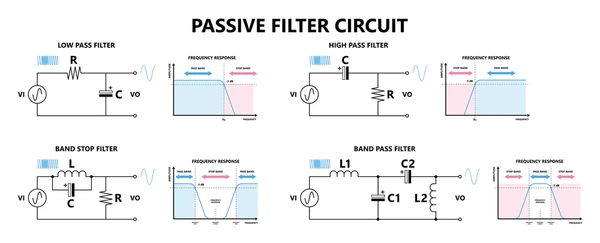
Notch filters typically consist of a band filter to pass useful frequencies and a series-connected element to attenuate a targeted frequency. This combination ensures precise isolation of unwanted signals while preserving desired frequencies.
Surface Acoustic Wave (SAW) Resonators
SAW resonators are widely used in filter designs for their ability to resonate at specific frequencies. This resonance enhances the filter’s ability to create a sharp attenuation at the desired notch frequency.
Tunable Frequency Adjustment
Modern designs incorporate variable capacitors and switches to adjust the filter’s notch frequency, enabling flexible frequency targeting. Additionally, voltage difference transconductance amplifiers (VDTAs) allow for resistor-free voltage-mode operation, simplifying circuit design and improving efficiency.
Performance Enhancements
To improve filter performance, negative resistance circuits are often included to offset losses in inductive components. Meanwhile, multi-branch circuits with adjustable components increase the filter’s ability to isolate specific frequency bands effectively, making them versatile for various applications.
Advantages of Using Notch Filters
Effective Signal Filtering:
Filters excel at isolating specific frequencies while allowing others to pass, improving signal clarity by reducing noise and interference.
Enhanced Safety Features:
In laser protection systems, these filters block harmful wavelengths, safeguarding users from photochemical damage and ensuring eye safety.
Compact and Efficient Design:
Their minimal component requirements and small form factors make filters ideal for integration into space-constrained devices.
Tunability and Flexibility:
Many filters offer adjustable frequency settings, adapting seamlessly to changing signal needs in dynamic environments.
High Precision and Performance:
Advanced designs with multilayer coatings provide steep roll-off and narrow stopbands, ensuring accurate and selective frequency attenuation.
Notch Filter vs. Bandpass Filter: Key Differences
Purpose and Functionality
A notch filter removes a specific frequency or narrow band, leaving other frequencies unaffected. It is ideal for eliminating interference in signals. In contrast, a bandpass filter selects a specific frequency range, allowing only signals within the passband to pass, making it useful for isolating desired frequencies.
Frequency Response
A notch filter sharply attenuates a stopband around its center frequency while maintaining a flat response elsewhere. A bandpass filter peaks at the center frequency, attenuating signals outside its passband.
Applications
Notch filters excel in removing interference in audio processing, communication systems, and biomedical devices. Bandpass filters are widely used in radio receivers, audio equalizers, and spectroscopy to isolate specific frequency ranges.
Design Challenges
Creating a narrow stopband with minimal impact on other frequencies is a challenge for notch filters. For bandpass filters, achieving steep roll-offs outside the passband while ensuring a flat response within requires precision engineering and resonant circuits.
Applications of Notch Filter
Diverse Applications of Advanced Filters
Spectroscopy and Microscopy
Filters play a critical role in removing unwanted spectral components in spectroscopic and multi-photon microscopy applications. By isolating specific wavelengths, they enhance measurement precision and ensure accurate data interpretation.
Laser Safety and Eye Protection
In laser protective gear, these filters reflect or suppress harmful wavelengths, ensuring user safety by blocking dangerous light waves while maintaining visibility in safe spectral regions.
Projection and Head-Up Displays (HUDs)
Filters are essential in HUDs for selectively reflecting or transmitting specific wavelengths. This enables clear projection of information onto transparent screens without disrupting the real-world view.
Plasma Imaging and Microwave Diagnostics
Quasi-optical filters protect imaging arrays from stray radiation in plasma imaging and are equally effective in rejecting unwanted electromagnetic radiation in microwave plasma diagnostics.
Optoelectronic Devices
These filters improve device performance by selectively managing the transmission and reflection of light, ensuring optimal functionality in a wide range of optoelectronic applications.
Sunscreen Technology
Innovative filter coatings in sunscreens reflect specific wavelengths while allowing safe absorption of UV rays. This protects skin from harmful light while maintaining effectiveness against UV exposure.
Electrical and Electronic Systems
Filters enhance sensor accuracy in electrical systems, such as Hall effect sensors, by removing unwanted signal components. This improves sensitivity and ensures reliable system performance.
Application Cases
| Product/Project | Technical Outcomes | Application Scenarios |
|---|---|---|
| Fiber-coupled Fabry-Perot Notch Filter | Provides high-speed tunability with a resonance frequency of 89.9 kHz and a travel distance of 800 nm. Exhibits a free spectral range up to 100 nm and a notch rejection ratio up to 20 dB around 1300 nm wavelength. | Spectroscopy, multi-photon microscopy, fluorescence instrumentation, and optical sensors where tunable notch filtering is required. |
| Quasi-optical Notch Filters | Stacking of multiple filters can provide a notch depth of >60 dB at 140 GHz, with high rejection over an incident angle range of ±8 degrees. | Plasma imaging applications to protect arrays from stray radiation from high-power electron cyclotron resonance heating (ECRH) sources. |
| Multifrequency Notch Filter | Provides several stop bands of defined width within up to two standard waveguide frequency bands, based on photonic bandgaps in corrugated circular waveguides. | Sub-THz applications requiring protection against unwanted radiation, such as stray radiation from high-power electron cyclotron resonance heating in nuclear fusion. |
Latest Technical Innovations in Notch Filter
Radio-Frequency Applications
Modern radio-frequency filters feature compact designs optimized for seamless integration into semiconductor chips. These filters are crucial for receiver-transmitter devices that demand wide frequency coverage and high-speed data transmission. By targeting specific frequency ranges, they effectively reduce interference, enhancing overall signal quality. Advanced designs use precision-tuned resonators and inductors to achieve exceptional attenuation in the desired bands.
Optical Applications
Filters for optical systems provide precise spectral management, essential for hyperspectral imaging and detection. They are engineered to allow specific wavelengths to pass while blocking others across a broad spectral range. Recent developments include tunable filters, which offer adjustable bandwidth and resolution, making them ideal for applications requiring dynamic spectral adjustments. These innovations significantly enhance performance in fields like remote sensing and optical diagnostics.
To get detailed scientific explanations of Notch Filter, try Patsnap Eureka.
