


What Is VXLAN?
VXLAN, or Virtual Extensible LAN, is a network virtualization technology developed to overcome the limitations of traditional VLANs (Virtual Local Area Networks). It provides a scalable and flexible solution, making it ideal for large-scale data center environments. VXLAN allows businesses to efficiently manage networks, enhance data center flexibility, and support the growing demands of modern applications and services. In this article, we explore how VXLAN works, its benefits, and its role in transforming network architecture.
How VXLAN Improves Scalability in Data Centers
- 1. Expanded Address Space
With a 24-bit Segment ID, VXLAN supports up to 16 million unique network identifiers, compared to the 4,096 IDs in VLANs. This increase enables data centers to handle a much larger number of virtual networks, making it ideal for large-scale cloud environments with multiple tenants. - 2. Overlay Architecture
VXLAN operates on an overlay network, allowing it to extend Layer 2 connectivity over Layer 3 networks. This enables seamless communication between virtual machines (VMs) across different physical locations, such as separate data centers. - 3. MAC-in-UDP Encapsulation
By using “MAC in UDP” encapsulation, VXLAN places Layer 2 Ethernet frames within UDP packets. This method not only expands the address space but also improves network traffic routing and segmentation. - 4. Scalability for Large-Scale Deployments
Designed for large-scale data centers, VXLAN can handle thousands of servers, exabytes of storage, and massive amounts of traffic. It supports scalable compute, storage, and network resources, making it perfect for modern data center needs. - 5. Enhanced Network Agility and Flexibility
VXLAN decouples network identity from physical location, offering better network agility. Virtual machines (VMs) can move and migrate across data centers without requiring reconfiguration, reducing downtime and improving flexibility. - 6. Ideal for Multi-Tenant Environments
VXLAN is perfect for environments that require isolation and segmentation. It creates isolated Layer 2 networks within shared infrastructure, ensuring security and compliance for different tenants. - 7. Hardware Acceleration for Efficiency
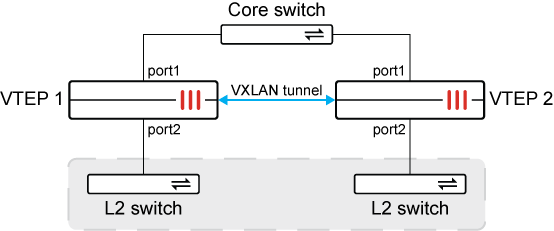
Recent hardware advancements have made VXLAN more efficient. With hardware-accelerated tunnel endpoints (VTEPs), servers can offload processing tasks, improving performance and reducing latency.
Key Features of VXLAN for Multi-Tenant Environments
Expanded Network IDs
This technology supports up to 16 million network identifiers, far surpassing the 4,096 limit of traditional VLANs. This expansion allows for a significantly larger number of virtual networks, making it ideal for large-scale data centers and multi-tenant environments.
Flexible and Scalable Architecture
Designed to accommodate growing server, storage, and traffic demands, the system supports cloud services. It ensures seamless scalability and expansion without limitations.
Overlay Network Model
By encapsulating Layer 2 packets within Layer 3 packets, this technology extends Layer 2 networks across Layer 3 networks, like the internet. It enables smooth communication between geographically separated data centers.
Multi-Tenant Support
In multi-tenant environments, the system provides logical isolation for each tenant. Each tenant is assigned a unique network identifier, ensuring secure and isolated traffic management.

Optimized Resource Utilization
This technology allows for dynamic resource allocation and virtual machine (VM) migration between servers. It enhances resource usage and adds flexibility to data center operations.
Improved Network Performance
By simplifying Layer 2 designs, the system reduces bottlenecks and enhances packet forwarding. The encapsulation method ensures lower latency and more efficient performance.
Integration with Software-Defined Networking (SDN)
The system integrates seamlessly with SDN, providing centralized control and management. It enables agile and automated network provisioning, which is crucial for dynamic, multi-tenant environments.
Hardware Acceleration for Enhanced Efficiency
Hardware-accelerated tunnel endpoints (VTEPs) offload processing from the CPU. This improves traffic throughput and reduces CPU usage, optimizing overall performance.
Standardization and Interoperability
As an industry standard, it is widely supported by vendors, ensuring interoperability across various devices and platforms. This simplifies deployment and management.
VXLAN’s Role in Network Segmentation and Isolation
- Network Segmentation
This technology expands the number of available network identifiers from 4,096 to 16 million by adding a 24-bit segment ID to VLAN tagging. This enables the creation of many more virtual networks within the same physical infrastructure. It’s especially useful for organizations that need to separate environments like development, testing, and production without running out of network IDs. - Network Isolation
One key feature is the ability to provide layer 2 isolation between different segments or tenants. By encapsulating layer 2 Ethernet frames within layer 3 UDP packets, the original addressing information is preserved. This allows the creation of isolated segments within a shared layer 3 network, crucial for multi-tenant data centers. - Scalability and Flexibility
With support for a large number of virtual networks, this technology is highly scalable, making it ideal for large data centers and cloud environments. It offers more flexible network design by enabling overlay networks that span across geographically dispersed data centers while maintaining the same level of segmentation and isolation as traditional VLANs. - Efficiency and Performance
Encapsulating layer 2 frames in layer 3 packets improves efficiency by extending layer 2 networks over layer 3 networks. This setup can enhance network performance, especially in complex environments. Additionally, features like Equal Cost Multi-Path (ECMP) routing enable multiple data paths, balancing the load and improving redundancy for better overall performance.

Practical Applications of VXLAN in Cloud Environments
This technology allows for the creation of isolated networks within a data center, enhancing segmentation and security. It’s especially beneficial in multi-tenant cloud environments, where tenants need isolation while maintaining communication within their own networks.
- VM Mobility and Scalability
A key advantage is supporting VM mobility across data centers without changing IP addresses. Layer 3 encapsulation ensures VMs can move seamlessly between servers and subnets, enhancing flexibility. - Large-Scale Network Deployment
With support for up to 16 million unique identifiers, this solution surpasses the 4,096 limit of traditional VLANs. It’s ideal for large-scale cloud deployments that require numerous virtual networks. - Overlay Network Construction
The technology enables the creation of overlay networks on top of existing Layer 3 networks. This flexibility allows for virtual LANs that span multiple physical networks, improving network design and management. - Improved Network Performance
Using UDP encapsulation, this solution reduces latency and improves network performance compared to traditional VLANs. This is particularly useful in cloud environments, where low latency is essential for optimal performance. - Integration with SDN
Integrating with Software-Defined Networking (SDN) allows for greater control and automation of network resources. This enhances efficiency in managing and optimizing network performance. - Support for IPv6
The technology supports IPv6 networks, improving packet encapsulation efficiency and transmission speed. As cloud environments increasingly adopt IPv6, this support is crucial for scalability and security. - Enhanced Security
By providing better isolation between virtual networks, it enhances security in cloud environments. This isolation helps protect sensitive data and prevent unauthorized access.
Application Cases
| Product/Project | Technical Outcomes | Application Scenarios |
|---|---|---|
| Inspur Cloud Platform Inspur Cisco Network Technology Co., Ltd. | Enables network communication between physical hosts and virtual cloud hosts by establishing external tunnels using VXLAN, and realizes automatic management of physical host access to virtual networks. | Cloud computing environments requiring communication between physical and virtual resources. |
| Huawei CloudEngine Switches Huawei Technologies Co., Ltd. | Improves encapsulation and transmission efficiency in IPv6 networks by carrying tunnel headers within IPv6 headers, addressing inefficiencies of existing VXLAN technologies. | IPv6-based cloud networks requiring efficient VXLAN implementation. |
| Ruijie VXLAN Solution Ruijie Networks Co., Ltd. | Maintains routing table by monitoring capacity and aging cycle of hardware routing table in VTEP, adding items from software routing table in real-time, and updating/deleting routing table items, ensuring communication stability and efficiency in VXLAN networks. | VXLAN-based cloud networks requiring efficient routing table management. |
| Ruijie VXLAN Solution Beijing Star-Net Ruijie Networks Co. Ltd. | Introduces VTEP server and client role interaction for rapid synchronization and verification of VTEP adjacency information, improving network adaptability, reliability, and reducing dependence on underlying network. | VXLAN networks requiring efficient VTEP adjacency learning and configuration. |
| ZTE VXLAN Solution ZTE Corp. | Designs a VXLAN processing device using SR-IOV network cards to convert and process VLAN messages through hardware acceleration, enabling integration of SR-IOV and VXLAN technologies in virtualized cloud environments with high performance. | Virtualized cloud environments requiring high-performance VXLAN networking with SR-IOV support. |
To get detailed scientific explanations of VXLAN, try Patsnap Eureka.
