


Introduction of The Toyota 2JZ-GTE
The Toyota 2JZ-GTE is a legendary inline-6 cylinder engine that was produced from 1991 to 2005. It is part of the JZ family of Toyota engines and was designed for rear-wheel-drive vehicles. This 3.0-litre twin-turbocharged powerplant has achieved an iconic status among automotive enthusiasts worldwide for its robust design, tuning potential, and impressive performance capabilities.
What are the specifications of the Toyota 2JZ-GTE engine? Eureka Technical Q&A provides expert insights into its displacement, turbocharging system, horsepower, and durability, highlighting why it’s a legendary performance engine.

Engine Specifications
- Displacement: 2,997 cc (3.0 litres)
- Bore x Stroke: 86 mm x 86 mm
- Compression Ratio: 8.5:1
- Valvetrain: DOHC, 24 valves
- Fuel System: Sequential twin-turbo
- Maximum Power: 280 PS (276 hp) at 6,200 rpm
- Maximum Torque: 451 Nm (332 lb-ft) at 3,600 rpm
Design and Construction
The 2JZ-GTE features a cast iron cylinder block and aluminium cylinder heads with dual overhead camshafts for each cylinder bank. It employs a cross-flow cylinder head design and a fully counterweighted forged crankshaft. The engine block is reinforced with a semi-closed deck design for added strength and rigidity. Toyota equipped the 2JZ-GTE with sequential twin-turbochargers, one for each cylinder bank, to minimize turbo lag and provide a broad torque curve.
Variants and Applications
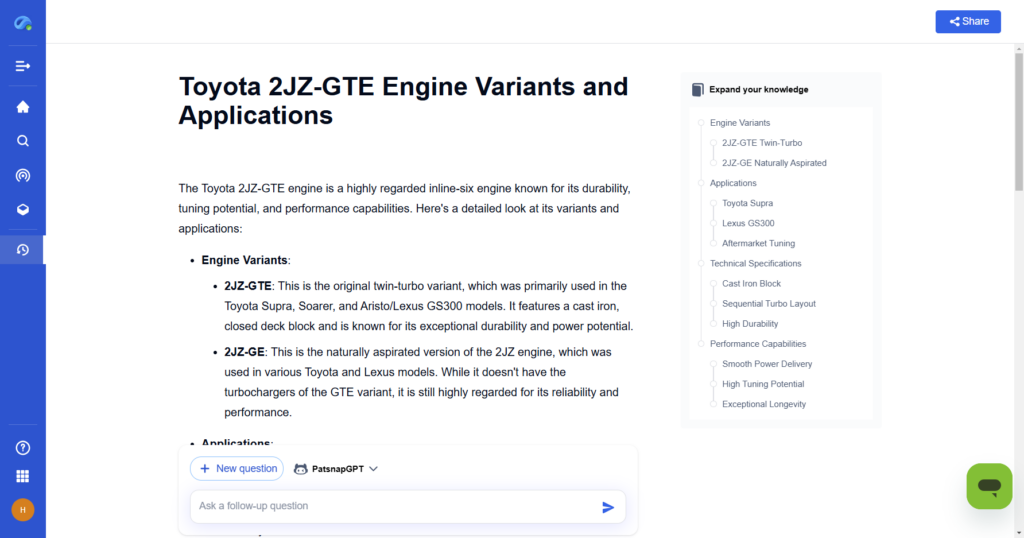
Toyota produced two main variants of the 2JZ-GTE:
- 2JZ-GTE: The original twin-turbo version found in the Toyota Supra, Soarer, and Aristo/Lexus GS300.
- 2JZ-GE: A naturally aspirated version used in the Toyota Crown, Progres, and Brevis.
The 2JZ-GTE was most famously used in the fourth-generation Toyota Supra (JZA80), where it propelled the sports car to legendary status with its potent performance and tuning potential.
What are the variants and applications of the Toyota 2JZ-GTE engine? Eureka Technical Q&A explores its different versions, power outputs, and uses in performance cars, tuning, and motorsports.
Tuning and Aftermarket Support
The 2JZ-GTE has gained immense popularity in the tuning community due to its robust construction and ability to handle significant power increases with proper modifications. Common upgrades include larger turbochargers, upgraded fuel systems, and reinforced internal components. With extensive tuning, the 2JZ-GTE can reliably produce over 1,000 horsepower on high-boost setups.
The aftermarket support for this engine is vast, with numerous companies offering performance parts, tuning solutions, and specialized services. This has contributed to the engine’s longevity and continued relevance among enthusiasts and professional tuners alike.
Legacy and Impact
The Toyota 2JZ-GTE has cemented its place in automotive history as one of the most iconic and revered Japanese performance engines. Its combination of power, reliability, and tuning potential has made it a favorite among drift enthusiasts, drag racers, and high-performance enthusiasts worldwide.
While Toyota discontinued the 2JZ-GTE in 2005, its legacy lives on through the vibrant enthusiast community and the numerous vehicles that continue to be powered by this legendary engine. It remains a benchmark for Japanese engineering excellence and a testament to Toyota’s commitment to producing high-performance powerplants.
Applications of Toyota 2JZ-GTE
| Product/Project | Technical Outcomes | Application Scenarios |
|---|---|---|
| Tesla Autopilot | Using model quantisation techniques, inference speed increased by 4 times, and power consumption reduced by approximately 2 times. | Resource-constrained edge devices, such as in-vehicle systems requiring quick response. |
| Google BERT | Adopting optimised TensorFlow Lite, quantisation and knowledge distillation techniques, latency reduced by around 10 times, model size shrunken to 1/4 of the original size. | Real-time online services, such as search engines that need to process and respond to user queries quickly and accurately. |
| NVIDIA Clara | Leveraging AI and deep learning, it can automatically detect and classify medical images with over 90% accuracy, significantly improving diagnostic efficiency. | Healthcare facilities and medical imaging centres, enabling faster and more accurate diagnosis and treatment planning. |
| OpenAI GPT-3 | Utilising a massive language model with 175 billion parameters, it can generate human-like text, code, and creative content, revolutionising natural language processing. | Content creation, code generation, language translation, and any task involving natural language understanding and generation. |
| DeepMind AlphaFold | Employing advanced machine learning techniques, it can accurately predict the 3D structure of proteins, a long-standing challenge in biology and drug discovery. | Pharmaceutical research, protein engineering, and any field involving the study and manipulation of proteins. |
Technical Challenges of Toyota 2JZ-GTE
| Improving Thermal Efficiency | Enhancing the thermal efficiency of the 2JZ-GTE engine to achieve higher power output and better fuel economy. |
| Reducing Turbo Lag | Minimizing turbo lag in the twin-turbo setup to provide more responsive acceleration and improved drivability. |
| Increasing Reliability and Durability | Strengthening the engine components and design to improve reliability and extend the service life of the 2JZ-GTE. |
| Optimizing Combustion and Emissions | Refining the combustion process and emission control systems to improve performance while meeting stringent emission regulations. |
| Enhancing Tuning Potential | Exploring ways to further unlock the tuning potential of the 2JZ-GTE for aftermarket modifications and performance upgrades. |
To get detailed scientific explanations of the Toyota 2JZ-GTE, try Patsnap Eureka.
