


Traveling at speeds beyond Mach 5 may sound like science fiction, but scramjet engines are making hypersonic flight a reality. Unlike traditional jet engines that rely on rotating parts and compressors, scramjets use air flowing at supersonic speeds to compress and ignite fuel—allowing aircraft to fly faster than ever imagined.
In this article, we’ll break down how scramjet engines work, what makes them different, and why they’re critical for the future of space access and defense systems.
What Is a Scramjet Engine?
What is a scramjet engine? Eureka Technical Q&A explains that a scramjet (Supersonic Combustion Ramjet) engine is an air-breathing propulsion system that operates at hypersonic speeds, using atmospheric oxygen for combustion—ideal for high-speed aerospace applications.

A scramjet (short for Supersonic Combustion Ramjet) is an air-breathing jet engine that operates at hypersonic speeds—typically Mach 5 (3,800 mph or 6,200 km/h) and above. Unlike traditional jet engines or ramjets, scramjets do not slow the incoming air to subsonic speeds for combustion. Instead, they maintain supersonic airflow throughout the engine, enabling efficient operation at extremely high speeds.
Scramjets have no moving parts. They rely entirely on the vehicle’s high velocity to compress incoming air before mixing it with fuel and igniting it.
How a Scramjet Engine Works
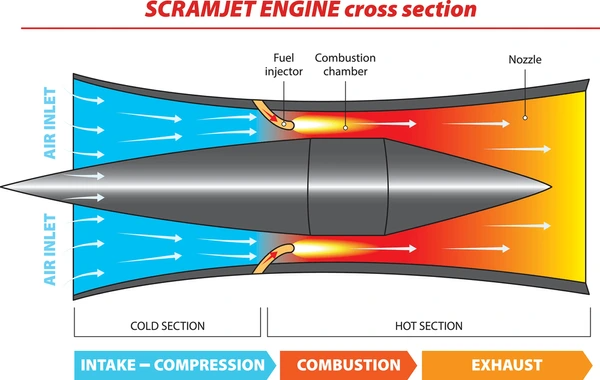
Scramjet operation involves four main stages:
1. Air Intake
At hypersonic speeds, air enters the engine at high pressure. The inlet geometry slows the air slightly while maintaining supersonic velocity.
2. Compression
Instead of using compressors, scramjets use shock waves and the natural compression of air at high speeds to raise pressure and temperature inside the engine.
3. Combustion
Hydrogen or another high-energy fuel is injected into the fast-moving air. Combustion occurs while the airflow remains supersonic, creating high-temperature, high-pressure exhaust gases.
4. Exhaust
The hot gases are expelled through a nozzle, generating forward thrust and propelling the vehicle at speeds ranging from Mach 5 to Mach 15.
Scramjet vs. Ramjet vs. Turbojet

Jet engines use different methods to compress air, burn fuel, and generate thrust. Turbojets, ramjets, and scramjets each operate in unique speed ranges and serve different aerospace needs. Understanding how they work helps explain their roles in modern and future aviation.
Turbojet Engine
- Turbojets work from a complete stop, making them ideal for takeoff and initial acceleration. They can propel aircraft efficiently up to about Mach 3.5, depending on the design.
- These engines include a compressor, combustion chamber, and turbine. The turbine powers the compressor, while the exhaust gases produce thrust.
- Turbojets operate best at subsonic and low-supersonic speeds. Engineers often use them in commercial jets and military aircraft for reliable, all-around performance.
Ramjet Engine
- Ramjets rely on high-speed flight to function. They need the aircraft to move fast enough to compress incoming air without a compressor or turbine.
- The engine includes an inlet, diffuser, combustion chamber, and nozzle. Air enters at high speed, slows down, mixes with fuel, and burns.
- Ramjets perform best at supersonic speeds. Missile systems and high-speed drones often use them for their simplicity and speed-focused design.
Scramjet Engine
- Scramjets operate at hypersonic speeds, above Mach 5. They burn fuel while the air inside remains at supersonic velocity.
- The design includes an inlet, combustion chamber, and nozzle. Unlike ramjets, scramjets allow air to stay supersonic throughout the combustion process.
- Scramjets offer unmatched efficiency at extreme speeds. Engineers are developing them for future spaceplanes and ultra-fast military aircraft.
Key Differences at a Glance
- Turbojets compress air using a mechanical compressor. Ramjets and scramjets rely on the aircraft’s speed to compress air naturally.
- Ramjets burn fuel at subsonic speed inside the engine. Scramjets ignite fuel at supersonic speed, requiring advanced materials and design.
- Turbojets deliver optimal performance below Mach 2. Ramjets peak in the supersonic range, while scramjets excel beyond Mach 5.
| Feature | Turbojet | Ramjet | Scramjet |
|---|---|---|---|
| Speed Range | Subsonic to low supersonic | Mach 3–6 | Mach 5–15 |
| Airflow in Combustion | Subsonic | Subsonic | Supersonic |
| Compression Method | Axial compressors | Inlet shock compression | Inlet + shock compression |
| Moving Parts | Yes | No | No |
| Ignition Requirement | Onboard ignition | Needs initial acceleration | Needs higher-speed launch |
Scramjets require an initial boost to reach hypersonic speeds—typically from a rocket or a turbojet stage—before they become operational.
Why Scramjets Matter
Scramjets offer unique benefits for aerospace and defense applications:
- Hypersonic Speed
They can travel at over 10,000 km/h, enabling flights from New York to London in under an hour or delivering payloads to orbit more efficiently. - Air Breathing
Scramjets use oxygen from the atmosphere, unlike rockets that carry oxidizers. This reduces onboard weight and increases payload capacity. - Simplified Design
With no rotating parts, scramjets can be more compact, lightweight, and potentially more reliable at extreme speeds. - Military Applications
Hypersonic missiles powered by scramjets are harder to detect and intercept, making them strategically valuable.
Challenges and Limitations
While promising, scramjet technology faces several hurdles:
- Launch Requirements
Scramjets cannot operate from a standstill. They need a separate propulsion system to reach at least Mach 4–5 before ignition. - Thermal Management
Air friction at hypersonic speeds generates extreme heat. Developing materials that withstand high temperatures is a major challenge. - Combustion Control
Achieving stable combustion in supersonic airflow is complex. It requires advanced fuel injection and flow control systems. - Short Operational Windows
Due to extreme speed and altitude requirements, scramjets operate efficiently only within specific flight profiles.
Applications of Scramjet Technology
1. Hypersonic Missiles
Scramjets are powering the next generation of defense systems capable of flying faster and with greater precision than current missile technologies.
2. Space Launch Vehicles
Air-breathing scramjets could reduce the cost of launching satellites by replacing some rocket stages with reusable hypersonic vehicles.
3. High-Speed Transport
Though still in the experimental phase, scramjets may one day enable global travel at speeds that make intercontinental flights last under two hours.
Notable Scramjet Programs
- NASA X-43A
The first aircraft to fly at Mach 9.6 using scramjet propulsion in 2004. - Boeing X-51A Waverider
Demonstrated sustained Mach 5+ flight for over 3 minutes in 2013. - India’s HSTDV
DRDO’s scramjet-powered Hypersonic Technology Demonstrator Vehicle achieved a test flight in 2020. - China and Russia
Both nations are actively developing scramjet-powered hypersonic weapons and experimental platforms.
FAQs
Can a scramjet take off from the ground?
No. Scramjets need to be accelerated to hypersonic speeds by another propulsion system before they can operate.
What fuel do scramjets use?
Hydrogen is the most common due to its high energy and fast ignition properties, but other fuels like hydrocarbon-based JP-7 are also being tested.
Are scramjets reusable?
Potentially. Their simple design and air-breathing capability support reusability, especially for space plane concepts.
Why is hypersonic flight important?
It offers faster travel, improved military response times, and the potential for more affordable access to space.
How fast can scramjets go?
Scramjets are designed for speeds between Mach 5 and Mach 15. Beyond that, combustion becomes difficult due to extreme conditions.
Conclusion
Scramjet engines represent a major leap forward in propulsion technology, enabling sustained hypersonic flight without relying on onboard oxygen. Their potential in defense, space exploration, and ultra-fast transportation makes them one of the most exciting frontiers in aerospace engineering. As researchers continue to solve challenges related to combustion, materials, and thermal control, scramjets could soon reshape how we travel across the Earth—and beyond.
To get detailed scientific explanations of Scramjet, try Patsnap Eureka.
