


What is phenolphthalein?
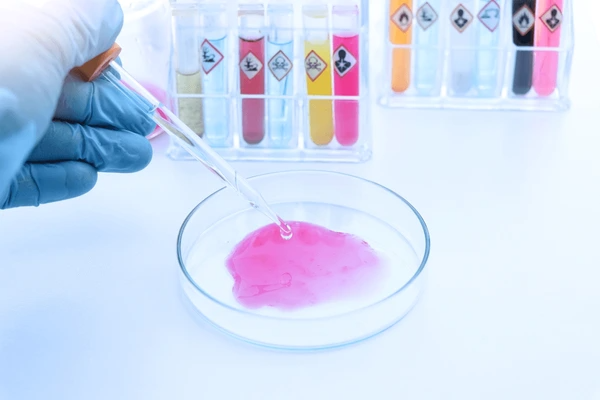
Phenolphthalein, a popular acid-base indicator, shifts from colorless to pink between pH 8.0 and 9.6. This transformation occurs due to hydrogen ion effects on its ionization. Essentially, phenolphthalein exists in two forms: undissociated (HIn) and dissociated (In-), each with distinct colors.
Properties of Phenolphthalein
Physical Properties
- Appearance: White or yellowish-white crystalline powder
- Melting point: 258-262°C (with decomposition)
- Solubility: Practically insoluble in water, soluble in ethanol and dilute alkali solutions
Chemical Properties
- pKa: 9.7 (at 20°C)
- Transition interval: pH range of 8.2-10.0 for color change from colorless to red-violet
- Mechanism: Phenolphthalein exists in a lactone form in acidic solutions, which is colorless. In basic solutions, the lactone ring opens, and the resulting dianionic form exhibits an intense red-violet color.
Synthesis of Phenolphthalein
- Heterogeneous Catalysis: The use of heteropolyacid catalysts supported on porous materials has been investigated. This approach offers advantages such as easy separation, reusability, and reduced waste generation.
- Microwave-Assisted Synthesis: Microwave irradiation has been employed to accelerate the reaction and improve the yield. This method is more energy-efficient and environmentally friendly compared to conventional heating methods.
- Solvent-Free Synthesis: Reactions carried out in the absence of solvents, using techniques like melt condensation or solid-state grinding, have been explored. These methods reduce the use of organic solvents and simplify the purification process.
Applications of Phenolphthalein
Acid-Base Indicator
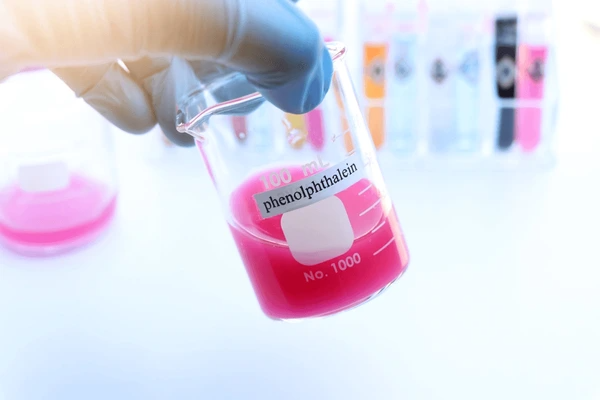
Phenolphthalein is widely used as an acid-base indicator in analytical chemistry. It exhibits a distinct color change from colorless to raspberry-purple in the pH range of 8.3-10.0, making it suitable for titrations involving strong bases.
- Volumetric Analysis: Phenolphthalein shines in acid-base titrations, offering a vivid color change at endpoints for clear, precise results.
- pH Monitoring: In test papers or swabs, phenolphthalein swiftly detects pH shifts in human metabolites and biological samples.
- Natural Alternatives: Explore plant extracts from red amaranth, sweet potato, and flowers as eco-friendly, cost-effective substitutes for synthetic indicators like phenolphthalein.
- 4o mini
Organic Synthesis
Phenolphthalein serves as a versatile starting material for organic synthesis due to its reactive structure.
- Mannich Reaction: Phenolphthalein reacts with formaldehyde and amines to form unique benzoxazines. These compounds offer heat resistance, flame retardance, and low water absorption. Thus, they are valuable in various applications.
- Fluorescent Probes: Fluorescent derivatives of phenolphthalein, including 9-iminopyronin, excel in pH sensing. Moreover, they monitor enzymatic activities in near-neutral to alkaline conditions.
- 4o mini
- pH-Responsive Polymers: Phenolphthalein-based polymers can exhibit pH-responsive behavior, making them suitable for applications like drug delivery, biosensing, and stimuli-responsive materials.
Other Applications
- Color Change Paints: It transforms into vibrant, non-toxic dyes for washable paints, ideal for kids’ use.
- Kinetic Studies: Researchers use spectroscopic techniques to explore phenolphthalein’s color fading in basic solutions, shedding light on reaction kinetics.
- Qualitative Analysis: It reveals the basicity of slightly soluble Arrhenius bases by reacting with stronger bases, shifting pH beyond its color change range.
Application Cases
| Product/Project | Technical Outcomes | Application Scenarios |
|---|---|---|
| Phenolphthalein Test Papers | Rapid and distinct colour change from colourless to raspberry-purple in the pH range of 8.3-10.0, enabling easy detection of alkaline conditions. | Monitoring pH changes in biological samples, human metabolites, and various industrial processes. |
| Phenolphthalein Indicator Solution | Sharp and easily distinguishable colour change at the endpoint, facilitating accurate determination of the equivalence point in acid-base titrations. | Volumetric analysis in analytical chemistry, including strong acid-strong base, strong acid-weak base, weak acid-strong base, and weak acid-weak base titrations. |
| Plant-Based Phenolphthalein Alternatives | Eco-friendly and cost-effective alternatives to synthetic indicators, with similar colour change properties as phenolphthalein. | Sustainable and environmentally-conscious applications in analytical chemistry and pH monitoring. |
| Phenolphthalein-Impregnated Swabs | Rapid and localised detection of pH changes, enabling targeted monitoring and sampling of specific areas or surfaces. | Medical applications, such as monitoring wound healing or detecting infections, and industrial applications, such as monitoring corrosion or leaks. |
| Phenolphthalein-Based pH Sensors | Continuous and real-time monitoring of pH changes, with the potential for integration into automated systems and remote monitoring capabilities. | Industrial processes requiring precise pH control, environmental monitoring, and research applications involving pH measurements. |
Latest innovations of Phenolphthalein
Novel Phenolphthalein Formulations and Synthesis
- Design of quick preparation reagent bottles for its indicator solutions, enabling rapid preparation of specific concentrations based on application needs.
- Synthesis of novel phthalexon compounds with potential use as acid-base indicators in food analysis, such as 3,3′-bis-(N,N’-dimethyl-6-aminopenicillanic acid)phenolsulfophthalein and 5,5′-bis-(N,N’-dimethylanthranilic acid)-3,3′-dichlorophenolsulfophthalein.
- Development of new chemical markers based on mixtures of individual phthaleins, characterized by high secrecy, good transferability, enhanced retention, and reliable identification.
Alternative pH Indicators and Sensing Applications
- A novel pH indicator from Orychophragmus violaceus petals offers an innovative alternative to phenolphthalein in detecting carbonation fronts. Moreover, it features a higher discoloration pH while accurately marking partially carbonated zones in cementitious materials.
- Inkjet-printed sulfonephthalein dye indicator arrays for volatile amine detection, enabling discrimination of various amines related to food spoilage.
- Highly selective flow injection chemiluminescence method for phenolphthalein determination using a molecular imprinting polymer, with a linear range of 1.0 × 10^-8 to 1.0 × 10^-6 g/mL.
Luminescent Markers and Metal Ion Detection
- Phthalamide-lanthanide complexes as luminescent markers, providing probes for detecting and quantifying chemical, biochemical, and biological substances.
- Novel family of fluorescent dyes with fluorescein lactone fluorophores and ionophores for sensitive detection of metal cations, offering improved cellular retention compared to existing indicators.
- New methods utilize fluorophore-labeled compositions to detect galectins, providing enhanced fluorescence imaging for diagnosing and treating galectin-related conditions.
Electroanalytical and Spectroscopic Techniques
- Electroanalytical method for determination of phenol and chlorophenols at unmodified glassy carbon electrodes, overcoming electrode fouling issues and enabling accurate concentration measurements.
- Automated in-situ instrumentation and methodologies for sensitive, precise, and accurate pH measurement of natural waters using spectrophotometry and sulfonephthalein indicators.
- Methods for fluorescence spectroscopic determination of biologically active substances and detection of analytes containing polyamino acids and macromolecules using luminescent markers
Technical Challenges
| Phenolphthalein Indicator Innovations | Developing novel formulations, synthesis methods, and applications for the phenolphthalein indicator to enhance its performance, stability, and versatility in various fields. |
| Novel Phenolphthalein Formulations | Designing quick preparation reagent bottles for rapid and convenient preparation of phenolphthalein indicator solutions with specific concentrations tailored for different applications. |
| Alternative pH Indicators | Exploring natural dye extracts from plant sources as potential replacements for phenolphthalein, offering improved discoloration pH ranges and reduced toxicity for applications in cementitious materials and durability testing. |
| Phenolphthalein Analogues and Derivatives | Synthesizing novel phthalexon compounds and phthalein mixtures as acid-base indicators for food analysis, chemical markers, and other specialized applications, enhancing secrecy, transferability, and identification reliability. |
| Phenolphthalein-based Sensing Applications | Developing inkjet-printed sulfonephthalein dye indicator arrays for volatile amine detection, enabling discrimination of various amines related to food spoilage and intelligent packaging systems. |
Find Out About Common Chemical Compounds and Their Properties
Exploring Sodium Percarbonate: A Comprehensive Guide
Methyl Methacrylate: Properties, Uses, and Innovations Unveiled
Barium Acetate: Essential Uses, Properties and Innovations
To get detailed scientific explanations of the phenolphthalein, try Patsnap Eureka.
