


In the fast-paced world of innovation, companies must move beyond trial-and-error approaches to problem-solving and embrace systematic methods that accelerate creativity and reduce development time. One of the most powerful tools for this is TRIZ—a structured methodology for inventive problem solving that originated in engineering but now spans industries and disciplines.
This article explores what TRIZ is, how it’s applied in engineering and product design, and how tools like PatSnap’s Eureka AI Agent can elevate the entire innovation process by uncovering technical contradictions, validating design directions, and accelerating the discovery of novel solutions.
What Is TRIZ?
TRIZ (pronounced “trees”) stands for the Theory of Inventive Problem Solving. Developed by Genrich Altshuller in the former Soviet Union, TRIZ is a systematic innovation methodology that analyzes patterns of invention in global patent literature to help engineers and designers solve problems more creatively and efficiently.
Rather than relying on brainstorming or intuition, TRIZ offers a structured way to:
- Identify contradictions in technical systems
- Map problems to abstract principles
- Generate innovative solutions based on proven strategies
- Avoid design compromises by resolving conflicts constructively
TRIZ is built on the idea that most engineering problems share common structures, and their solutions often follow repeatable patterns. By studying how thousands of problems have been solved before, TRIZ provides a toolkit for overcoming similar challenges in new contexts.
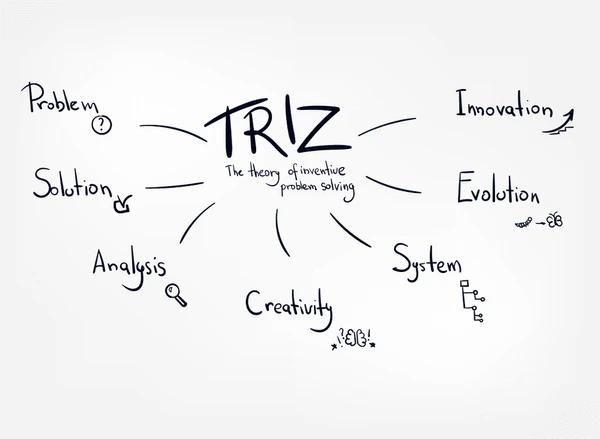
Core Principles of TRIZ
TRIZ is composed of several foundational tools and concepts:
1. Technical Contradictions
These occur when improving one parameter of a system causes another to worsen. For example, increasing engine power might increase fuel consumption.
2. 40 Inventive Principles
These are general strategies—such as segmentation, inversion, or dynamism—that have been used to resolve contradictions in existing technologies.
3. Contradiction Matrix
This tool matches specific engineering parameters with suitable inventive principles to guide solution generation.
4. Physical Contradictions
A situation where a component needs two opposite properties (e.g., a material that should be both hot and cold) is resolved using separation principles.
5. Trends of Technological Evolution
TRIZ identifies predictable patterns in how systems evolve (e.g., increased dynamism, automation, or miniaturization) to guide long-term innovation.
6. Substance-Field Analysis (Su-Field)
A modeling technique used to represent interactions in systems and identify ways to eliminate harmful effects or enhance useful ones.
How TRIZ Is Used in Engineering and Product Design
TRIZ is widely applied in R&D, product development, and process engineering across industries such as:
- Automotive: Solving design conflicts in vehicle dynamics or emissions systems
- Consumer Electronics: Innovating in space-constrained devices or cooling mechanisms
- Aerospace: Improving performance without compromising safety or weight
- Medical Devices: Designing systems with conflicting requirements like flexibility and rigidity
- Manufacturing: Reducing cycle time without sacrificing precision or durability
In product design, TRIZ helps teams identify the root cause of challenges, frame them correctly as contradictions, and then apply inventive principles to discover unconventional solutions—often ones they wouldn’t have thought of otherwise.
Benefits of Applying TRIZ
Using TRIZ leads to numerous advantages:Structured Problem Solving
TRIZ offers a logical and systematic method to tackle complex challenges. It moves beyond trial-and-error approaches.
- Structured Problem Solving
This methodology offers a logical and systematic way to tackle complex challenges. It eliminates guesswork and trial-and-error. - Boosts Creativity and Innovation
It encourages out-of-the-box thinking and helps teams break through mental barriers to generate effective ideas. - Improves Innovation Efficiency
The approach shortens development timelines by guiding focused idea generation and reducing wasted resources. - Applicable Across Disciplines
You can apply its principles in engineering, business, education, and healthcare—making it highly versatile. - Forecasts Technology Trends
The system helps predict how technologies evolve, supporting long-term planning and smarter R&D investment. - Solves Technical Conflicts
It handles contradictions where improving one part affects another, offering tools to resolve such issues innovatively. - Supports Better Decision-Making
A clear framework guides teams through complex problems, enabling more confident and informed choices. - Promotes Collaboration
By encouraging knowledge sharing across teams, it fosters more comprehensive and high-quality solutions. - Saves Time and Reduces Cost
With less trial-and-error, projects move faster and use fewer resources, lowering overall development costs. - Encourages Ongoing Improvement
This mindset promotes continuous innovation, helping organizations stay competitive in dynamic markets.
However, implementing TRIZ effectively requires expertise and often access to broad technical knowledge, data, and examples—which is where AI and intelligent platforms come into play.
How Eureka AI Agent Enhances the TRIZ Methodology

PatSnap’s Eureka Feasibility Analysis AI Agent brings a next-generation layer to TRIZ by automating research, validating technical contradictions, and accelerating inventive solution generation.
1. Automated Problem Framing
Eureka helps identify and define technical contradictions using system models, patent data, and design specifications. For example, in designing a dynamic silencer system with variable chambers, Eureka highlights performance conflicts like noise reduction vs. pressure drop.
2. Real-Time Inventive Principle Mapping
Instead of manually referencing the TRIZ matrix, Eureka maps engineering problems to relevant inventive principles using AI, historical data, and real-world solution cases—saving time and improving accuracy.
3. Contradiction Resolution with Global Insights
Eureka accesses global patent databases and retrieves real-world examples of how industries have solved similar contradictions—delivering proven strategies tailored to your application.
4. Feasibility Validation
Once Eureka identifies a TRIZ-inspired solution, it evaluates material behavior, system dynamics, and real-world constraints to perform feasibility analysis. It ensures your ideas aren’t just creative—they’re technically viable.
5. Innovation Acceleration and Reporting
Eureka compiles insights, contradiction maps, and solution pathways into detailed reports—making it easy for teams to review, collaborate, and iterate faster without missing documentation standards.
TRIZ in Action: A Silencer System Example
Imagine a team designing a multi-level dynamically adjustable silencer. They face the classic TRIZ contradiction: they want large internal chambers to maximize sound attenuation but small, dynamic ones to maintain compactness and control.
Using Eureka, the team identifies this as a contradiction between “volume of moving object” and “system controllability.” The platform suggests inventive principles like:
- Segmentation (dividing chambers into modular zones)
- Dynamism (adjustable cavity shapes)
- Preliminary Action (pre-tuning chambers based on conditions)
Eureka then validates these ideas using technical performance models and material simulations, ensuring that acoustic efficiency doesn’t compromise size or responsiveness.
Best Practices for Applying TRIZ with Eureka
To get the most out of TRIZ and Eureka combined:
- Start with a well-defined technical contradiction
- Use cross-functional teams for better problem framing
- Leverage historical data from patents and prior designs
- Use Eureka to accelerate and validate each TRIZ step
- Document the entire process to support IP creation and knowledge transfer
Conclusion
TRIZ gives engineers and innovators a powerful roadmap to solve technical problems creatively and systematically. When paired with PatSnap’s Eureka Feasibility Analysis AI Agent, TRIZ becomes even more effective—delivering faster problem framing, smarter contradiction resolution, and real-time feasibility validation.
Whether you’re designing a new product, improving a process, or planning long-term R&D strategy, integrating TRIZ with Eureka helps you turn complex challenges into breakthrough innovations—faster, smarter, and with greater confidence.
To get detailed scientific explanations of TRIZ, try Patsnap Eureka.
