

COVERAGE
200M+
Patents across 174 jurisdictions
Search across the global patent landscape with the jurisdictional context IP work requires.

Turn invention, product, and design questions into source-linked patent evidence for review, moving work from weeks of manual search toward minutes.
Trusted by IP and innovation teams worldwide























Eureka turns a patent question into a structured evidence package.
Each search is designed to help teams move from technical input to a review-ready decision.
Turn an invention disclosure into ranked prior art and feature-level evidence. Review source-linked findings before making a filing decision.

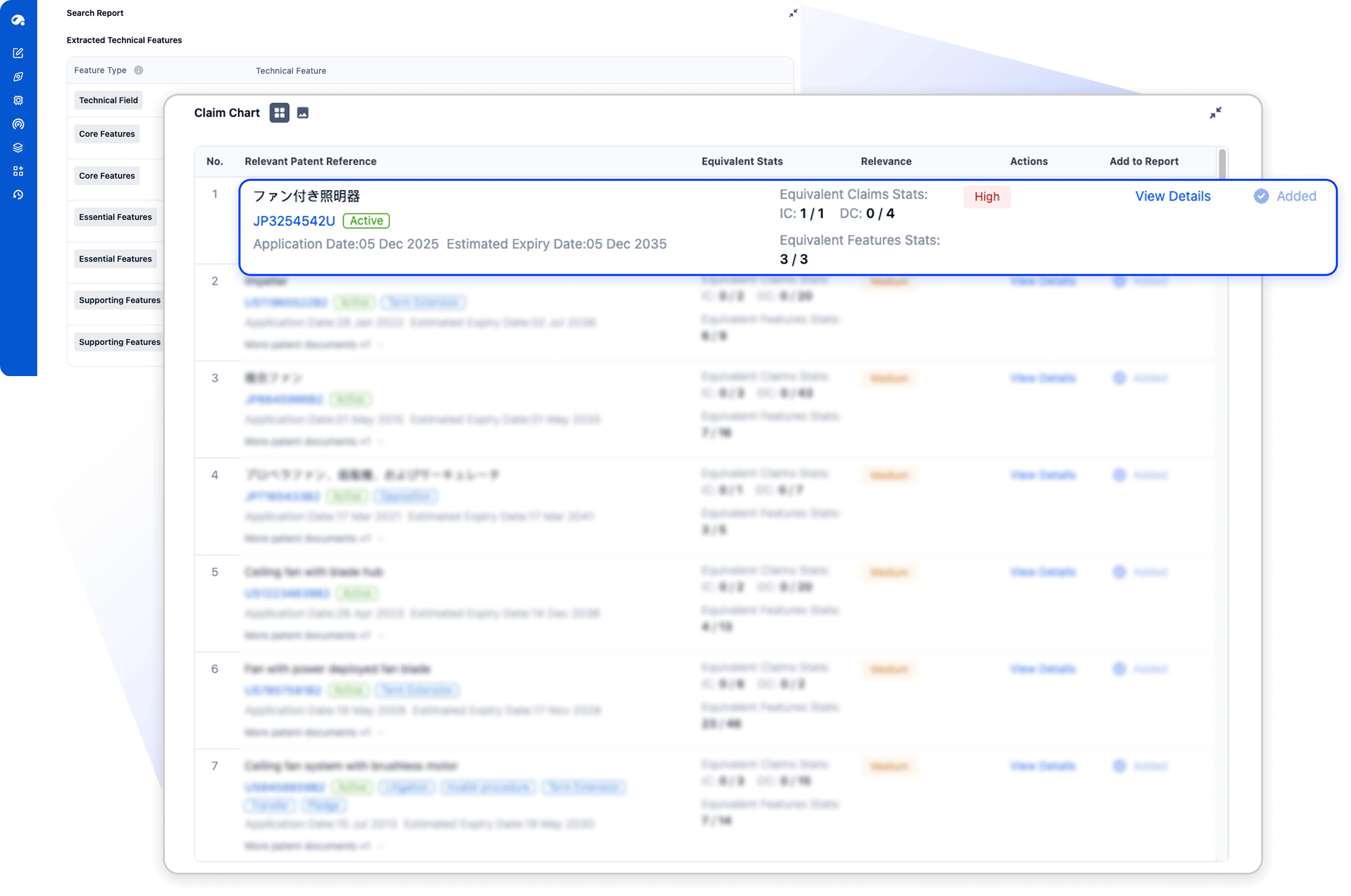
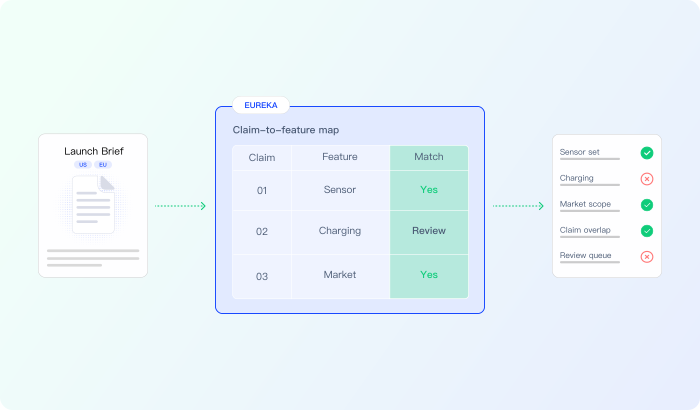
Turn product features and target markets into claim-level evidence with legal-status context. Focus review on potential blockers before launch or expansion.
Compare product appearance with visually similar design registrations. Review visual features and source-linked evidence before manufacturing or release.

Eureka helps teams turn invention, product, and design inputs into structured patent evidence for review.
Turn an invention disclosure into ranked prior art and feature-level evidence, so IP teams can review novelty risk with clearer context.

Translate product scope and target markets into claim-level evidence and legal-status context, helping teams focus review on potential blockers.
Upload product imagery or describe the design. Eureka compares visual features with relevant design registrations and organizes evidence for review.

PatentBench — the first comprehensive benchmark built specifically for patent AI.
COVERAGE
Search across the global patent landscape with the jurisdictional context IP work requires.
NOVELTY SEARCH
Found at least one examiner-cited X document in 81% of 340 test cases.
DESIGN FTO SEARCH
Retrieved the reference high-risk design patent in 77% of 261 test cases.
Scale from a single IP check to continuous IP research
No Credit Card Required
10,000 Trial Credits Included
Typically enough for:
For professionals running IP Search workflows
$400/month · 4-8 IP Search reports
Right for you when one product becomes a product line:
For teams running IP work together…
Right for you when IP checks stop being one person's job:
Patent searches often involve unpublished inventions, product plans, and client-confidential material. Eureka is designed to keep that work protected at every step.
Your queries, saved patents, uploads, and analysis outputs are never used to train our models.
Your data is encrypted at rest and isolated within secure, enterprise–grade infrastructure.
Neither Patsnap employees nor any third party can see your data. Everything is sandboxed to you and your organization alone.
You choose what to upload and when to delete it. SSO, audit logs, and role-based permissions are built for how innovation teams work.



Can't find what you're looking for? Reach out to our team.
A novelty search looks for publicly available information that may be relevant to whether an invention is new before a filing decision. It starts with the technical features that matter, then looks beyond matching titles or abstracts to patents, published applications, and, where relevant, non-patent literature. In Eureka, the agent turns an invention description into search strategies, ranks potentially relevant references, and maps passages back to the disclosed features. The result helps a team prepare for a filing discussion; it does not determine patentability, replace examination by a patent office, or substitute for advice from qualified patent counsel.
A novelty search asks whether the technical idea appears to have been disclosed before, which is useful when evaluating an invention before filing. A freedom-to-operate, or FTO, search asks a different business question: whether a planned product or process could fall within claims that are enforceable in specific target markets. FTO work therefore needs product features, intended jurisdictions, claim analysis, and legal-status context. A positive novelty result does not establish freedom to operate, and owning a patent does not automatically give a company the right to commercialize a product.
No. A granted patent generally gives its owner the right to exclude others from making, using, selling, or importing the claimed invention in the relevant jurisdiction. It does not guarantee that the owner can use or sell a product without encountering another party's rights. A product can include an improvement that is patentable while still relying on technology covered by an earlier, broader patent. Before launch, teams usually need to assess the product as it will actually be made, used, and sold in each target market, then seek qualified legal advice on the relevant risks.
An effective FTO search begins with a defined commercial scenario: the product or process, the features that may matter, the countries or regions involved, and the expected timing of launch. The search should identify potentially relevant patent rights and published applications, then examine the claims and legal-status context rather than relying only on titles, abstracts, or similarity scores. Eureka helps structure this evidence into claim-level comparisons for review. The output is designed to help legal and product teams prioritize questions, but it is not an infringement opinion or a guarantee that no enforceable rights exist.
AI can reduce the time required to structure a search, explore terminology, retrieve potentially relevant documents, and organize evidence for review. It should not replace the professional judgment needed to interpret claim scope, assess legal status, account for jurisdiction-specific rules, or provide legal advice. Eureka is designed for a human-in-the-loop workflow: the agent prepares search strategies and reviewable evidence, while IP professionals decide what is relevant, what requires deeper analysis, and what action to take. This division of work helps teams move faster without treating an AI response as a legal conclusion.
Design-risk review should start with the actual appearance of the product, including the visual features most likely to shape overall impression. Teams should consider the relevant design registrations and applications in the markets where the product will be manufactured, offered, or sold, then review visual similarity in context. Eureka converts product imagery into patent-standard line drawings, retrieves visually similar design registrations, and organizes the visual evidence for review. The output can help surface potential issues before tooling or release, but the final assessment of infringement risk requires qualified legal analysis in the relevant jurisdiction.
Patent searching often begins before an invention, product plan, or design has been made public. Eureka is designed for that context: queries, saved patents, uploads, and analysis outputs are not used to train its models; data is encrypted at rest and isolated within enterprise-grade infrastructure. Users control what they upload and when they delete it, while enterprise teams can use controls such as SSO, audit logs, and role-based permissions. These safeguards support confidential research workflows, but each organization should still apply its own information-governance, access-control, and legal-review policies.
Try expert-grade novelty, FTO, and design patent clearance - free, no credit card required.