Supercharge Your Innovation With Domain-Expert AI Agents!

Gas quenching method using a recycling facility

An air-cooling quenching and gas technology, which is applied in the direction of quenching agent, quenching device, heat treatment equipment, etc., can solve the problems of inability to perform load cooling function and complex equipment, etc., to reduce gas transmission time, recovery time, and recovery cycle time Effect

Inactive Publication Date: 2007-12-05
LAIR LIQUIDE SA POUR LETUDE & LEXPLOITATION DES PROCEDES GEORGES CLAUDE
View PDF6 Cites 0 Cited by
  • Summary
  • Abstract
  • Description
  • Claims
  • Application Information

AI Technical Summary

Problems solved by technology

[0013] - With respect to gas cleaning plants: these generally make the plant more complex; moreover, conventional gas separation plants require either the use of separate compressor plants (see for example document US2002 / 0104589A1), or by running the above mentioned for recompression and transport of the gas compressor (see for example the example of document EP0450050) to compress the gas;
[0014] -Quench chamber out of service: The quench chamber is out of service for a significant portion of its duty cycle due to (limitations of) the recirculation method, making it incapable of performing load cooling functions

Method used

the structure of the environmentally friendly knitted fabric provided by the present invention; figure 2 Flow chart of the yarn wrapping machine for environmentally friendly knitted fabrics and storage devices; image 3 Is the parameter map of the yarn covering machine
View more

Image

Smart Image Click on the blue labels to locate them in the text.
Viewing Examples
Smart Image
  • Gas quenching method using a recycling facility
  • Gas quenching method using a recycling facility
  • Gas quenching method using a recycling facility

Examples

Experimental program
Comparison scheme
Effect test

Embodiment Construction

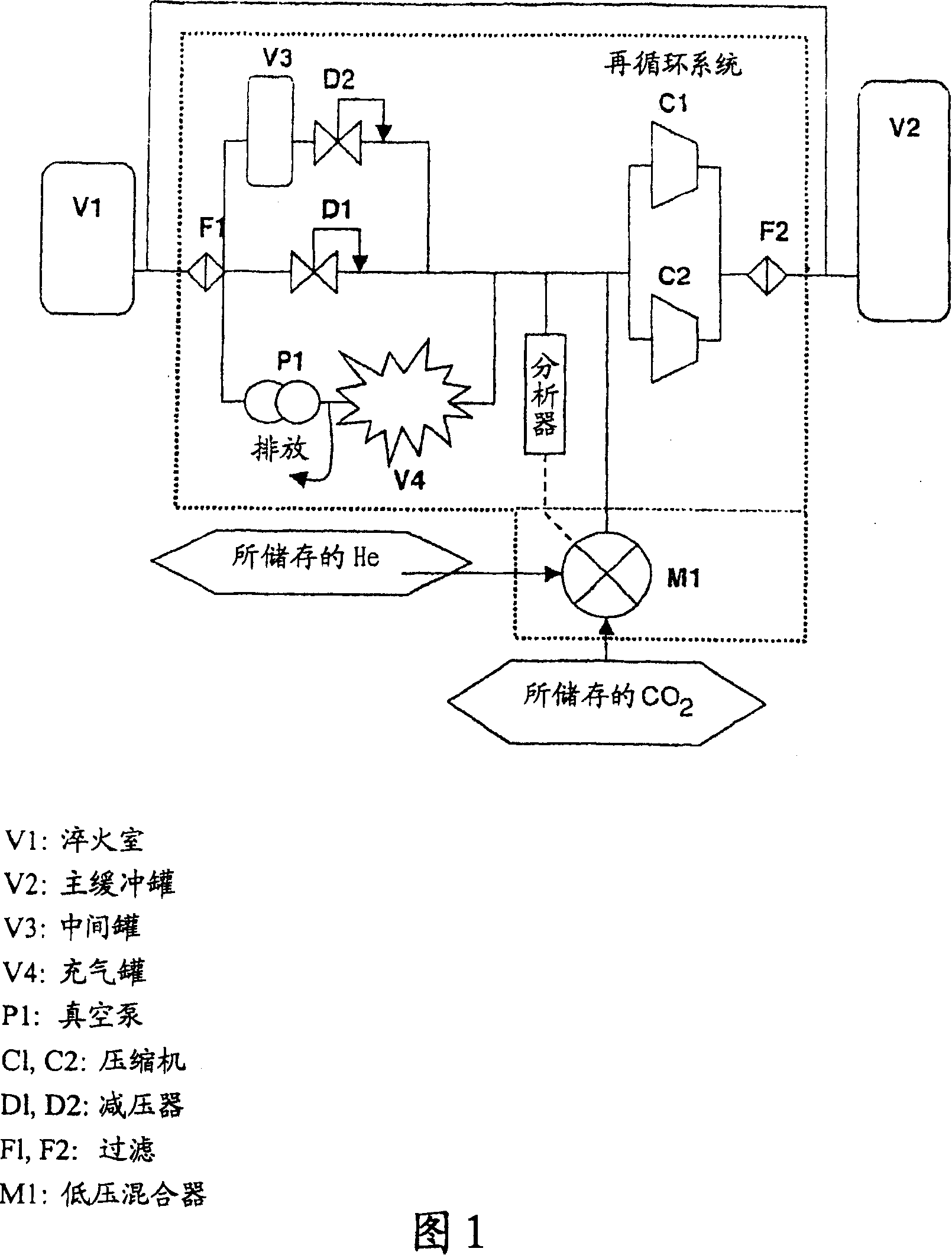
[0070] Figure 1 shows all the components already fully explained and mentioned above, in particular the chamber V1, the buffer tank V2, the piston compressor unit including the two compressors C1 and C2 connected in parallel, for feeding the compressor unit and An intermediate storage tank V3 located on a bypass of the main line, an aeration tank V4 also located on a bypass of the main line, and a vacuum pump P1 outputting to discharge or tank V4.

[0071] The figure shows the vent valve (indicated by the curved discharge arrow) present between the pump and tank V4, which valve is used to vent part of the gas drawn from V1 to atmosphere when required.

[0072] This obviously depends on the expected gas recovery: part is recycled by the method and part is vented to the atmosphere. For example, the gas drawn from V1 can be vented when the pressure in V1 falls below a preset threshold, which can be set as the recovery pressure according to the selected recovery rate.

[0073] As...

the structure of the environmentally friendly knitted fabric provided by the present invention; figure 2 Flow chart of the yarn wrapping machine for environmentally friendly knitted fabrics and storage devices; image 3 Is the parameter map of the yarn covering machine
Login to View More

PUM

No PUM Login to View More

Abstract

The invention relates to a gas quenching method of the type that makes use of (i) a quenching cell (V1) which is intended to receive objects to be quenched with a quenching gas and (ii) a buffer capacity (V2) which is designed to contain the quenching gas. The invention is characterised in that following a quenching operation, all or part of the gas contained in the cell (V1) is recycled in the following manner consisting in: obtaining a first intermediate storage balloon (V3) which can receive the quenching gas from the cell; after a quenching operation, performing one or more operations comprising the partial emptying of the contents of the cell (V1) into the first intermediate storage balloon (V3), by means of partial or total pressure balancing between the two volumes of the cell (V1) and the first intermediate storage balloon; transferring the gas stored in the first intermediate storage balloon (V3) to the buffer capacity (V2); and, if necessary, releasing part of the contents of the cell (V1) into the atmosphere.

Description

technical field [0001] The present invention relates to a method and an apparatus for recycling a gas or gas mixture used in a gas-cooled quenching operation. Background technique [0002] Air-cooled quenching of steels that have been vacuum heat treated (heating before quenching, annealing, stress relieving, etc.) . The gas may include nitrogen, air, argon, helium, or any other industrial gas or gas mixture. [0003] Improvements in rapid steel cooling methods in recent years have mainly involved the use of fluids with better heat transfer characteristics, such as helium and hydrogen, mixtures of inert and lighter gases (N 2 -H 2 , N 2 -He, etc.), and increasing the gas pressure and flow rate in the pressure vessel. At the same time, the quenching chamber technology has been improved: high working pressure, high heat exchange capacity, etc. [0004] Certain noble gases and gas mixtures, such as helium, require the use of a gas recovery system suitable for delivering a...

Claims

the structure of the environmentally friendly knitted fabric provided by the present invention; figure 2 Flow chart of the yarn wrapping machine for environmentally friendly knitted fabrics and storage devices; image 3 Is the parameter map of the yarn covering machine
Login to View More

Application Information

Patent Timeline
no application Login to View More
Patent Type & Authority Patents(China)
IPC IPC(8): C21D1/613C21D1/62
CPCC21D2241/01C21D1/613C21D1/62Y02P10/20C21D1/56
Inventor F·沙福特N·布朗夏尔O·德洛贝尔L·勒菲弗
Owner LAIR LIQUIDE SA POUR LETUDE & LEXPLOITATION DES PROCEDES GEORGES CLAUDE
Features
  • R&D
  • Intellectual Property
  • Life Sciences
  • Materials
  • Tech Scout
Why Patsnap Eureka
  • Unparalleled Data Quality
  • Higher Quality Content
  • 60% Fewer Hallucinations
Social media
Patsnap Eureka Blog
Learn More