Self-adaptive watermark embedding method based on partial quality estimation
A technology for quality evaluation and watermark embedding, applied in instrumentation, calculation, image data processing, etc., can solve problems such as inflexible signal quality and reduced watermark robustness
- Summary
- Abstract
- Description
- Claims
- Application Information
AI Technical Summary
Problems solved by technology
Method used
Image

Examples
Embodiment 1
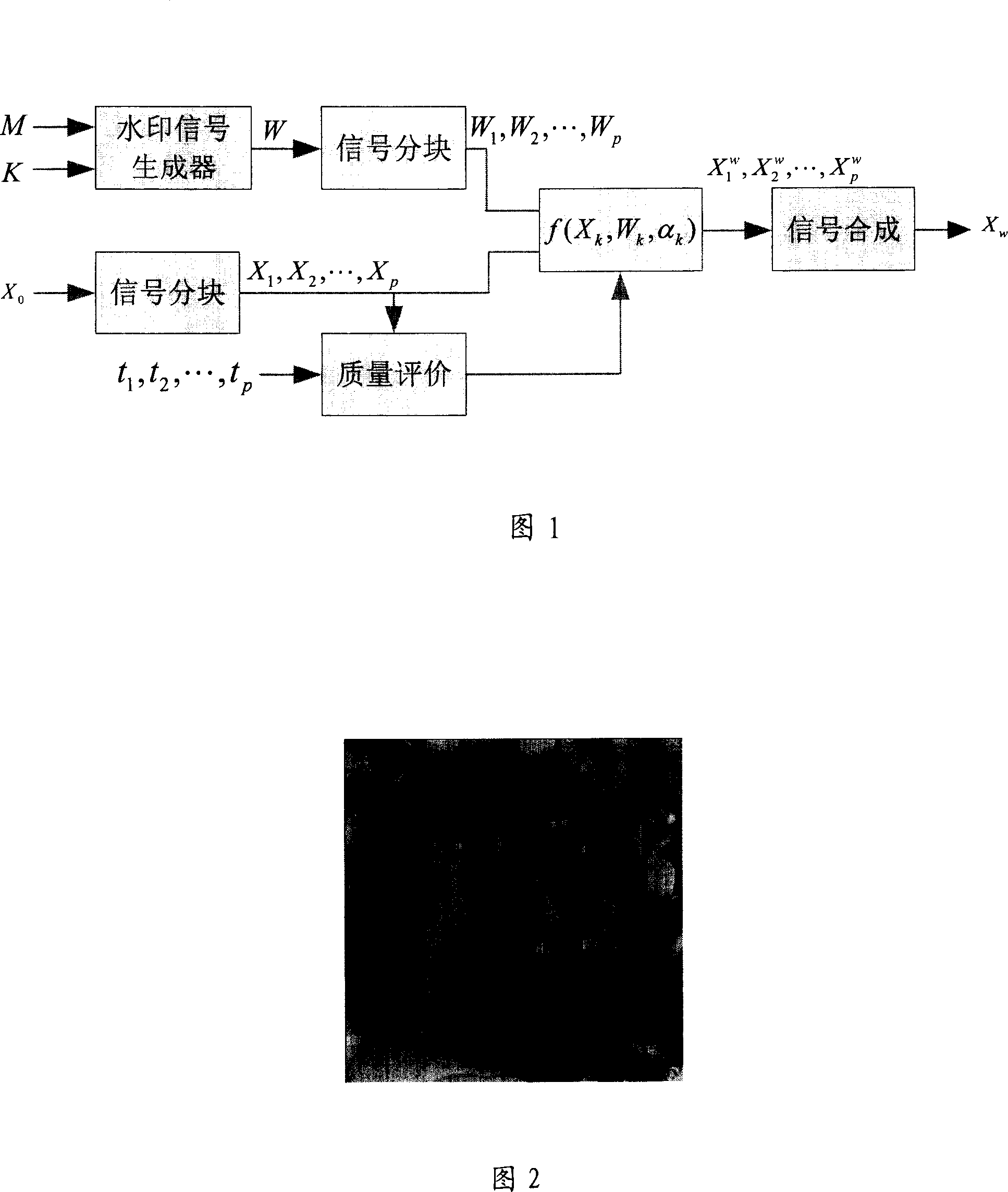
[0049] An adaptive watermark embedding method based on local quality evaluation, comprising the following steps:
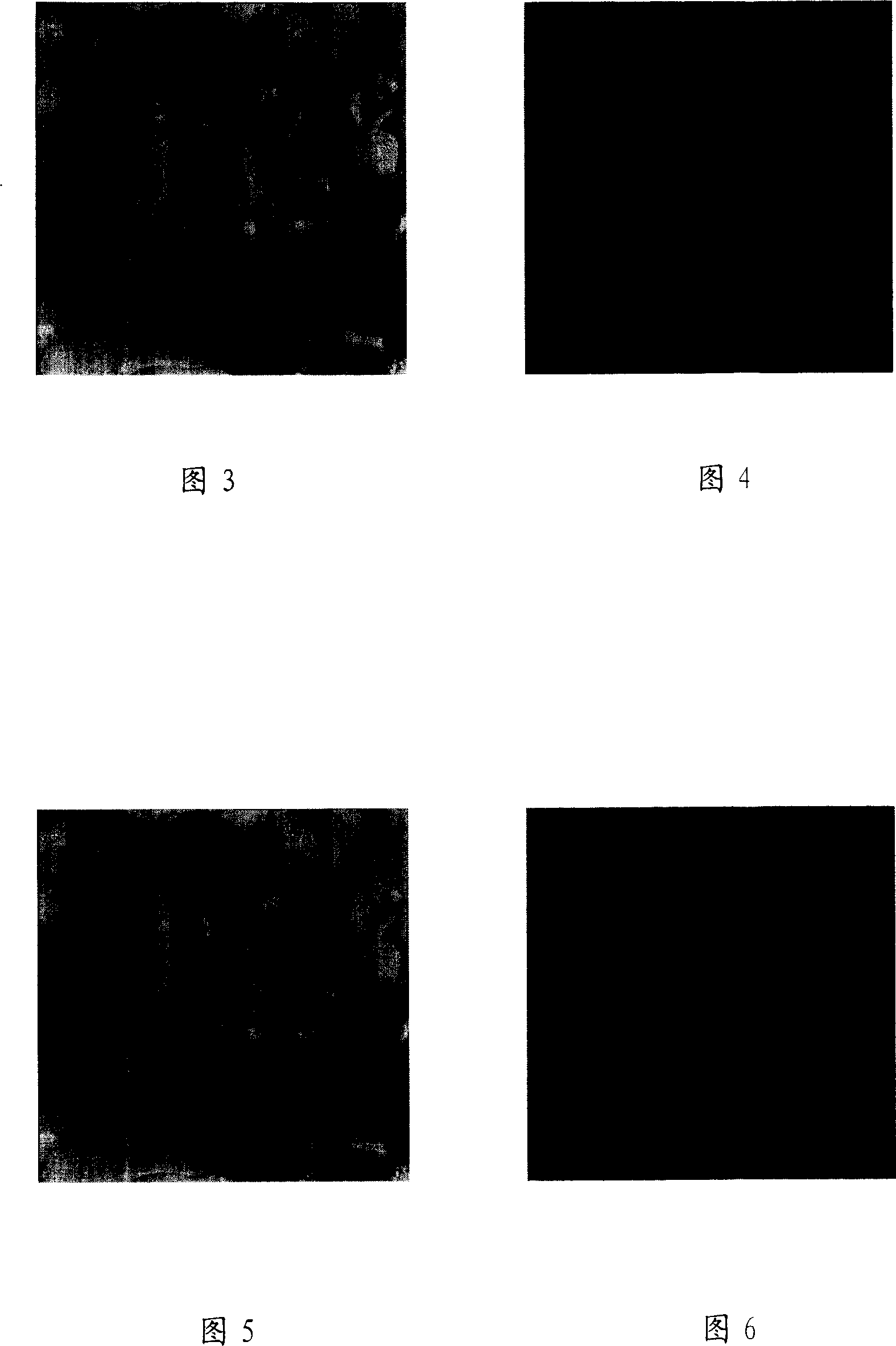
[0050] (1) Suppose the original signal X o ={x ij} M×N is an image, such as the typical "pepper" image in this example. The information M to be embedded is 0 or 1. In this embodiment, a random number generator is used and a large integer K is selected as a seed to generate an independent and identically distributed Gaussian sequence {w ij ) M×N , if M=1, take W={w ij} M×N As a watermark signal, otherwise take W={-w ij} M×N As a watermark signal, it is assumed here that the dimensions of the watermark signal are consistent with the carrier signal without loss of generality. In order to ensure the security of the watermark signal, the key K of the watermark should be absolutely kept secret.
[0051] (2) Next, image X o All pixels in are divided into p non-overlapping blocks according to their spatial positions, denoted as X o =X 1 ‖X 2 ‖...‖X p , for ...
Embodiment 2
[0099] The difference from Example 1 is that
[0100] The original signal X of step (1) o ={x ij} M×N is the inverted frequency coefficient of the "Lena" image transformed by 8×8 block DCT, the size is 240×240, and the information M to be embedded is 0;
[0101] In step (2), the size of the sub-block is 24×24, so the carrier signal and the watermark signal are divided into 10×10 sub-blocks;
[0102] In step (3), the Watson perceptual model based on 8×8 block DCT transform is used to evaluate the local quality of the signal, and the acceptable perceptual quality index t on each block is set 1 = t 2 =...=t p = 0.3.
[0103] In step (4), first use the Watson model to obtain the maximum invisible modifier of each frequency point, denoted as D={d ij} M×N , divide D into 10×10 sub-blocks according to step (2), and record the kth block as D k , then in each subblock X k Embed the corresponding watermark block W k , using the embedding function as follows
[0104] 1≤k≤p ...
PUM
 Login to View More
 Abstract
Description
Claims
Application Information
 Login to View More
 - R&D
- Intellectual Property
- Life Sciences
- Materials
- Tech Scout
- Unparalleled Data Quality
- Higher Quality Content
- 60% Fewer Hallucinations
Browse by: Latest US Patents, China's latest patents, Technical Efficacy Thesaurus, Application Domain, Technology Topic, Popular Technical Reports.
© 2025 PatSnap. All rights reserved.Legal|Privacy policy|Modern Slavery Act Transparency Statement|Sitemap|About US| Contact US: help@patsnap.com