Manufacturing method of high silica red light emitting glass
A manufacturing method and high-silica technology, applied in the field of high-silica glass, can solve problems such as unrealized breakthroughs with practical value
- Summary
- Abstract
- Description
- Claims
- Application Information
AI Technical Summary
Problems solved by technology
Method used
Image

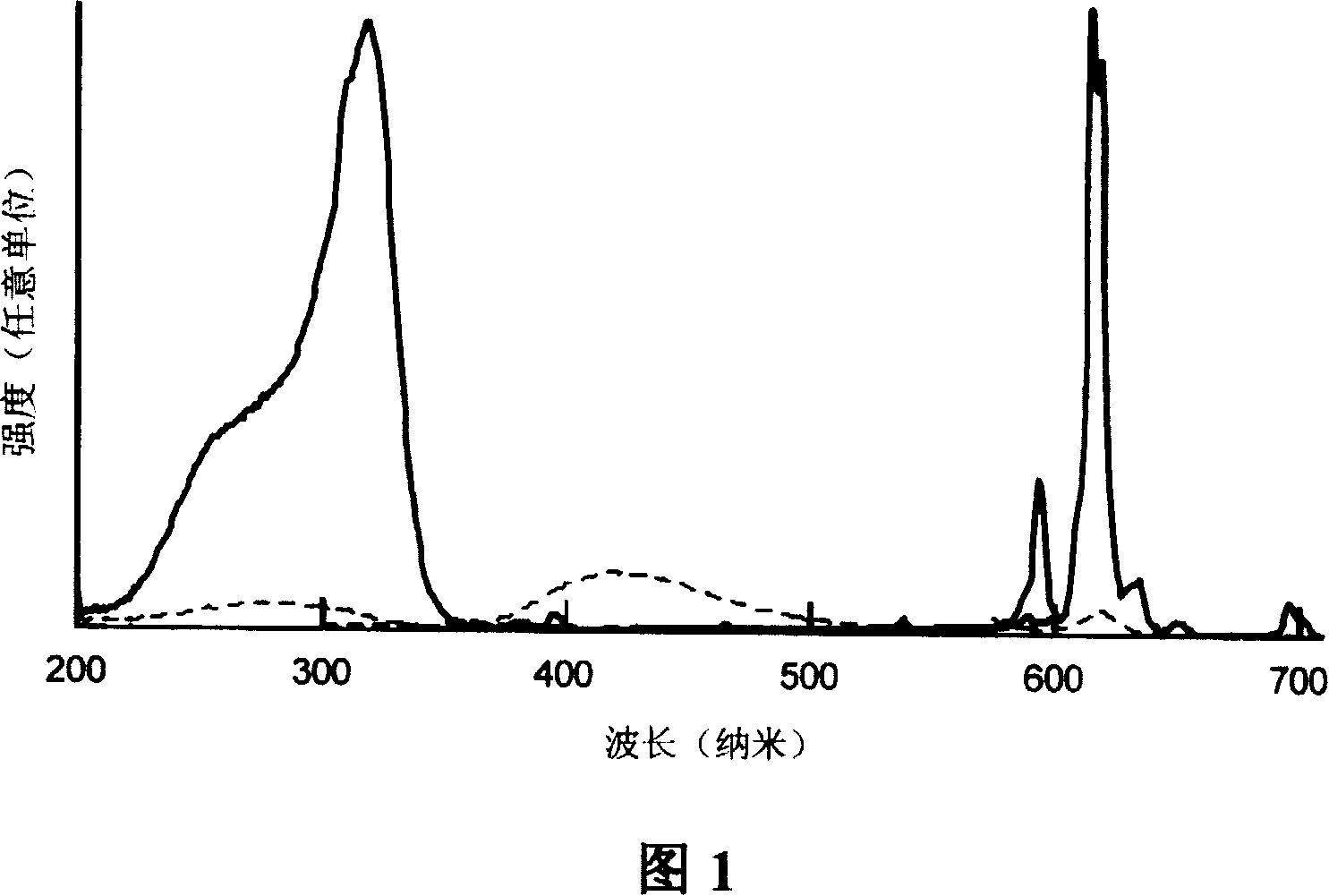
Examples
Embodiment 1
[0017] Will be decomposed equivalent to 0.4g of Eu 2 o 3 1.152g of analytically pure Eu(NO 3 ) 3 9H 2 O and Y equivalent to O.05g after decomposition 2 o 3 0.17g of analytically pure Y (NO 3 ) 3 9H 2 O, equivalent to 0.2g of V after decomposition 2 o 5 0.36g of analytically pure VOSO 4 Put it into 25 ml of 0.5 molar hydrochloric acid solution, after it is completely dissolved, put the SiO 2 The porous glass whose content exceeds 97wt% is soaked in the solution for more than 10 minutes; after that, the high-silica microporous glass doped with these ions is placed in a high-temperature furnace, and undergoes solid-state sintering at 1100°C in oxygen to eliminate Micropores become dense and transparent high-silica glass doped with various oxides at a total concentration of about 0.6%. During the sintering process, after rising from room temperature to 400°C at a speed of less than 5°C per minute, it rises to around 950°C at a speed of 10°C per minute, and then rises f...
Embodiment 2
[0019] Will be decomposed equivalent to 0.05g Eu 2 o 3 0.142g of analytically pure Eu(NO 3 ) 3 9H 2 O and Y equivalent to 0.02g after decomposition 2 o 3 0.07g of analytically pure Y (NO 3 ) 3 9H 2 O, equivalent to 0.03g of V after decomposition 2 o 5 0.05 g of analytically pure VOSO 4 Put it into 25 ml of 0.3 molar hydrochloric acid solution or aqueous solution, after completely dissolving, then put the size of 5 × 5 × 3mm, SiO 2 The porous glass whose content exceeds 96wt% is soaked in the solution for more than 10 minutes; after that, the high-silica microporous glass doped with these ions is put into a high-temperature furnace, and undergoes solid-state sintering at 1150°C in oxygen to eliminate microporous The pores become dense and transparent high-silica glass doped with various oxides at a total concentration of about 0.1%. During the sintering process, after rising from room temperature to 400°C at a speed of less than 5°C per minute, it rises to around 95...
Embodiment 3
[0021] Will be decomposed equivalent to 0.7g of Eu 2 o 3 2.0g of analytically pure Eu(NO 3 ) 3 9H 2 O and Y equivalent to 0.03g after decomposition 2 o 3 0.1g of analytically pure Y (NO 3 ) 3 9H 2 0, equivalent to 0.5g of V after decomposition 2 o 5 0.9 g of analytically pure VOSO 4 Put it into 25 ml of 1.5 molar concentration of sulfuric acid solution, after completely dissolving, then place the size of 5 × 5 × 3mm, SiO 2 The porous glass with a content of more than 98wt% is put into the solution and soaked for more than 10 minutes; after that, the high-silica porous glass doped with these ions is put into a high-temperature furnace, and undergoes solid-phase sintering at 1080°C in oxygen to eliminate micropores. It becomes a dense and transparent high-silica glass doped with various oxides with a total concentration of about 1.2%. During the sintering process, after rising from room temperature to 400°C at a speed of less than 5°C per minute, it rises to around 9...
PUM
| Property | Measurement | Unit |
|---|---|---|
| pore size | aaaaa | aaaaa |
Abstract
Description
Claims
Application Information
 Login to View More
 - R&D
- Intellectual Property
- Life Sciences
- Materials
- Tech Scout
- Unparalleled Data Quality
- Higher Quality Content
- 60% Fewer Hallucinations
Browse by: Latest US Patents, China's latest patents, Technical Efficacy Thesaurus, Application Domain, Technology Topic, Popular Technical Reports.
© 2025 PatSnap. All rights reserved.Legal|Privacy policy|Modern Slavery Act Transparency Statement|Sitemap|About US| Contact US: help@patsnap.com