

Method for terminal user to forward call
A technology for call forwarding and end users, applied in the field of communication
- Summary
- Abstract
- Description
- Claims
- Application Information
AI Technical Summary
Problems solved by technology
Method used
Image

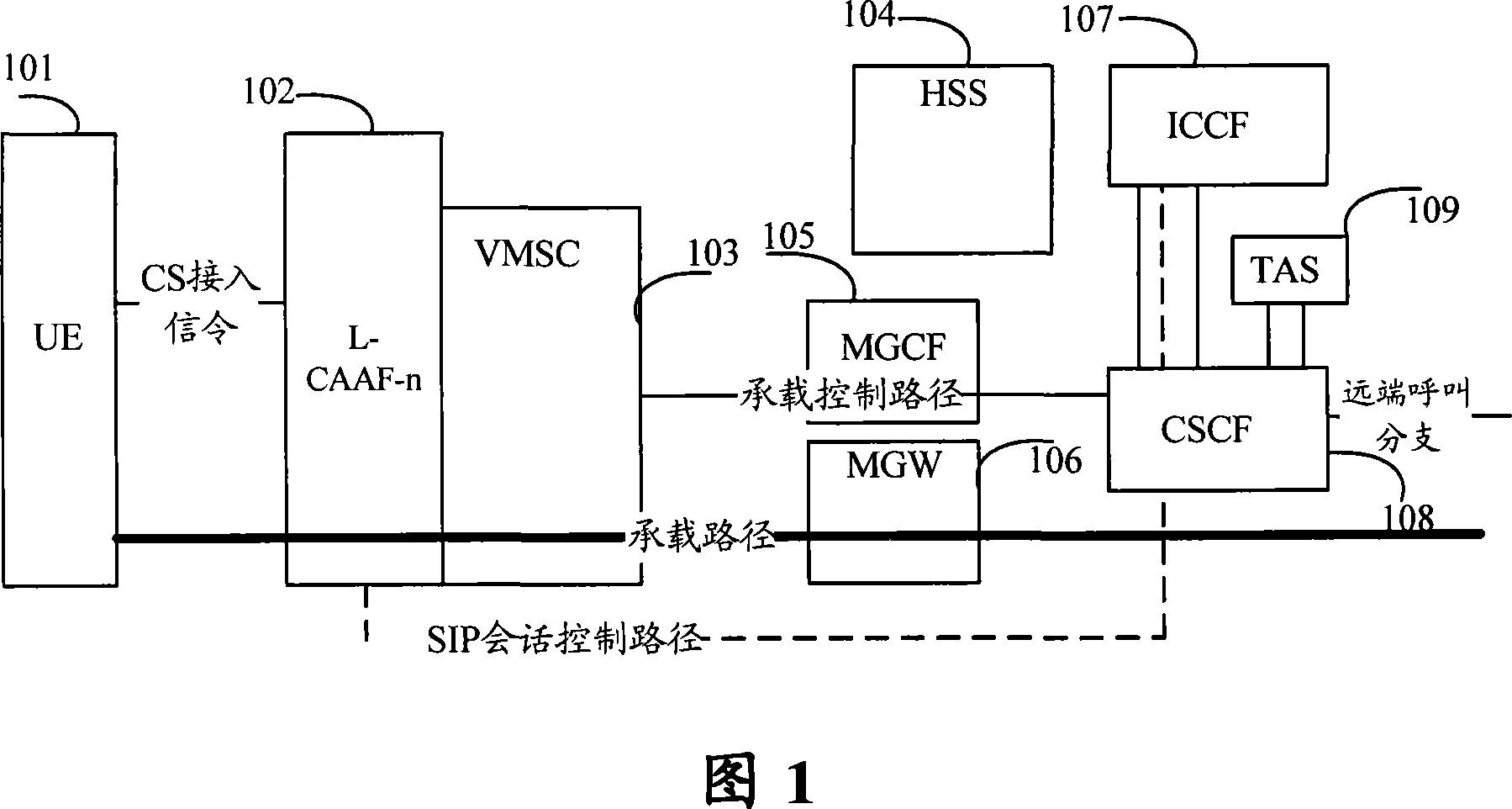


Examples
example 1
[0071] Fig. 5 shows the implementation process of Example 1 of the present invention, wherein the session control is performed by using SIP messages on the CS domain session control path. As shown in Figure 5, specifically include:
[0072] 501-503. The IMS calling user initiates a call to the traditional non-ICS called user B through TAS, CSCF, ICCF, MGCF, VMSC, and L-CAAF-n, and user B starts ringing; (the called process is shown in Figure 2 Steps 201~205, the calling process is shown in steps 301~304 in Fig. 3);
[0073] 504. User B refuses to answer the call because the user is busy, sends an on-hook message carrying the value of the user's determination of the user's busy reason to L-CAAF-n, and releases the media resource;
[0074] 505. The L-CAAF-n converts the on-hook message into a SIP 486 user busy message, and sends the SIP 486 user busy message to the ICCF through the CSCF on the CS domain session control path through the IP bearer channel;
[0075] 506. The ICCF...
example 2
[0082]FIG. 6 shows the implementation process of Example 2 of the present invention, wherein, session control is performed by using SIP messages on the CS domain session control path channel. The difference from Example 1 in FIG. 5 lies in the implementation of the media resource release process. In FIG. 5 , the L-CAAF-n initiates the media resource release process, while in FIG. 6 , the ICCF initiates the media resource release process. Steps 601~607 correspond to steps 501~507 one by one, and the different steps are as follows:
[0083] 608. When the ICCF sends a SIP 486 user busy message to the TAS in step 606, it also sends a SIP CANCEL message to the MGCF to release the session from the ICCF to user B;
[0084] 609. The MGCF converts the SIP CANCEL cancel message into an ISUP release message and sends it to the VMSC, releasing the media resources from the MGCF to the VMSC;
[0085] 610. The VMSC sends a release message to the L-CAAF-n to release the media resources from ...
example 3
[0087] FIG. 7 shows the implementation process of Example 3 of the present invention, wherein session control is performed without using the CS domain session control path channel. This example shows that when the CS domain session control path channel is not used, the user-determined user busy reason value carried when the called user hangs up can be used to notify the ICCF that the user is busy, and the ICCF notifies the TAS to initiate the call forwarding process when the user is busy. As shown in Figure 7, the following processing may be included:
[0088] 701. The CSCF receives the called SIP session request message initiated by the calling side user A to the called side user B, the CSCF routes the session request to the TAS responsible for the call forwarding service, and the TAS routes the called session request message to the ICCF;
[0089] 702. The ICCF obtains the roaming number of user B, and then uses the obtained roaming number to route the SIP session request of ...
PUM
 Login to View More
 Abstract
Description
Claims
Application Information
 Login to View More