Check patentability & draft patents in minutes with Patsnap Eureka AI!

Electrolytes, cells and methods of forming passivaton layers

A technology for electrolytes and batteries, applied in the fields of electrolytes, batteries and the formation of passivation layers

Active Publication Date: 2009-02-25
AIR PROD & CHEM INC
View PDF17 Cites 18 Cited by
  • Summary
  • Abstract
  • Description
  • Claims
  • Application Information

AI Technical Summary

Problems solved by technology

[0013] The present invention solves the problems associated with conventional reversible or rechargeable cells for lithium batteries by providing an electrolyte that produces a suitable SEI layer

Method used

the structure of the environmentally friendly knitted fabric provided by the present invention; figure 2 Flow chart of the yarn wrapping machine for environmentally friendly knitted fabrics and storage devices; image 3 Is the parameter map of the yarn covering machine
View more

Image

Smart Image Click on the blue labels to locate them in the text.
Viewing Examples
Smart Image
  • Electrolytes, cells and methods of forming passivaton layers
  • Electrolytes, cells and methods of forming passivaton layers
  • Electrolytes, cells and methods of forming passivaton layers

Examples

Experimental program
Comparison scheme
Effect test

Embodiment 1

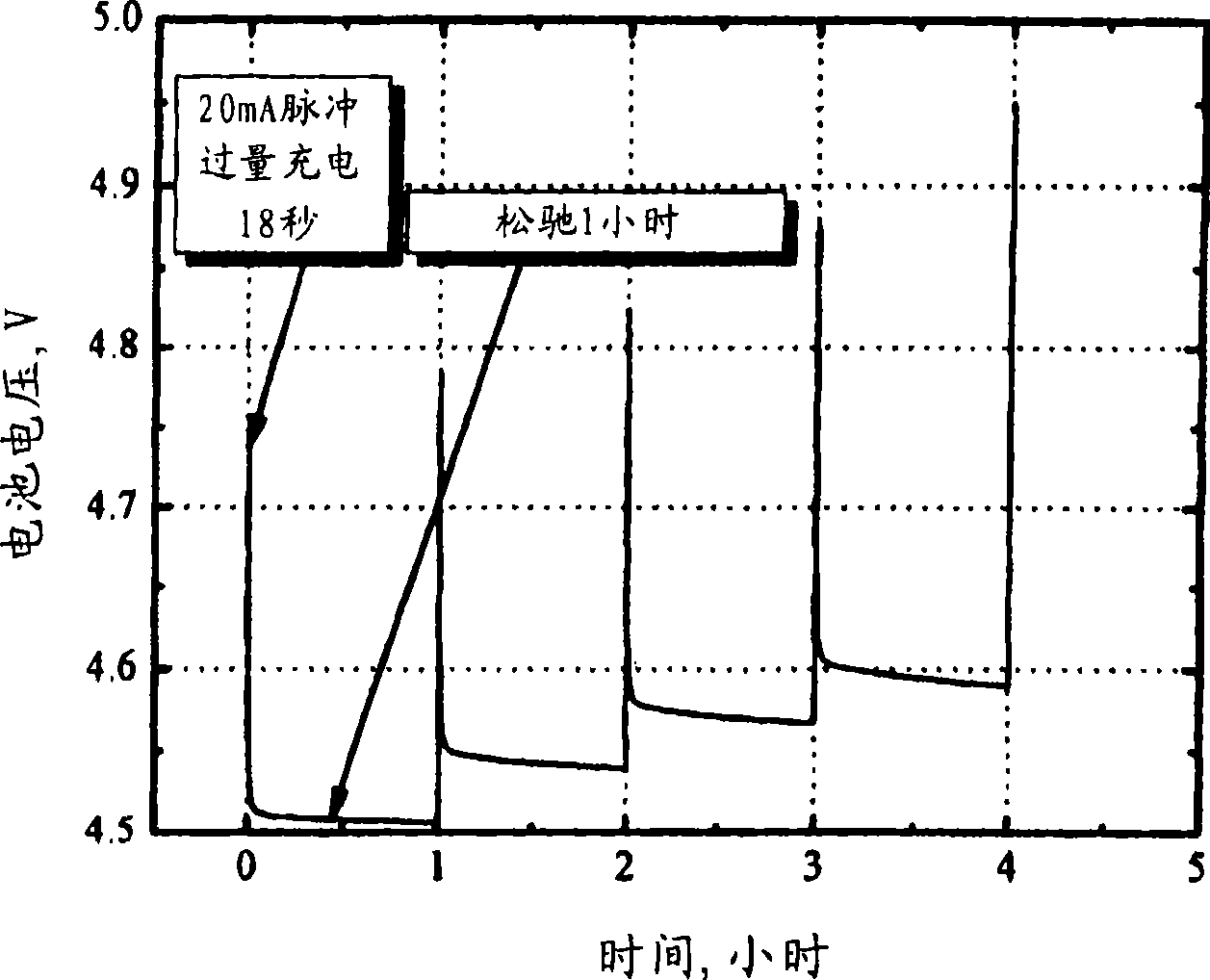
[0055] figure 1 MCMB / Li overcharged by a pulse is shown 1.1 [Mn 1 / 3 Ni 1 / 3 co 1 / 3 ] 0.9 o 2 (L333) The battery voltage of the Li-ion battery. The electrolyte used was 1.2 M LiPF in EC / PC / DMC (1:1:3 by weight, EC for ethylene carbonate, PC for propylene carbonate and DMC for dimethyl carbonate) 6 . The battery was pulse overcharged for 18 seconds every 60 minutes at the 8C rate (20 mA). figure 1 It is clearly shown that the cell voltage increases steadily with the number of pulsed currents applied. In only 4 pulses, the peak voltage of the battery increased to 4.95 V, which was high enough to trigger the decomposition of the positive electrode and anhydrous electrolyte.

Embodiment 1

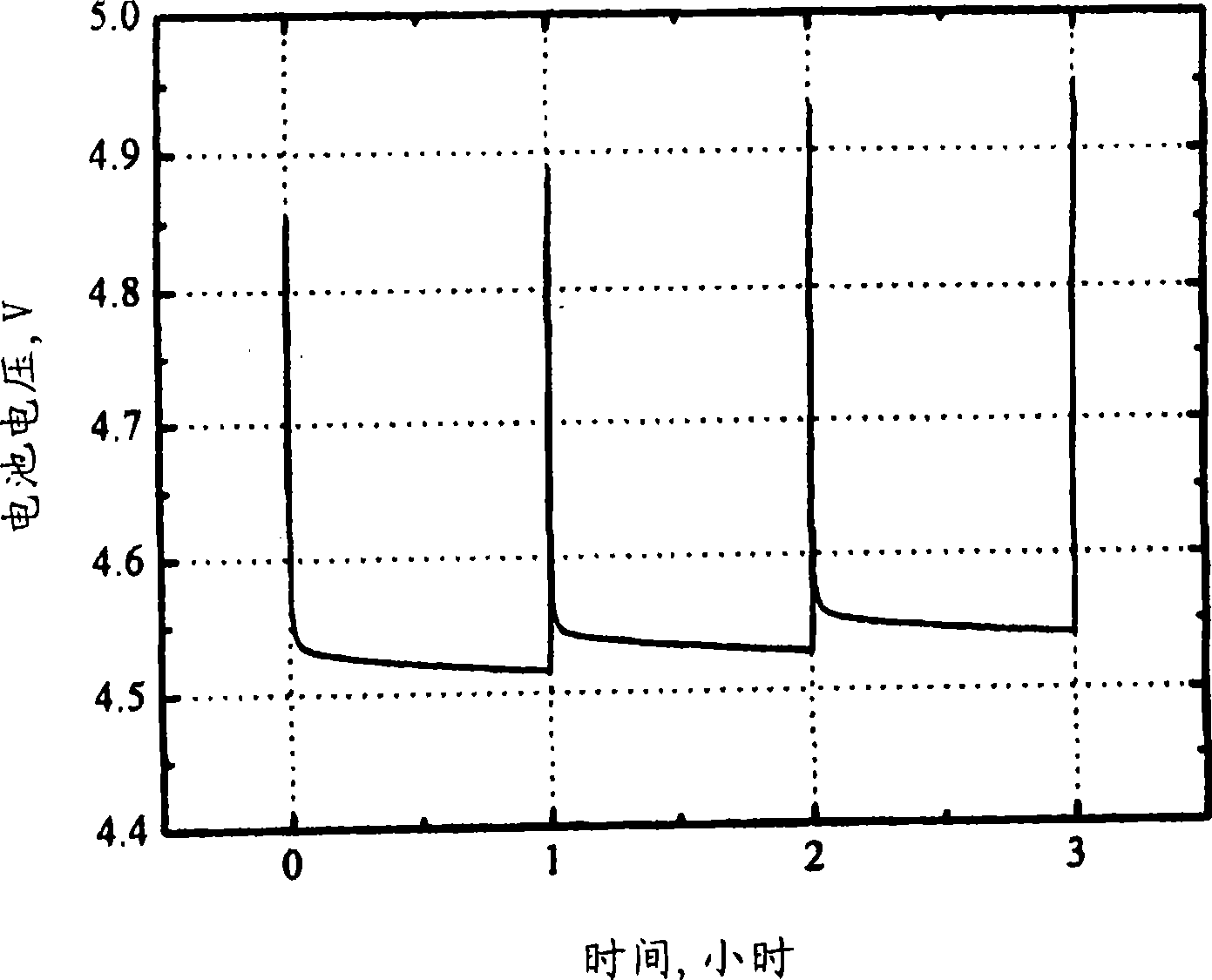
[0056] figure 2 MCMB / Li overcharged by a pulse is shown 1.1 [Mn 1 / 3 Ni 1 / 3 co 1 / 3 ] 0.9 o 2 (L333) The battery voltage of the Li-ion battery. The electrolyte used was 0.8M LiBOB in EC / PC / DMC (1:1:3 by weight). The battery was pulse overcharged for 18 seconds every 60 minutes at the 8C rate (20 mA). figure 2 It is clearly shown that the cell voltage increases steadily with the number of pulsed currents applied. In only 4 pulses, the peak voltage of the battery increased to 4.95 V, which was high enough to trigger the decomposition of the positive electrode and anhydrous electrolyte.

Embodiment 1

the structure of the environmentally friendly knitted fabric provided by the present invention; figure 2 Flow chart of the yarn wrapping machine for environmentally friendly knitted fabrics and storage devices; image 3 Is the parameter map of the yarn covering machine
Login to View More

PUM

No PUM Login to View More

Abstract

An electrolyte comprising at least one organic aprotic solvent, at least one salt and at least one chelatoborate additive. A method of forming an SEI layer in a cell comprising a positive electrode, a negative electrode and an electrolyte, said method comprising the step of overcharging the electrolyte prior to fabricating the cell, or said cell during the formation cycle.

Description

[0001] This application is a continuation-in-part of Application No. 11 / 300287, filed December 15,2005. Application No. 11 / 300287 claims priority over provisional application No. 60 / 642,815, filed January 11,2005. The disclosure of the prior application is hereby incorporated by reference. [0002] Statement Regarding Federally Sponsored Research or Development [0003] The Government has rights in this invention pursuant to Agreement 85N14 between Argonne National Laboratory and Air Products And Chemicals, Inc. Background of the invention [0001] Lithium and lithium-ion secondary batteries, due to the large reduction potential and low molecular weight of elemental lithium, offer enormous improvements in power density over existing primary battery and storage battery technologies. A lithium secondary battery is a battery including metallic lithium as a negative electrode. Lithium-ion batteries contain a lithium-ion host material as a negative electrode. "Battery" means a ...

Claims

the structure of the environmentally friendly knitted fabric provided by the present invention; figure 2 Flow chart of the yarn wrapping machine for environmentally friendly knitted fabrics and storage devices; image 3 Is the parameter map of the yarn covering machine
Login to View More

Application Information

Patent Timeline
no application Login to View More
Patent Type & Authority Applications(China)
IPC IPC(8): H01M10/40H01M6/16H01M4/58H01M4/48H01G11/06H01G11/54H01G11/58H01G11/60H01G11/62H01M4/131H01M4/133H01M4/38H01M4/485H01M4/505H01M4/525H01M4/587H01M10/052H01M10/0525H01M10/0567H01M10/0568H01M10/0569H01M10/36
CPCH01M10/052H01M10/0567H01M10/0568Y02T10/7011Y02E60/122H01M4/133H01M4/131Y02E60/10Y02P70/50H01M10/05H01M4/02H01M4/48H01M4/58
Inventor 陈宗海K·阿迈恩
Owner AIR PROD & CHEM INC
Features
  • R&D
  • Intellectual Property
  • Life Sciences
  • Materials
  • Tech Scout
Why Patsnap Eureka
  • Unparalleled Data Quality
  • Higher Quality Content
  • 60% Fewer Hallucinations
Social media
Patsnap Eureka Blog
Learn More