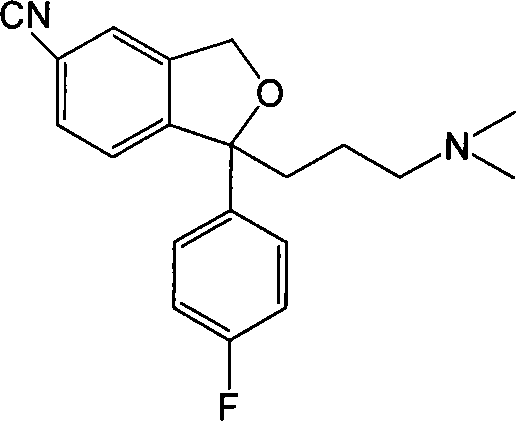
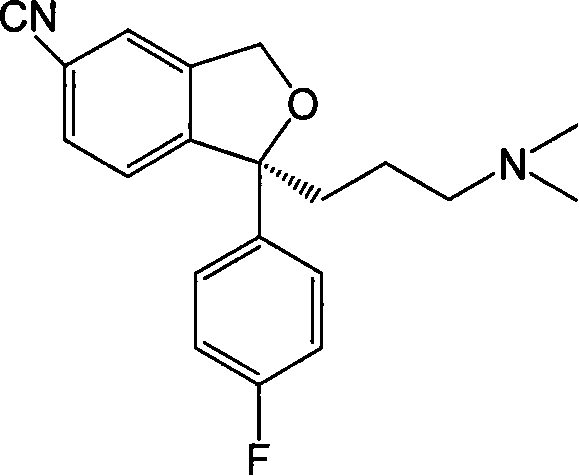
Method for preparing escitalopram
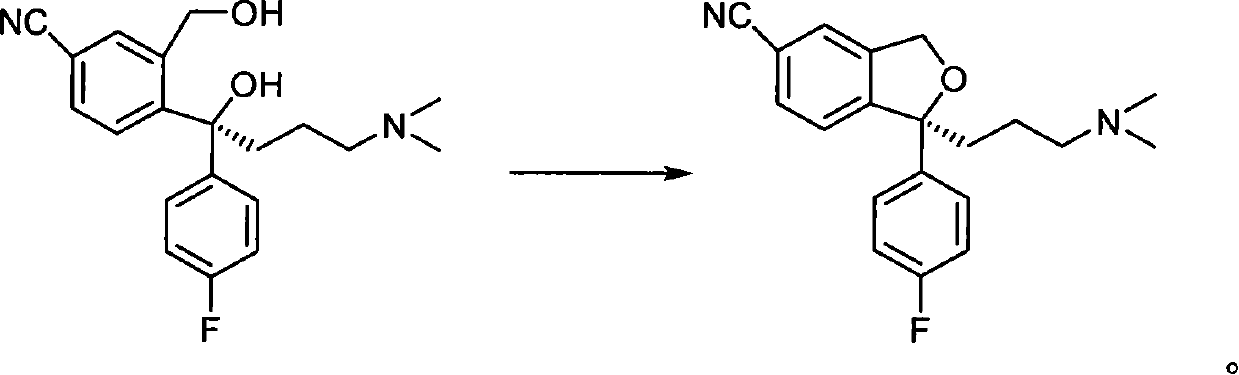
A coordination and phosphine compound technology, which is applied in nervous system diseases, organic chemistry, drug combination, etc., can solve the problems of racemization or isomerization, low yield, etc., and achieve mild conditions, high yield, and optical purity and the effect of high yield
- Summary
- Abstract
- Description
- Claims
- Application Information
AI Technical Summary
Problems solved by technology
Method used
Image

Examples
Embodiment 1
[0030] Example 1 Preparation of Escitalopram
[0031] In the reaction flask under the protection of nitrogen, add S-4-[4-(dimethylamino)-1-(4'-fluorophenyl)-1-hydroxybutyl]-3-(hydroxymethyl)-cyanide Benzene (S-type diol ee value 98.5%) 34.2g (0.1mol), anhydrous tetrahydrofuran 340ml, add triphenylphosphine 57.6g (0.22mol) at room temperature, 98% formic acid 10.2g (0.22mol), Add 44.5 g (0.22 mol) of diisopropyl azodicarboxylate dropwise, and react at room temperature at 20°C. After the reaction is detected by thin-layer chromatography (TLC) (2 hours), evaporate the tetrahydrofuran to dryness under reduced pressure, and add toluene to the remaining oil 200ml, cooled to 0°C and stirred, a large amount of white solids precipitated, suction filtered, added 200ml of 1N dilute hydrochloric acid to the filtrate, stirred, separated, the water layer was washed once with 100ml of ethyl acetate, adjusted to pH=10 with dilute aqueous sodium hydroxide solution, Ethyl acetate was extracted...
Embodiment 2
[0034] Example 2 Preparation of Escitalopram
[0035] In the reaction flask under the protection of nitrogen, add S-4-[4-(dimethylamino)-1-(4'-fluorophenyl)-1-hydroxybutyl]-3-(hydroxymethyl)-cyanide Add 16.7 g (0.22 mol) of trimethylphosphine and 10.2 g (0.22 mol) of 98% formic acid to 34.2 g (0.1 mol) of benzene (S-type diol ee value 98.5%) and 340 ml of anhydrous tetrahydrofuran. Add 44.5 g (0.22 mol) of diisopropyl azodicarboxylate dropwise and react at 30°C. After the reaction is detected by TLC (2 hours), evaporate THF to dryness under reduced pressure and add 200 ml of toluene to the remaining oil. , cooled to 0°C and stirred, a large amount of white solids precipitated, filtered with suction, added 200ml of 1N dilute hydrochloric acid to the filtrate, stirred, and separated, the water layer was washed once with 100ml of ethyl acetate, adjusted to pH=10 with dilute aqueous sodium hydroxide solution, acetic acid Ethyl ester 100ml*3 was extracted, the organic layers were ...
Embodiment 3
[0037] Example 3 Preparation of Escitalopram
[0038]In the reaction flask under the protection of nitrogen, add S-4-[4-(dimethylamino)-1-(4'-fluorophenyl)-1-hydroxybutyl]-3-(hydroxymethyl)-cyanide Add 15.2 g (0.2 mol) of trimethylphosphine and 9.2 g (0.2 mol) of 98% formic acid to 34.2 g (0.1 mol) of benzene (S-type diol ee value 98.5%) and 340 ml of anhydrous tetrahydrofuran. Add 19.2 g (0.2 mol) of diethyl azodicarboxylate dropwise and react at room temperature at 25°C. After the end of the reaction (2 hours) as detected by TLC, evaporate the tetrahydrofuran to dryness under reduced pressure and add 200 ml of toluene to the remaining oil , cooled to 0°C and stirred, a large amount of white solids precipitated, filtered with suction, added 200ml of 1N dilute hydrochloric acid to the filtrate, stirred, and separated, the water layer was washed once with 100ml of ethyl acetate, adjusted to pH=10 with dilute aqueous sodium hydroxide solution, acetic acid Ethyl ester 100ml*3 wa...
PUM
 Login to View More
 Abstract
Description
Claims
Application Information
 Login to View More
 - R&D
- Intellectual Property
- Life Sciences
- Materials
- Tech Scout
- Unparalleled Data Quality
- Higher Quality Content
- 60% Fewer Hallucinations
Browse by: Latest US Patents, China's latest patents, Technical Efficacy Thesaurus, Application Domain, Technology Topic, Popular Technical Reports.
© 2025 PatSnap. All rights reserved.Legal|Privacy policy|Modern Slavery Act Transparency Statement|Sitemap|About US| Contact US: help@patsnap.com