Check patentability & draft patents in minutes with Patsnap Eureka AI!

Device for testing marine anti-pollution materials

A technology for material testing and marine antifouling, applied in the direction of measuring devices, analyzing materials, and adopting mechanical devices, can solve the problems of difficulty in satisfying antifouling material screening, poor universality, limited use, etc., and achieve low cost of testing , Accurate antifouling performance, easy operation effect

Inactive Publication Date: 2014-02-05
DALIAN OCEAN UNIV
View PDF4 Cites 0 Cited by
  • Summary
  • Abstract
  • Description
  • Claims
  • Application Information

AI Technical Summary

Problems solved by technology

In the past, there are mainly two traditional evaluation methods for the antifouling performance of antifouling coatings: one is to indirectly reflect the antifouling performance by measuring the exudation rate of active ingredients in antifouling coatings. The evaluation of antifouling coatings as an antifouling method is not suitable for the evaluation of antifouling coatings that use the special properties of the coating surface as an antifouling method. Therefore, the use of this method is limited and its universality is poor; The docks and others have established experimental bases to directly evaluate the antifouling performance of the actual sea-hanging panels (antifouling coating test panels). This method has a long experimental period and high risks; the above two traditional evaluation methods are difficult to meet the initial screening of antifouling material development Merit job
For this reason, at present, indoor biological methods are used to evaluate the effectiveness and sustainability of antifouling coatings and their main components (antifouling agents, functional resins), but they only test the ion leakage of antifouling coatings in a static state. rate, antibacterial activity and amount of fouling organisms, it is difficult to comprehensively and accurately evaluate the surface antifouling performance of antifouling materials

Method used

the structure of the environmentally friendly knitted fabric provided by the present invention; figure 2 Flow chart of the yarn wrapping machine for environmentally friendly knitted fabrics and storage devices; image 3 Is the parameter map of the yarn covering machine
View more

Image

Smart Image Click on the blue labels to locate them in the text.
Viewing Examples
Smart Image
  • Device for testing marine anti-pollution materials
  • Device for testing marine anti-pollution materials
  • Device for testing marine anti-pollution materials

Examples

Experimental program
Comparison scheme
Effect test

Embodiment 1

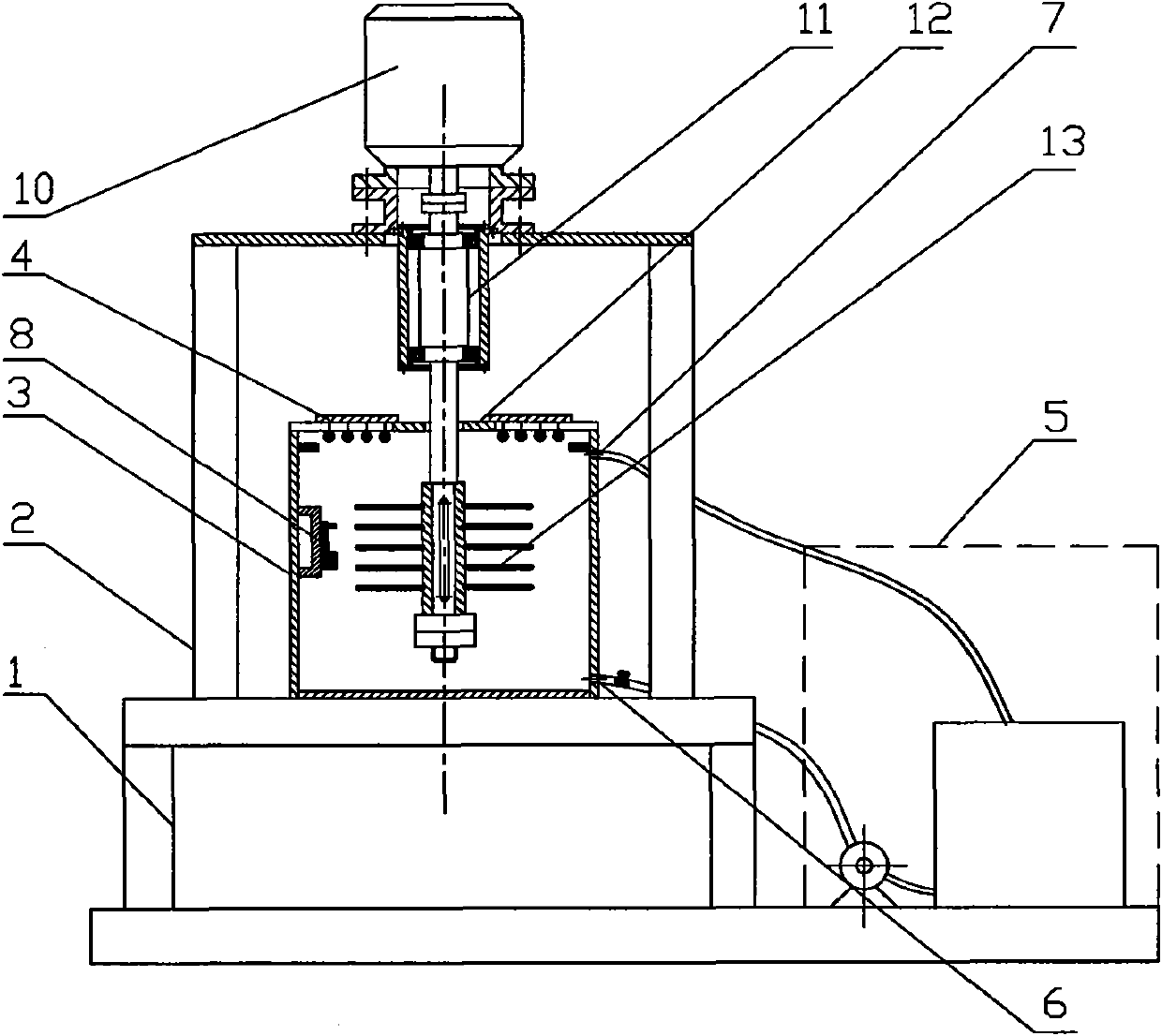
[0020] Such as figure 1 As shown: a base 1 is provided, on which a bracket 2 and a container 3 are fixed, and the container 3 is provided with an illumination system 4 and a seawater inlet 6 and a seawater outlet 7 connected with the seawater circulation device 5, and the A pressure sensor 8 is fixed on the inner wall of the container 3; a power transmission mechanism 10 is fixed on the bracket 2 at the upper end of the container 3, and the power transmission mechanism 10 is connected with a transmission shaft 11, and the transmission shaft 11 passes through the top cover on the container 3 12 joins with the stirring rotor 13 that is positioned at container 3.

[0021] The base 1 is welded by 40×40 square steel, the material is corrosion-resistant stainless steel, and a stainless steel plate is added on it.

[0022] The support 2 is welded by four uprights, and the material is corrosion-resistant stainless steel, which is evenly distributed on the base 1, and the support is c...

Embodiment 2

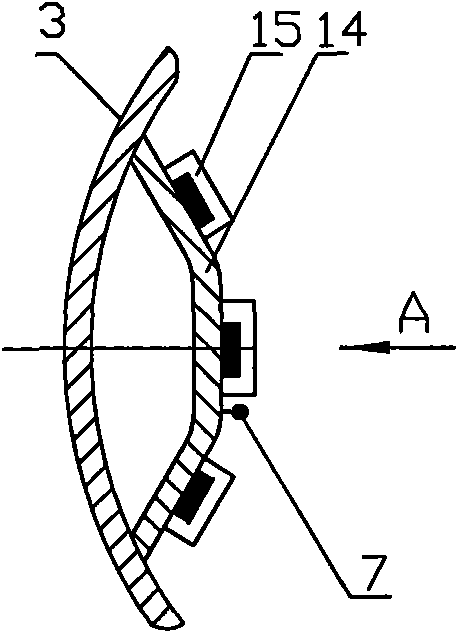
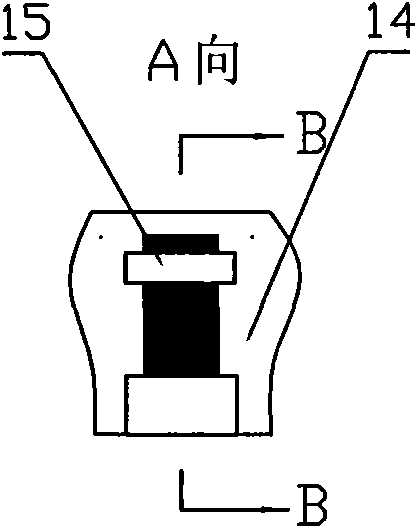
[0030] Basic structure is as embodiment 1, and difference is as figure 2 , image 3 , Figure 4 As shown: the container 3 is provided with a raised plate 14 made of anti-corrosion polytetrafluoroethylene plate whose two sides are connected to the busbar of the inner wall of the container 3, and which protrudes toward the center in the middle, whose shape imitates the streamlined structure of the ship hull , in order to facilitate the fixation of the test piece, the raised plate 14 is bonded by three vinyl plates along the circumferential direction, the included angle is 120°, and the joints are all transitioned by arcs, respectively simulating the bow, stern and middle part of the hull ; Each plate is provided with a test piece fixing frame 15, so that the test piece is respectively fixed on three surfaces, the two test pieces before and after the experiment are washed by seawater, and the middle test piece is cut with seawater, so that different parts of the ship can be tes...

Embodiment 3

[0032] Basic structure can be with embodiment 1 or embodiment 2, and difference is as Figure 5 As shown: the container 3 is cylindrical, and the top cover 12 is formed by splicing two semicircles, with a shaft hole in the middle, and the outer edges of the two semicircles are provided with card slots 16, and the upper side of the container 3 is placed in the card slots 16, to prevent the top cover 12 from slipping off the container 3.

the structure of the environmentally friendly knitted fabric provided by the present invention; figure 2 Flow chart of the yarn wrapping machine for environmentally friendly knitted fabrics and storage devices; image 3 Is the parameter map of the yarn covering machine
Login to View More

PUM

No PUM Login to View More

Abstract

The invention discloses a device for testing marine anti-pollution materials, which has simple structure, easy operation and low testing cost and can test and analyze fouling organisms in static and dynamic states so as to thoroughly and accurately evaluate the anti-pollution performance of the surfaces of the materials. The device comprises a base (1), wherein a bracket (2) and a container (3) are fixed on the base (1), the container (3) is provided with an illumination system (4) and a seawater inlet (6) and a seawater outlet (7) which are connected with a seawater circulating device (5), and a pressure sensor (8) is fixed on the inner wall of the container (3); the bracket (2) at the upper end of the container (3) is fixed with a power transmission mechanism (10) which is connected with a transmission shaft (11), and the transmission shaft (11) is connected with a stirring rotor (13) in the container (3) after passing through a top cap (12) on the container (3).

Description

Technical field: [0001] The invention relates to a testing device for marine antifouling materials, in particular to a device with simple structure, easy operation, low testing cost, capable of testing and analyzing the attachment of marine fouling organisms in both static and dynamic states, so as to comprehensively and accurately evaluate A marine antifouling material testing device for the antifouling performance of the material surface. Background technique: [0002] In the development and utilization of marine resources, the corrosion of seawater and the fouling of marine organisms have always been two major problems faced by human beings. Marine fouling organisms, also known as marine fouling organisms, are a general term for animals, plants, and microorganisms that grow on the surface of marine underwater facilities such as ships, such as barnacles, algae, fungi, and shellfish. The attachment of marine organisms will increase the sailing resistance of the ship, block...

Claims

the structure of the environmentally friendly knitted fabric provided by the present invention; figure 2 Flow chart of the yarn wrapping machine for environmentally friendly knitted fabrics and storage devices; image 3 Is the parameter map of the yarn covering machine
Login to View More

Application Information

Patent Timeline
no application Login to View More
Patent Type & Authority Patents(China)
IPC IPC(8): G01N33/00G01N19/04
Inventor 蔡卫国迟建卫汪静
Owner DALIAN OCEAN UNIV
Features
  • R&D
  • Intellectual Property
  • Life Sciences
  • Materials
  • Tech Scout
Why Patsnap Eureka
  • Unparalleled Data Quality
  • Higher Quality Content
  • 60% Fewer Hallucinations
Social media
Patsnap Eureka Blog
Learn More