Check patentability & draft patents in minutes with Patsnap Eureka AI!

Method for recycling waste acid and waste residues in production of herbicide oxadiazon

A technology for oxadiazon and herbicides, which is applied in the field of recycling and utilization of waste acid residues in the production of herbicide oxadiazon, can solve problems such as the decline in the production profit of the original oxadiazone, and achieves reduction of production costs and environmental protection and energy consumption. , the effect of simple operation

Active Publication Date: 2012-09-26
HEFEI XINGYU CHEM
View PDF5 Cites 0 Cited by
  • Summary
  • Abstract
  • Description
  • Claims
  • Application Information

AI Technical Summary

Problems solved by technology

However, with the recovery of the economy, the recovery of oxadiazone production and the entry of new companies into the competition, it will directly lead to a decline in the profit of oxadiazone technical production

Method used

the structure of the environmentally friendly knitted fabric provided by the present invention; figure 2 Flow chart of the yarn wrapping machine for environmentally friendly knitted fabrics and storage devices; image 3 Is the parameter map of the yarn covering machine
View more

Image

Smart Image Click on the blue labels to locate them in the text.
Viewing Examples
Smart Image
  • Method for recycling waste acid and waste residues in production of herbicide oxadiazon
  • Method for recycling waste acid and waste residues in production of herbicide oxadiazon

Examples

Experimental program
Comparison scheme
Effect test

Embodiment 1

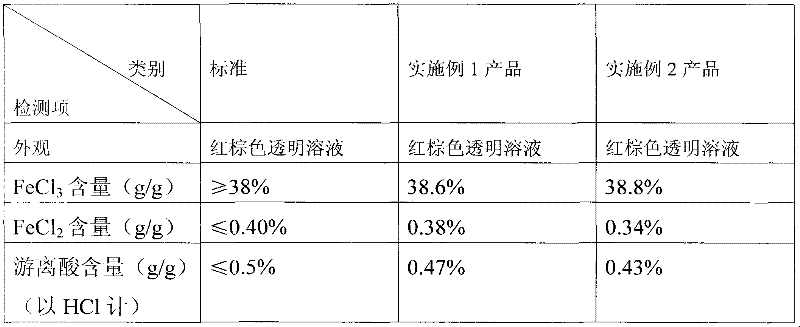
[0017] 1) Put 2 tons of waste acid with an HCl content of about 30% into a 3000L enamel reactor, and put 0.46 tons of waste residue (the iron content in the waste residue is about 60% to 70%) while stirring, and control the temperature at 85°C. Stir for 1.5 hours after throwing the waste residue. Sampling and measuring free acid content was 1.0%.

[0018] 2) Place it in the settling tank for 6-8 hours, take the supernatant and send it to the oxidation device, and dispose of a small amount of waste residue in the lower layer of the settling tank to the solid waste tank. The measured volume of the supernatant is 1900L, and the night specific gravity of the analyzed supernatant is 1.2940g / L, FeCl 2 The content is 12.2%, calculated FeCl 2 The molar mass is 2.3618kmol, according to Fe 2+ :Cl 2 = 1:0.525 (mol / mol) ratio into the chlorine gas 88kg, after the aeration, stirring reaction 2h, sampling analysis Fe 2+ Residue was 0.26%.

[0019] 3) Send the oxidized material to the ...

Embodiment 2

[0022] 1) Put 2 tons of waste acid with an HCl content of about 30% into a 3000L enamel reactor, and put 0.46 tons of waste residue (the iron content in the waste residue is about 60% to 70%) while stirring, and control the temperature at 80°C. Stir for 1 hour after throwing the waste residue. Sampling and measuring free acid content was 0.84%.

[0023] 2) Place it in the settling tank for 6-8 hours, take the supernatant and send it to the oxidation device, and dispose of a small amount of waste residue in the lower layer of the settling tank to the solid waste tank. The measured volume of the supernatant is 1880L, the analytical specific gravity is 1.3014g / L, FeCl 2 The content is 13.0%, calculated FeCl 2 The molar weight is 2.5044kmol, according to Fe 2+ :H 2 o 2 =1:0.525 (mol / mol) Add 44.7kg of hydrogen peroxide dropwise, stir for 2 hours, and take samples to analyze Fe 2+ Residue was 0.26%.

[0024] 3) Send the oxidized material to the concentration tank for concent...

the structure of the environmentally friendly knitted fabric provided by the present invention; figure 2 Flow chart of the yarn wrapping machine for environmentally friendly knitted fabrics and storage devices; image 3 Is the parameter map of the yarn covering machine
Login to View More

PUM

PropertyMeasurementUnit
volumeaaaaaaaaaa
Login to View More

Abstract

The invention discloses a method for recycling waste acid and waste residues in the production of herbicide oxadiazon, which comprises the following steps of: (1) adding waste residues obtained by iron reducing reaction into waste acid obtained by phosgene cyclization reaction for carrying out mixing reaction; (2) settling reaction liquid and introducing chlorine or adding hydrogen peroxide into supernatant for carrying out oxidizing reaction; and (3) concentrating the reaction liquid for removing a solvent. The method for recycling the waste acid and the waste residues in the production of the herbicide oxadiazon of the invention effectively treats a great quantity of waste acid and waste residues generated in the production of the herbicide oxadiazon, obtains ferric chloride meeting industrial standard GB / T1621-93 by utilizing the waste acid and the waste residues, greatly reduces the production cost of oxadiazon raw herbicide, achieves considerable economic benefits and environmental-friendly benefits when reducing the emission of the waste liquid and the waste residues and has the characteristics of easy control of condition, simple operation, environmental protection, less energy consumption, less investment cost, and the like.

Description

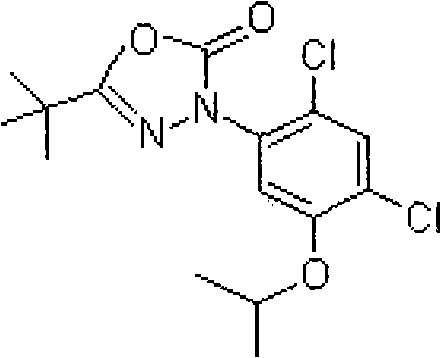
technical field [0001] The invention relates to a recycling method of waste acid waste residue in the production of herbicide oxadiazone. Background technique [0002] Oxadiazon, the common name in English is Oxadiazon, and other names are Oxadiazon and Ronstar. Its scope of application is suitable for rice, soybean, cotton, sugarcane and other crops and orchards to control barnyardgrass, daughter, paspalum, special-shaped sedge, echinacea, bermudagrass, melon skin grass, knotgrass, amaranthaceae, Chenopodium Broad-leaved weeds for annual Gramineae such as Euphorbiaceae, Oxaliaceae, Convolvulaceae, etc. Its molecular structural formula is as follows: [0003] [0004] There are many production processes of oxadiazone, and the most used methods in the current production include esterification, nitration, hydrolysis, etherification, iron reduction, diazotization, stannous chloride reduction, alkalization, acylation, and phosgene cyclization. The ten-step main reaction wi...

Claims

the structure of the environmentally friendly knitted fabric provided by the present invention; figure 2 Flow chart of the yarn wrapping machine for environmentally friendly knitted fabrics and storage devices; image 3 Is the parameter map of the yarn covering machine
Login to View More

Application Information

Patent Timeline
no application Login to View More
Patent Type & Authority Patents(China)
IPC IPC(8): C02F9/04C02F103/36
Inventor 何普泉姚海波王龙王振元王传品
Owner HEFEI XINGYU CHEM
Features
  • R&D
  • Intellectual Property
  • Life Sciences
  • Materials
  • Tech Scout
Why Patsnap Eureka
  • Unparalleled Data Quality
  • Higher Quality Content
  • 60% Fewer Hallucinations
Social media
Patsnap Eureka Blog
Learn More