Unlock instant, AI-driven research and patent intelligence for your innovation.

Method for detecting psychrophilic bacteria in crude milk by utilizing aminopeptidase method

A technology for raw milk and psychrophilic bacteria, which is applied in the preparation of test samples and the measurement of color/spectral properties, etc., can solve problems such as production stoppage, and achieve the effects of high accuracy, reduced system errors, and simple operation.

Inactive Publication Date: 2011-01-12
ZHEJIANG UNIV
View PDF2 Cites 6 Cited by
  • Summary
  • Abstract
  • Description
  • Claims
  • Application Information

AI Technical Summary

Problems solved by technology

[0010] With the continuous updating of technology, the improved aminopeptidase method used by Susana et al. to detect psychrophilic bacteria in raw milk can no longer be used by dairy factories because it is used to detect psychrophilic bacteria extracted from raw milk in the early stage medicines have been discontinued

Method used

the structure of the environmentally friendly knitted fabric provided by the present invention; figure 2 Flow chart of the yarn wrapping machine for environmentally friendly knitted fabrics and storage devices; image 3 Is the parameter map of the yarn covering machine
View more

Image

Smart Image Click on the blue labels to locate them in the text.
Viewing Examples
Smart Image
  • Method for detecting psychrophilic bacteria in crude milk by utilizing aminopeptidase method
  • Method for detecting psychrophilic bacteria in crude milk by utilizing aminopeptidase method
  • Method for detecting psychrophilic bacteria in crude milk by utilizing aminopeptidase method

Examples

Experimental program
Comparison scheme
Effect test

Embodiment 1

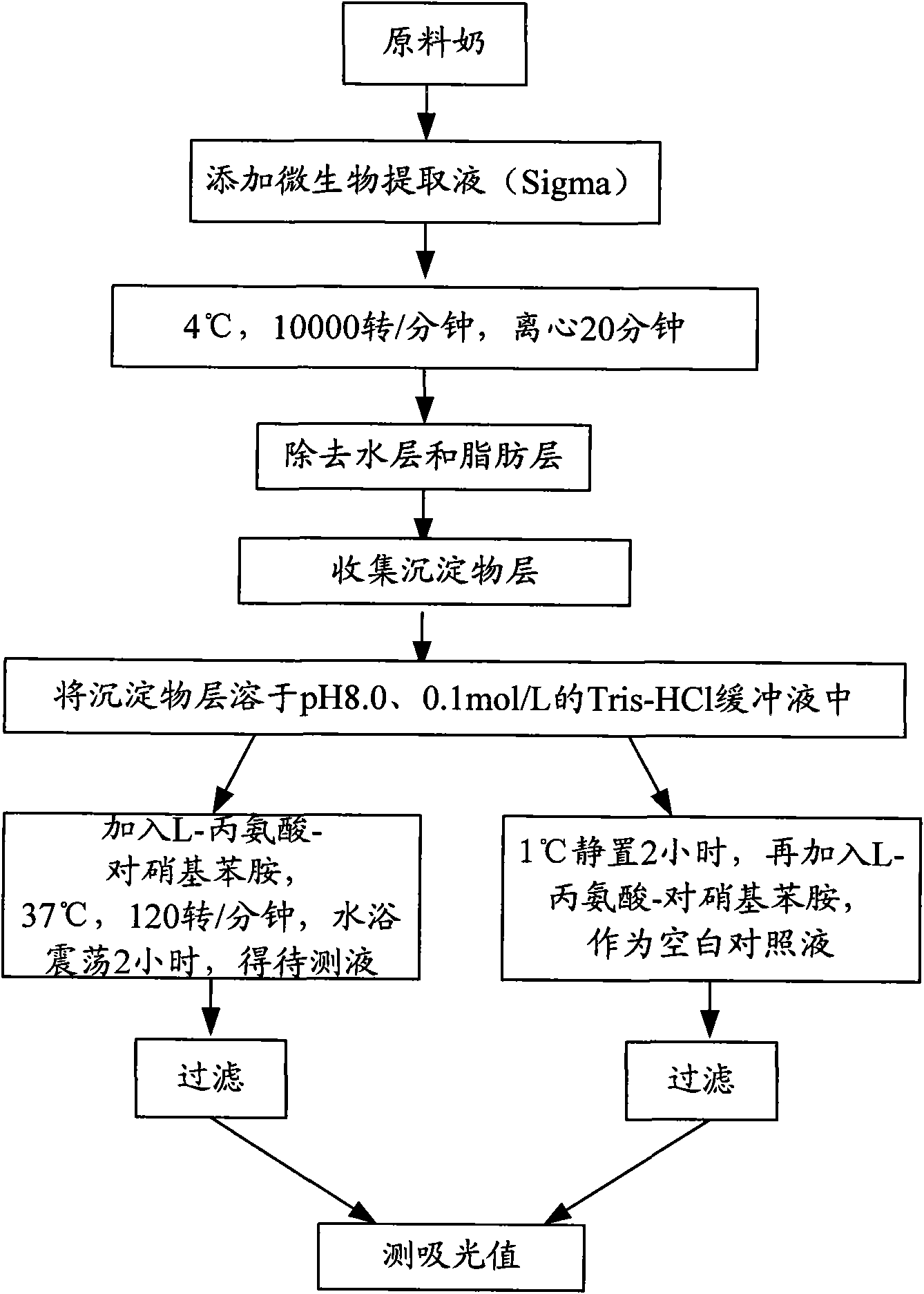
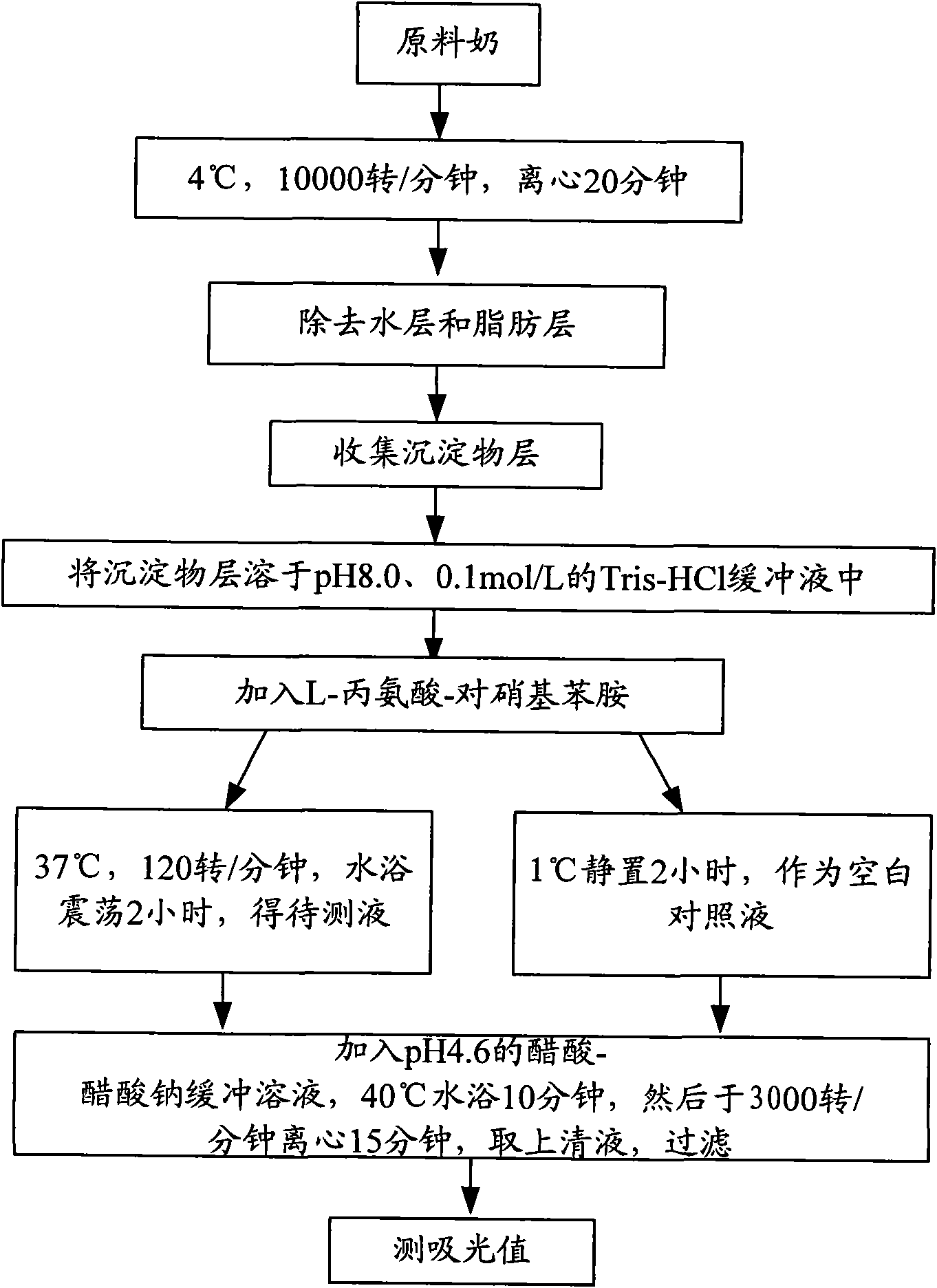
[0047] (1) Aseptically draw two 10ml portions of the same raw milk into sterile centrifuge tubes, centrifuge the two portions of raw milk at a temperature of 4°C and a speed of 10,000 rpm for 20 minutes to obtain two portions Centrifuge divided into fat layer, water layer and sediment layer;

[0048] (2) Remove the fat layer and water layer in the above two centrifuges respectively and collect the sediment layer, and dissolve the collected sediment layer in 5 mL of sterile trimethylol with a pH value of 8.0 and a concentration of 0.1 mol / L In the aminomethane-hydrochloric acid buffer solution, add 2.5mL of 1g / L L-alanine-p-nitroaniline aqueous solution, correspondingly obtain the first pretreatment solution and the second pretreatment solution;

[0049] (3) Shake the first pretreatment solution in a water bath at 37°C for 2 hours at a rotation speed of 120 rpm to obtain the solution to be tested;

[0050] Let the second pretreatment solution stand at 1°C for 2 hours as a blan...

Embodiment 2

[0058] (1) Aseptically draw two 10ml portions of the same raw milk and put them in sterile centrifuge tubes respectively, centrifuge the two raw milks at a temperature of 5°C and a speed of 8000 rpm for 15 minutes to obtain two Centrifuge divided into fat layer, water layer and sediment layer;

[0059] (2) Remove the fat layer and water layer in the above two centrifuges respectively and collect the sediment layer, and dissolve the collected sediment layer in 5 mL of sterile trimethylol with a pH value of 8.0 and a concentration of 0.1 mol / L In the aminomethane-hydrochloric acid buffer solution, add 2.5mL of 1.2g / L L-alanine-p-nitroaniline aqueous solution, correspondingly obtain the first pretreatment solution and the second pretreatment solution;

[0060] (3) Shake the first pretreatment solution in a water bath at 35°C for 2.5 hours at a speed of 100 rpm to obtain the solution to be tested;

[0061] Let the second pretreatment solution stand at 0°C for 2.5 hours as a blank...

Embodiment 3

[0066] (1) Aseptically draw two 10ml portions of the same raw milk and put them in sterile centrifuge tubes respectively, centrifuge the two portions of raw milk at a temperature of 3°C and a speed of 9000 rpm for 25 minutes to obtain two portions Centrifuge divided into fat layer, water layer and sediment layer;

[0067] (2) Remove the fat layer and water layer in the above two centrifuges respectively and collect the sediment layer, and dissolve the collected sediment layer in 5 mL of sterile trimethylol with a pH value of 8.0 and a concentration of 0.1 mol / L In the aminomethane-hydrochloric acid buffer solution, add 2.5mL of 0.8g / L L-alanine-p-nitroaniline aqueous solution, correspondingly obtain the first pretreatment solution and the second pretreatment solution;

[0068] (3) Shake the first pretreatment solution in a water bath at 36°C for 2.2 hours at a speed of 150 rpm to obtain the solution to be tested;

[0069] Let the second pretreatment solution stand at 2°C for ...

the structure of the environmentally friendly knitted fabric provided by the present invention; figure 2 Flow chart of the yarn wrapping machine for environmentally friendly knitted fabrics and storage devices; image 3 Is the parameter map of the yarn covering machine
Login to View More

PUM

PropertyMeasurementUnit
concentrationaaaaaaaaaa
Login to View More

Abstract

The invention discloses a method for detecting psychrophilic bacteria in crude milk by utilizing an aminopeptidase method. In the method, centrifugation is performed in advance on the crude milk to remove a fatty layer and an aqueous layer from the crude milk to obtain a precipitate layer rich in the psychrophilic bacteria and lactoproteins; aminopeptidase reaction is directly performed on the aminopeptidase of living psychrophilic bacteria in the precipitate layer and L-alanine-paranitroaniline in sterile tris-hydroxymethyl aminomethane-hydrochloric acid buffer solution so as to maximally ensure the survival of the psychrophilic bacteria; the lactoproteins are removed from the system and clear reaction solution is extracted so as to solve the problem on a living bacterium recovery rate caused by the in-advance extraction of the psychrophilic bacteria and reduce system errors in experiments; and simultaneously, quantitative detection can be performed on the count of the psychrophilic bacteria in the crude milk by utilizing a corresponding relationship between an absorbance value of liquid to be detected and the count of the psychrophilic bacteria.

Description

technical field [0001] The invention belongs to the field of food microorganism detection, and in particular relates to a method for detecting psychrophilic bacteria in raw milk by using an aminopeptidase method. Background technique [0002] Psychrophilic bacteria is a general term for a class of microorganisms whose optimum growth temperature is equal to or lower than 15°C and whose maximum growth temperature is not higher than 20°C (Morita, Psychrophilic bacteria, "Bacteriological Reviews", 1975, 39(2), 144- 167). Such microorganisms widely exist in nature and are closely related to human production and life. [0003] In recent years, with the rapid development of the dairy industry, the output of dairy products has increased significantly, making the safety of dairy products one of the focuses of people's attention. In dairy enterprises in my country, raw milk may need to be stored at 4°C for one to several days from collection to production and processing. Heat-resist...

Claims

the structure of the environmentally friendly knitted fabric provided by the present invention; figure 2 Flow chart of the yarn wrapping machine for environmentally friendly knitted fabrics and storage devices; image 3 Is the parameter map of the yarn covering machine
Login to View More

Application Information

Patent Timeline
no application Login to View More
Patent Type & Authority Applications(China)
IPC IPC(8): G01N21/33G01N1/28
Inventor 叶兴乾吕元刘东红陈健初吴丹唐佳妮
Owner ZHEJIANG UNIV