Check patentability & draft patents in minutes with Patsnap Eureka AI!

Entity morphing in metamodel-based tools

A meta-model and entity technology, applied in the field of model-driven process development, can solve problems such as not providing quick adjustment of graphics elements

Active Publication Date: 2014-01-22
SAP AG
View PDF2 Cites 0 Cited by
  • Summary
  • Abstract
  • Description
  • Claims
  • Application Information

AI Technical Summary

Problems solved by technology

However, this information does not currently provide any functionality in the modeling infrastructure to quickly adjust diagram elements based on a given metamodel definition

Method used

the structure of the environmentally friendly knitted fabric provided by the present invention; figure 2 Flow chart of the yarn wrapping machine for environmentally friendly knitted fabrics and storage devices; image 3 Is the parameter map of the yarn covering machine
View more

Image

Smart Image Click on the blue labels to locate them in the text.
Viewing Examples
Smart Image
  • Entity morphing in metamodel-based tools
  • Entity morphing in metamodel-based tools
  • Entity morphing in metamodel-based tools

Examples

Experimental program
Comparison scheme
Effect test

Embodiment Construction

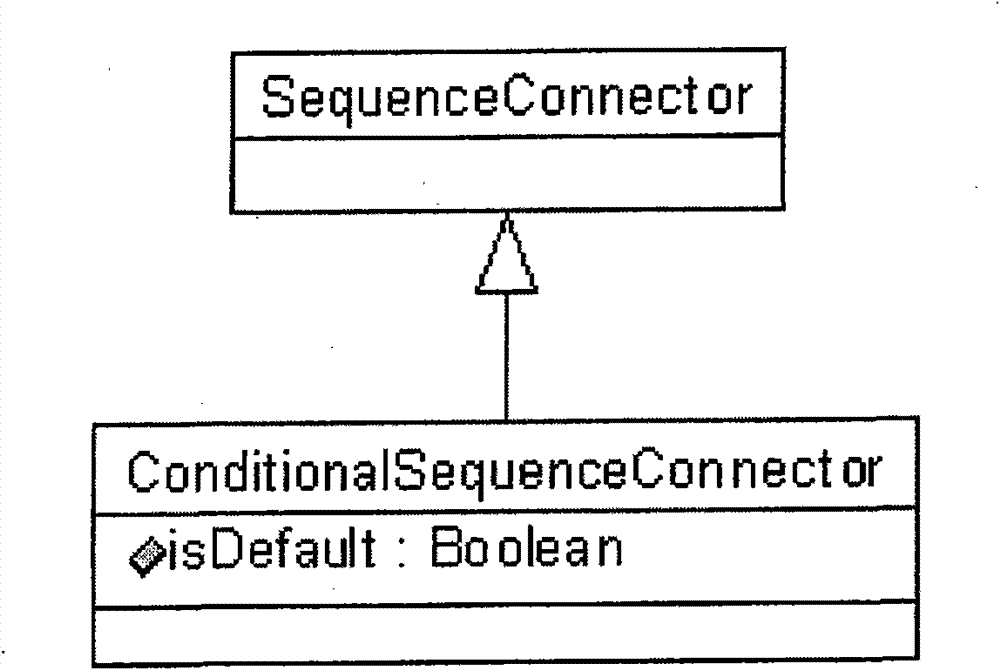
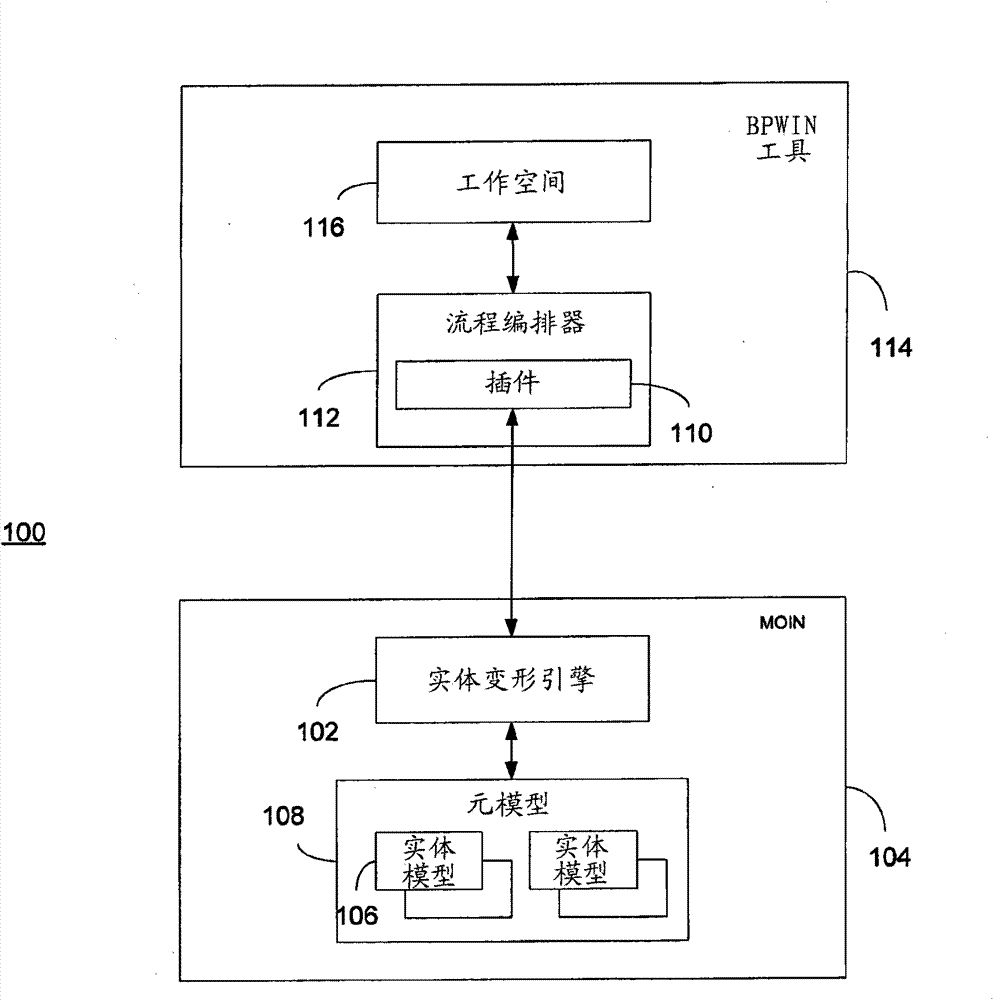
[0017] The present application describes a system and method for solid morphing in a metamodel-based tool. Specifically, the system includes in the modeling infrastructure the ability to quickly adjust primitives based on a given metamodel definition. According to some implementations, functional modules are configured to "morph" entities of a model based on a given metamodel definition, and may be exposed as generic commands in a modeling infrastructure (MOIN) used by BPMN tools. MOIN enables model-driven development, which means that things modeled by users (such as BPMN artifacts) are stored in the form of models in MOIN based on a given metamodel.

[0018] The term "morphing" as used herein has several meanings, eg changing to a more specific type, or changing to a sibling while maintaining existing attribute values, relationships and identities as much as possible. Transformation can occur at one level of the inheritance hierarchy or at multiple levels. In more complex ...

the structure of the environmentally friendly knitted fabric provided by the present invention; figure 2 Flow chart of the yarn wrapping machine for environmentally friendly knitted fabrics and storage devices; image 3 Is the parameter map of the yarn covering machine
Login to View More

PUM

No PUM Login to View More

Abstract

A system and method for morphing entities in metamodel-based business process model and notation (BPMN) tools is disclosed. A command is received for an entity to be morphed from a first non-abstract entity type to a second non-abstract entity type. A modeling infrastructure (MOIN) returns all non-abstract sub-types or siblings of the entity based on an inheritance hierarchy in a metamodel associated with the entity. The second non-abstract entity type is determined from the non-abstract sub-types or siblings of the entity, and the selected entity is morphed from the first non-abstract entity type to the second non-abstract entity type.

Description

technical field [0001] The present invention relates generally to model driven process development, and more particularly to systems and methods for refining model entities based on metamodels. Background technique [0002] Business process management (Business Process Management, BPM) tools allow users to model, execute and monitor their own business processes based on a common process model. Business Process Model and Notation (BPMN) is an industry standard graphical notation for representing business process workflows. BPMN shows the end-to-end flow of a business process in a flowchart-type style, and is often used with user-interface-oriented BPMN tools. One example of a BPMN tool is SAP's NetWeaver BPM component (NW BPM, also known as "Galaxy"), which is designed to help users increase the efficiency of business processes, reduce errors in complex and repetitive tasks, and reduce Exception handling fee. Using SAP BPM, users can orchestrate process steps, define busin...

Claims

the structure of the environmentally friendly knitted fabric provided by the present invention; figure 2 Flow chart of the yarn wrapping machine for environmentally friendly knitted fabrics and storage devices; image 3 Is the parameter map of the yarn covering machine
Login to View More

Application Information

Patent Timeline
no application Login to View More
Patent Type & Authority Patents(China)
IPC IPC(8): G06F17/00
CPCG06Q10/067G06F8/10
Inventor 鲁文·戴
Owner SAP AG
Features
  • R&D
  • Intellectual Property
  • Life Sciences
  • Materials
  • Tech Scout
Why Patsnap Eureka
  • Unparalleled Data Quality
  • Higher Quality Content
  • 60% Fewer Hallucinations
Social media
Patsnap Eureka Blog
Learn More