

Multi-group image classification method based on characteristic expansion and fuzzy support vector machine
A technology of fuzzy support vector and classification method, applied in the field of image processing, can solve the problem that the multi-group image classification method cannot effectively extract the essential features of the image, and the classification accuracy is low, so as to avoid the disaster of dimensionality and improve the classification accuracy.
- Summary
- Abstract
- Description
- Claims
- Application Information
AI Technical Summary
Problems solved by technology
Method used
Image



Examples
specific Embodiment approach 1
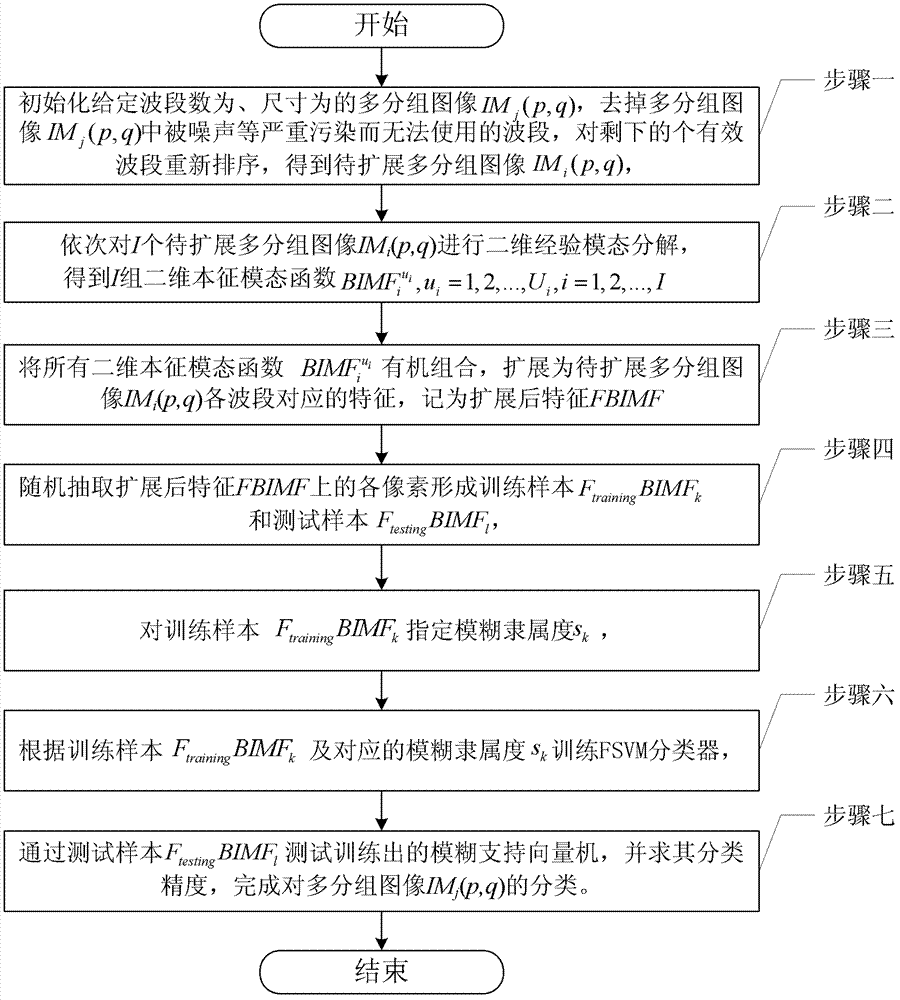
[0032] Specific implementation mode one: the following combination figure 1 Describe this embodiment, the multi-group image classification method based on feature extension and fuzzy support vector machine described in this embodiment, the method comprises the following steps:
[0033] Step 1. Initialize the given number of bands as I 0 , a multi-group image of size P×Q
[0034] IM j (p, q), j=1, 2, ..., I 0 , p=1, 2,..., P, q=1, 2,..., Q,
[0035] Remove multi-group image IM j (p, q) are severely polluted by noise and other bands that cannot be used, and the remaining I effective bands are reordered to obtain multi-group images to be expanded
[0036] IM i (p, q), i=1, 2, ..., 1,
[0037] where I 0 , I, P and Q are natural numbers;
[0038] Step 2, successively to I multi-group image IM to be extended i (p, q) perform two-dimensional empirical mode decomposition to obtain the I group of two-dimensional eigenmode functions
[0039] BIMF ...
specific Embodiment approach 2
[0052] Specific implementation mode two: the following combination figure 2 Describe this embodiment mode, this embodiment mode will be further described to embodiment mode one, in step 2 sequentially to 1 multi-packet image IM to be extended i (p, q) perform two-dimensional empirical mode decomposition to obtain the I group of two-dimensional eigenmode functions The process is:
[0053] Step A. Initialize r 1 =IM i (p,q); u=1; v=0; SD=1000; h u,v = r 1 ; c u = r 1 ,
[0054] Among them, the to-be-expanded multi-group image of the i-th band to be processed is IM i (p,q),
[0055] r 1 is the residual after the first two-dimensional empirical mode decomposition,
[0056] SD is the termination iteration threshold,
[0057] h u,v is the residual function after the vth screening in the uth two-dimensional empirical mode decomposition,
[0058] c u is the two-dimensional eigenmode function
[0059] Step B, let v=v+1; h u,(v-1) = r u , and by comparing with adja...
specific Embodiment approach 3
[0074] Specific implementation mode three: this implementation mode will further explain implementation mode one, and in step three, all two-dimensional eigenmode functions Organic combination, the process of obtaining the extended feature FBIMF is:
[0075] The i=1, 2,..., the two-dimensional eigenmode function of the I band are processed sequentially to obtain the extended feature FBIMF corresponding to the two-dimensional eigenmode function of each band, and the two-dimensional eigenmode function of each band The method of obtaining the extended characteristic FBIMF of the intrinsic mode function is the same, as follows: in the two-dimensional intrinsic mode function of the band i = 1, 2, ..., U i For a BIMF, if u i is an odd number, then the link directly to tail if u i is an even number, then the Flip left and right and connect to Tail, in turn, until all U of the two-dimensional intrinsic mode function of the band i All BIMFs are processed, and the extended ...
PUM
 Login to View More
 Abstract
Description
Claims
Application Information
 Login to View More