Two artificially synthesized site-specific recombination recognition sequences and applications thereof
A technology for identifying sequences and artificial synthesis, applied in the field of plant genetic engineering, can solve the problems of limited deletion and application deletion efficiency, difficult to meet the practical application of large-scale production, etc., to improve biological safety and food safety, and achieve significant social and economic benefits. benefit, the effect of increasing acceptance
- Summary
- Abstract
- Description
- Claims
- Application Information
AI Technical Summary
Problems solved by technology
Method used
Image


Examples
Embodiment 1
[0050] [Example 1] Design and synthesis of a new recognition site
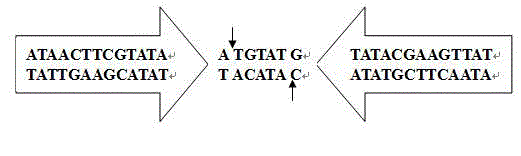
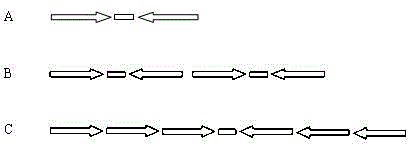
[0051] According to the structure and mechanism of action of the loxP site and referring to the modification method of Luo Kemin et al., extend or repeat in tandem based on all or part of the sequence of the loxP site, and add 1- between each extended or tandem repeat fragment. The 4 bases are separated to form a new recognition site, which are designed as L1 and L2 respectively. Among them, L1 is the tandem repeat of the double fragment of the loxP site, with a 4-base spacer sequence added in the middle. The structure diagram is as follows figure 2 As shown in B, the sequence is shown in SEQ ID NO.1; L2 is based on the loxP site, on both sides of the original arms as the unit to continue to repeat the series 2 times, and add one between each arm Base, its structure diagram is as figure 2 As shown in C, the sequence is as shown in SEQ ID NO.2.
[0052] In order to verify the functions of the new recognition site...
Embodiment 2
[0053] [Example 2] Construction of plant expression vector
[0054] 2.1 The acquisition of plant expression vectors p1300-GUSACS-L1 and p1300-GUSACS-L2
[0055] use Eco RI and Pst I double digestion vector p1300-Gluc-CreM-Tnos, after filling in, recover the 3.8kb fragment (Gluc-CreM-Tnos), insert it into Stu I single-enzyme digestion and fill-in and dephosphorylated pGH-L1 vector to construct an intermediate vector pCre-L1; Xho I and Pst The plasmid p1300-LF-GFSAGS was digested with double restriction enzymes, and after filling in, the fragment (Actin1-GUS-Tnos) with a size of about 3.6 kb was recovered and inserted into the Xho I. The intermediate vector pCre-L1, which was cut and filled in and dephosphorylated with a single restriction enzyme, was constructed into the intermediate vector pCre-Gus-L1; Pvu II Single restriction digestion of the intermediate vector pCre-Gus-L1, after filling in, recovering a fragment with a size of about 8.0kb (Actin1-Gus-Tnos-Tnos-CreM-Gluc), ...
Embodiment 3
[0059] [Example 3] Obtaining transgenic rice
[0060] 3.1 NB medium formula (basic medium)
[0061] N6 large amount: potassium nitrate KNO 3 2830 mg.L -1 , Ammonium sulfate (NH 4 ) 2 SO 4 463 mg.L -1 , Potassium dihydrogen phosphate KH 2 PO 4 400 mg.L -1 , Magnesium sulfate MgSO 4 ·7H 2 O 185 mg.L -1 , Calcium chloride CaCl2·2H2O 166 mg.L -1 ;
[0062] B5 trace amount: boric acid H 3 BO 4 3 mg.L -1 , Manganese sulfate MnSO 4 ·H 2 O 7.58 mg.L -1 , Zinc sulfate ZnSO 4 ·7H 2 O 2 mg.L -1 , Potassium iodide KI 0.75 mg.L -1 , Sodium molybdate Na2MoO 4 ·2H 2 O 0.25 mg.L -1 , Copper sulfate CuSO 4 ·5H 2 O 0.025 mg.L -1 , Cobalt Chloride CoCl 2 ·6H 2 O 0.025 mg.L -1 ;
[0063] Iron salt: ferrous sulfate FeSO 4 ·7H 2 O 27.8 mg.L -1 , Disodium ethylenediaminetetraacetic acid Na 2 EDTA 37.3 mg.L -1 ;
[0064] Inositol: Myo-inositol 100 mg.L -1 ;
[0065] Organic ingredients: Thiamine HCl 10 mg.L -1 , Pyridoxine HCl 1 mg.L -1 , Niacin Niacin 1 mg.L -1 , Hydrolyzed casein Casamino acids 300 mg...
PUM
 Login to View More
 Abstract
Description
Claims
Application Information
 Login to View More
 - R&D
- Intellectual Property
- Life Sciences
- Materials
- Tech Scout
- Unparalleled Data Quality
- Higher Quality Content
- 60% Fewer Hallucinations
Browse by: Latest US Patents, China's latest patents, Technical Efficacy Thesaurus, Application Domain, Technology Topic, Popular Technical Reports.
© 2025 PatSnap. All rights reserved.Legal|Privacy policy|Modern Slavery Act Transparency Statement|Sitemap|About US| Contact US: help@patsnap.com