A time slot allocation method for td-scdma and ad hoc heterogeneous network
A TD-SCDMA, time slot allocation technology, applied in the field of heterogeneous networks, can solve problems such as reducing network capacity
- Summary
- Abstract
- Description
- Claims
- Application Information
AI Technical Summary
Problems solved by technology
Method used
Image

Examples
Embodiment 1
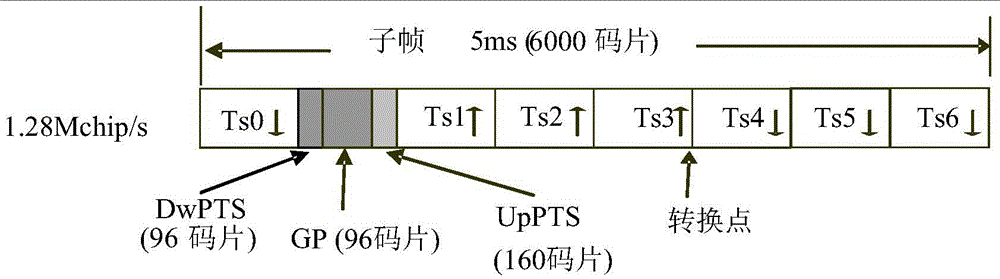
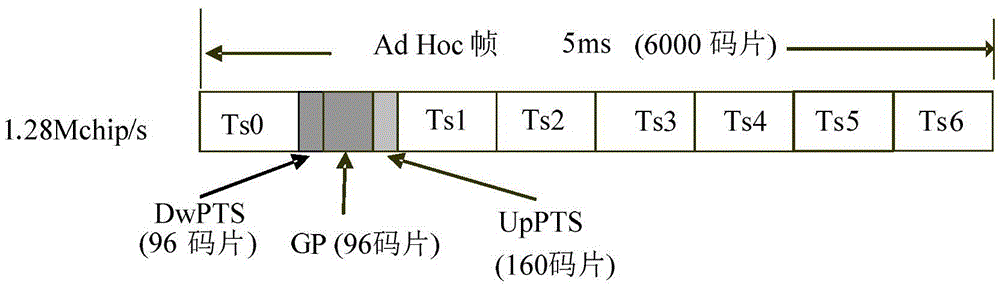
[0034] Embodiment 1: In a traditional TD-SCDMA network, a TD-SCDMA radio frame (RadioFrame) is 10ms long, 1.28MChips, and is divided into two subframes of 5ms. The subframe is 5ms long, that is, 6400 chips. Each subframe contains 7 fixed-length business time slots TS0~TS6 (675us), 3 special time slots: downlink transmission special frame (DwPTS), protection time slot (GP), uplink transmission special frame (UpPTS), such as figure 1 shown. Among the seven main time slots, except that TS0 must be used in the downlink direction and TS1 must be used in the uplink direction, the directions of the remaining time slots can be changed. At the same time, the uplink time slot and the downlink time slot are separated by a conversion point, the time slot before the conversion point is allocated as an uplink time slot, and the time slot after the conversion point is allocated as a downlink time slot.
[0035] For Adhoc network, we use the time slot allocation format similar to TD-SCDMA f...
PUM
 Login to View More
 Abstract
Description
Claims
Application Information
 Login to View More
 - R&D
- Intellectual Property
- Life Sciences
- Materials
- Tech Scout
- Unparalleled Data Quality
- Higher Quality Content
- 60% Fewer Hallucinations
Browse by: Latest US Patents, China's latest patents, Technical Efficacy Thesaurus, Application Domain, Technology Topic, Popular Technical Reports.
© 2025 PatSnap. All rights reserved.Legal|Privacy policy|Modern Slavery Act Transparency Statement|Sitemap|About US| Contact US: help@patsnap.com