Supercharge Your Innovation With Domain-Expert AI Agents!

Method for removing water-soluble pesticide residues in catechin preparation process

A pesticide residue and preparation technology, applied in the direction of organic chemistry, can solve problems such as hidden dangers to human health and safety, obstruction of export trade, market application restrictions, etc., to reduce the base of water-soluble pesticide residues, facilitate equipment, and solve the problems of excessive pesticide residues Effect

Active Publication Date: 2015-06-24
HUNAN AGRICULTURAL UNIV +1
View PDF5 Cites 0 Cited by
  • Summary
  • Abstract
  • Description
  • Claims
  • Application Information

AI Technical Summary

Problems solved by technology

However, the water extraction-column chromatography preparation method of catechin uses water as the extraction solvent, and a large amount of residual water-soluble pesticides (such as imidacloprid, acetamiprid, dimethoate, methamidophos, etc.) in tea leaves will be extracted at the same time , the conventional catechin preparation process is actually a process in which trace amounts of water-soluble pesticides in tea are concentrated and enriched, while the pesticide residue limit in catechin products is implemented according to the standards of tea, and qualified tea raw materials are extracted However, catechins often become products with serious pesticide residues exceeding the standard, resulting in serious obstacles to their export trade and restrictions on their application in domestic and foreign markets.
In addition, catechins are easily soluble in water, and are generally used as additives in water-based beverages or foods. The residual water-soluble pesticides in the beverages or foods are then dissolved in the beverages or foods and directly ingested by consumers, which may pose a threat to human health. Security risks

Method used

the structure of the environmentally friendly knitted fabric provided by the present invention; figure 2 Flow chart of the yarn wrapping machine for environmentally friendly knitted fabrics and storage devices; image 3 Is the parameter map of the yarn covering machine
View more

Image

Smart Image Click on the blue labels to locate them in the text.
Viewing Examples
Smart Image
  • Method for removing water-soluble pesticide residues in catechin preparation process
  • Method for removing water-soluble pesticide residues in catechin preparation process
  • Method for removing water-soluble pesticide residues in catechin preparation process

Examples

Experimental program
Comparison scheme
Effect test

Embodiment 1

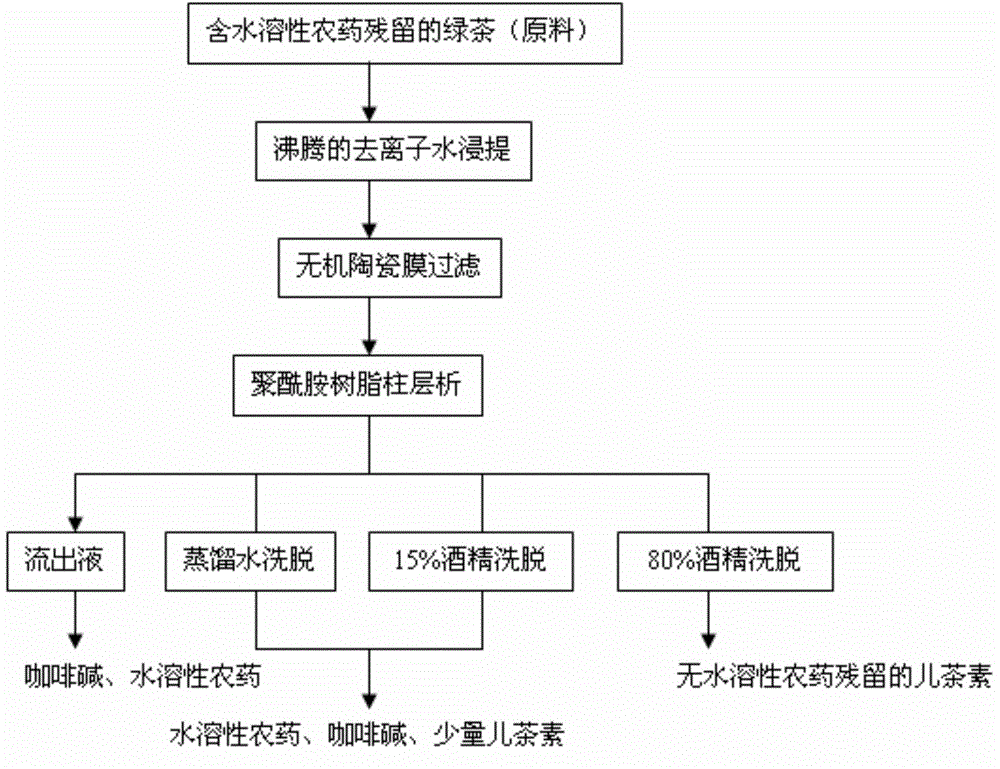
[0028] according to figure 1 As shown in the process flow chart, the green tea raw materials that have been tested to contain imidacloprid and acetamiprid water-soluble pesticides are crushed, weighed 2 kg and added to 30 L of boiled deionized water, keep boiling slightly for 10 minutes, pour out the tea soup, and repeatedly extract the tea dregs once. Merge the two tea soups, cool to 20-25°C, pre-filter to obtain 50L of primary filtrate, and then filter through a ceramic membrane with a pore size of 0.2μm (microfiltration), operating temperature is 40°C, pressure is 0.3MPa, and 40L fine filtrate is obtained , concentrated by reverse osmosis membrane to a solid content of 5-6%, to obtain tea extract.

[0029] Take the above tea extract, pass it through a polyamide chromatography column (Ф4cm×80cm, polyamide filling height is 40cm) at a flow rate of 2mL / min, discard the effluent; first elute with 2000mL deionized water (flow rate 1.5mL / min) , then elute with 1500mL of 15% alco...

the structure of the environmentally friendly knitted fabric provided by the present invention; figure 2 Flow chart of the yarn wrapping machine for environmentally friendly knitted fabrics and storage devices; image 3 Is the parameter map of the yarn covering machine
Login to View More

PUM

PropertyMeasurementUnit
particle size (mesh)aaaaaaaaaa
pore sizeaaaaaaaaaa
Login to View More

Abstract

The invention relates to the field of deep processing of tea leaves and in particular relates to a method for removing water-soluble pesticide residues in a catechin preparation process. According to the method, part of the water-soluble pesticide residues bonded with macromolecular substances are removed while the macromolecular substances such as proteins, pectins and saccharides in tea soup are removed by virtue of inorganic ceramic film equipment; then, the rest of the water-soluble pesticide residues are effectively removed while the decaffeinated catechin is prepared by a polyamide resin column chromatography method. The method solves the problem of excessive pesticide residues, especially excessive water-soluble pesticide residues in a tea leaf extract, is suitable for general popularization and application in tea leaf deep processing enterprises, especially catechin producers, is relatively high in economic benefit, and has an important social meaning.

Description

technical field [0001] The invention relates to the field of tea deep processing, in particular to a method for removing water-soluble pesticide residues in the process of preparing catechins. Background technique [0002] Catechin is also called catechin, tea tannin. It is a derivative of flavanol, which was first proposed from catechin, and it belongs to the two important functional components in tea together with caffeine, but catechin is the most important component in tea soup. Catechin is a phenolic substance with obvious phenolic properties, accounting for about 75% to 80% of the content of tea polyphenols, and is also one of the sources of tea's bitter taste. Catechin is one of the main components that form the color and aroma of tea, and is also the most important health-care functional component in tea. Studies have shown that catechin has many functions such as preventing and treating cardiovascular diseases and preventing cancer. It is a reducing polyphenolic s...

Claims

the structure of the environmentally friendly knitted fabric provided by the present invention; figure 2 Flow chart of the yarn wrapping machine for environmentally friendly knitted fabrics and storage devices; image 3 Is the parameter map of the yarn covering machine
Login to View More

Application Information

Patent Timeline
no application Login to View More
Patent Type & Authority Patents(China)
IPC IPC(8): C07D311/62
CPCC07D311/62
Inventor 刘仲华谭君黄建安王坤波叶艳
Owner HUNAN AGRICULTURAL UNIV
Features
  • R&D
  • Intellectual Property
  • Life Sciences
  • Materials
  • Tech Scout
Why Patsnap Eureka
  • Unparalleled Data Quality
  • Higher Quality Content
  • 60% Fewer Hallucinations
Social media
Patsnap Eureka Blog
Learn More