Anionic dye desalting ceramic composite membrane preparation method
An anionic dye, ceramic composite membrane technology, applied in chemical instruments and methods, membrane technology, semi-permeable membrane separation, etc., can solve the problems of complex preparation and low removal rate, and achieve simple process, good permeability, operation easy effect
- Summary
- Abstract
- Description
- Claims
- Application Information
AI Technical Summary
Problems solved by technology
Method used
Image

Examples
Embodiment 1
[0028] Step 1: Membrane tube pretreatment. Wash the tubular ceramic ultrafiltration membrane (titanium oxide single-tube membrane, its PEG molecular weight cut-off is 1800, and the pore size is 2.2nm), remove the impurities on the surface of the membrane and in the pores, and then dry it;
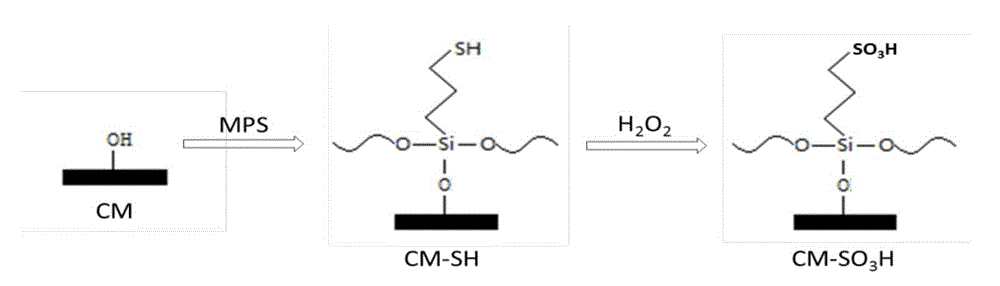
[0029] Step 2: Preparation of silane coupling agent solution. Dissolve (3-mercaptopropyl)trimethoxysilane in ethanol at a concentration of 0.05mol / L, add acetic acid as a hydrolysis catalyst, adjust the pH to 3.5, and mix and stir at room temperature;
[0030] Step 3: silanization reaction. Soak the pretreated tubular ceramic ultrafiltration membrane in the stirred reaction solution, take it out after reacting in a constant temperature oscillator at 35°C for 10 hours, and put it in an oven at 110°C to dry for 3 hours after cleaning;
[0031] Step 4: mercapto oxidation reaction. Soak the tubular ceramic ultrafiltration membrane in 4% hydrogen peroxide, oxidize it for 6 hours, take it out,...
Embodiment 2
[0038] Step 1: Membrane tube pretreatment. Wash the tubular ceramic ultrafiltration membrane (titanium oxide single-tube membrane, its PEG molecular weight cut-off is 2200, and the pore size is 2.4nm), remove the impurities on the surface of the membrane and in the pores, and then dry it;
[0039] Step 2: Preparation of silane coupling agent solution. Dissolve 2-mercaptoethyltriethoxysilane in ethanol at a concentration of 0.08mol / L, add hydrochloric acid as a hydrolysis catalyst, adjust the pH value to 4, and mix and stir at room temperature;
[0040] Step 3: silanization reaction. Soak the pretreated tubular ceramic ultrafiltration membrane in the stirred reaction solution, react in a constant temperature oscillator at 45°C for 10 hours, take it out, clean it and put it in an oven at 120°C to dry for 2 hours;
[0041] Step 4: mercapto oxidation reaction. Soak the tubular ceramic ultrafiltration membrane in 3% hydrogen peroxide, oxidize it for 9 hours, take it out, wash an...
Embodiment 3
[0046] Step 1: Membrane tube pretreatment. Wash the tubular ceramic ultrafiltration membrane (zirconia single-tube membrane, its PEG molecular weight cut-off is 1900, and the pore size is 2.3nm), and then dry it after removing impurities on the surface of the membrane and in the pores;
[0047] Step 2: Preparation of silane coupling agent solution. Dissolve (3-mercaptopropyl)trimethoxysilane in ethanol at a concentration of 0.06mol / L, add acetic acid as a hydrolysis catalyst, adjust the pH to 5, and mix and stir at room temperature;
[0048] Step 3: silanization reaction. Soak the pretreated tubular ceramic ultrafiltration membrane in the stirred reaction solution, react in a constant temperature oscillator at 60°C for 8 hours, take it out, and put it in an oven at 130°C to dry for 1 hour after cleaning;
[0049] Step 4: mercapto oxidation reaction. Soak the tubular ceramic ultrafiltration membrane in 3% hydrogen peroxide, oxidize it for 8 hours, take it out, wash and dry i...
PUM
 Login to View More
 Abstract
Description
Claims
Application Information
 Login to View More
 - R&D
- Intellectual Property
- Life Sciences
- Materials
- Tech Scout
- Unparalleled Data Quality
- Higher Quality Content
- 60% Fewer Hallucinations
Browse by: Latest US Patents, China's latest patents, Technical Efficacy Thesaurus, Application Domain, Technology Topic, Popular Technical Reports.
© 2025 PatSnap. All rights reserved.Legal|Privacy policy|Modern Slavery Act Transparency Statement|Sitemap|About US| Contact US: help@patsnap.com