Activity remodeling method for changing lipase catalytic activity
A technology of catalytic activity and lipase, applied in the field of enzyme engineering, can solve the problems of lipase losing ester synthesis ability, lipase not showing esterification activity, etc.
- Summary
- Abstract
- Description
- Claims
- Application Information
AI Technical Summary
Problems solved by technology
Method used
Image


Examples
Embodiment 1
[0070] Example 1: Extraction of Membrane Environment Complex WTS
[0071] TritonX-100, CHAPS, Tween80, deoxycholic acid and other surfactants were used to extract membrane environment complexes and membrane-bound proteins from the cultured Rhizopus sinensis, and then passed through the Bio-BeadsSM-2 adsorbent of American bio-rad company. Adsorb the surfactant in the extract to precipitate the membrane-bound protein, and the supernatant obtained after high-speed centrifugation is the membrane environment complex. The specific method is as follows:
[0072] Rhizopus sinensis CCTCCM201021 was cultured on potato-dextrose agar medium at 30°C for 3 days, and the spores were washed with sterile water. 200μl of spore suspension was inoculated into a shake flask (250mL Erlenmeyer flask) containing 20mL of fermentation medium, at 30°C, 150r min -1 Conditioned for 72h. The concentration of spore suspension is about 10 7 pcs ml -1 . After the bacterial cell culture, the mycelium was...
Embodiment 2
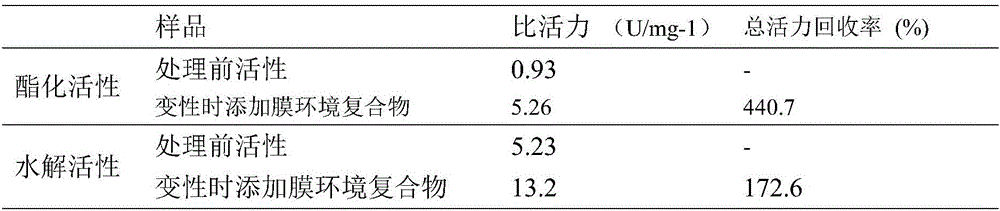
[0074] Example 2: Active Remodeling Method
[0075] Perform in vitro refolding by any of the following methods:
[0076] Protocol A: Adding Membrane Environment Complexes During Refolding
[0077] (1) Protein denaturation: take lipase protein solution or suspension, slowly add 0.5g of ground urea powder per milliliter of solution under low temperature shaking, stir magnetically at 4°C for 2-4h, take out 100μL every half hour for hydrolysis activity Determination, complete loss of activity means that the tertiary structure is completely opened to form a peptide chain, and the protein is completely denatured. Denatured protein 12000r·min -1 Centrifuge for 10 minutes, take the supernatant for concentration determination, and ensure that the protein concentration is not higher than 2.5 mg·mL -1 , to ensure that the protein can be completely refolded. (2) Protein renaturation: Add excess prepared membrane environment complex at a volume ratio of 1:1, stir magnetically for 5-10 ...
Embodiment 3
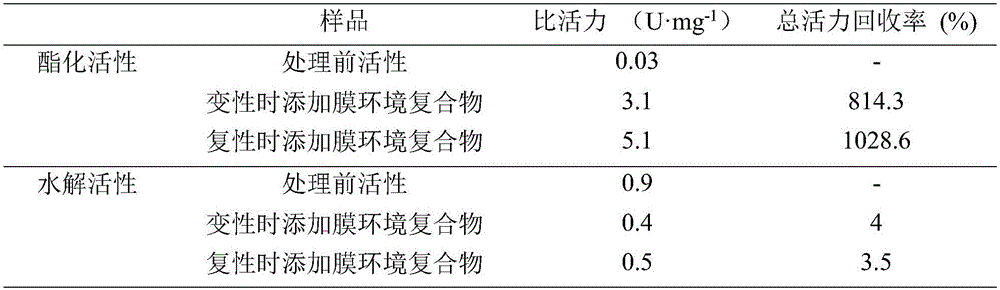
[0083] Example 3: Escherichia coli heterologous expression of Rhizopus chinensis mature peptide lipase MP 1 Restoration of vitality
[0084]Primers were designed according to the whole genome sequence of Rhizopus sinorifica lipase, and the mature peptide lipase gene A06672 of Rhizopus sinensis was amplified by PCR (http: / / genome.jgi.doe.gov / Rhich1 / Rhich1.home. html) Connection expression vector 6xHis-MBP 3 -TEV-pET15 (constructed by inserting the MBP fusion protein gene fragment (J.Am.Chem.Soc.2012,134,375–385) with a 6xHis tag at the N-terminal of pQEH6MBP and containing a TEV protease cleavage site into pET15), Transformation of E.coliBL21trxB(DE3), IPTG induction to obtain fusion protein MBP (His)8 -MP 1 , HisTrap was purified and digested with TEV protease, and then purified by HisTrap and DEAE column to obtain pure enzyme MP 1 .
[0085] According to the scheme B and scheme A of Example 2, add the membrane environment complex during denaturation and add the membrane ...
PUM
 Login to View More
 Abstract
Description
Claims
Application Information
 Login to View More
 - R&D
- Intellectual Property
- Life Sciences
- Materials
- Tech Scout
- Unparalleled Data Quality
- Higher Quality Content
- 60% Fewer Hallucinations
Browse by: Latest US Patents, China's latest patents, Technical Efficacy Thesaurus, Application Domain, Technology Topic, Popular Technical Reports.
© 2025 PatSnap. All rights reserved.Legal|Privacy policy|Modern Slavery Act Transparency Statement|Sitemap|About US| Contact US: help@patsnap.com