A method for estimating the armor-piercing capability of dense fragments
A technology of fragmentation and ability, which is applied in the field of estimation of armor-piercing ability of dense fragments, and can solve problems such as the lack of calculation methods for the penetration ability of fragment groups on protective structures
- Summary
- Abstract
- Description
- Claims
- Application Information
AI Technical Summary
Problems solved by technology
Method used
Image

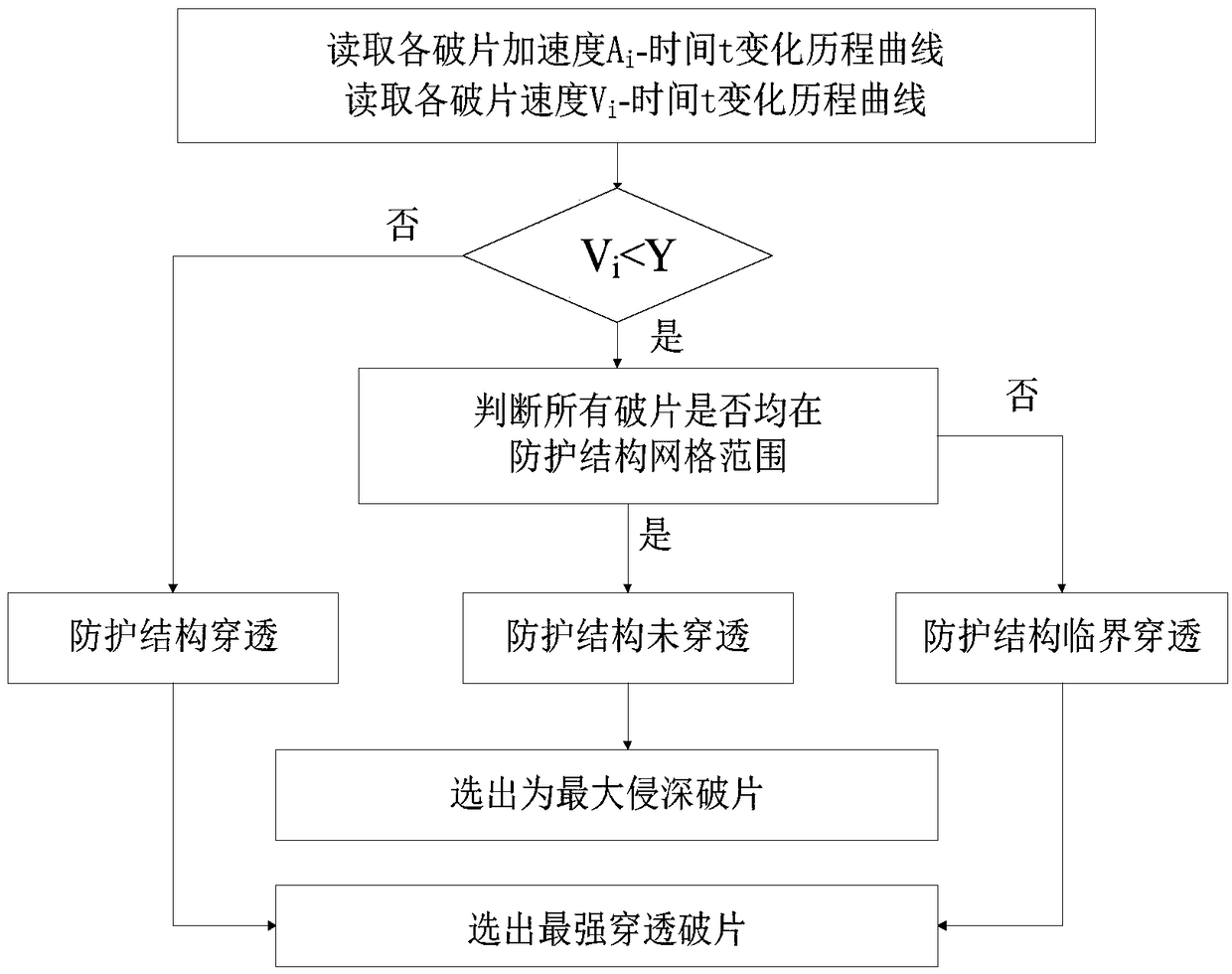

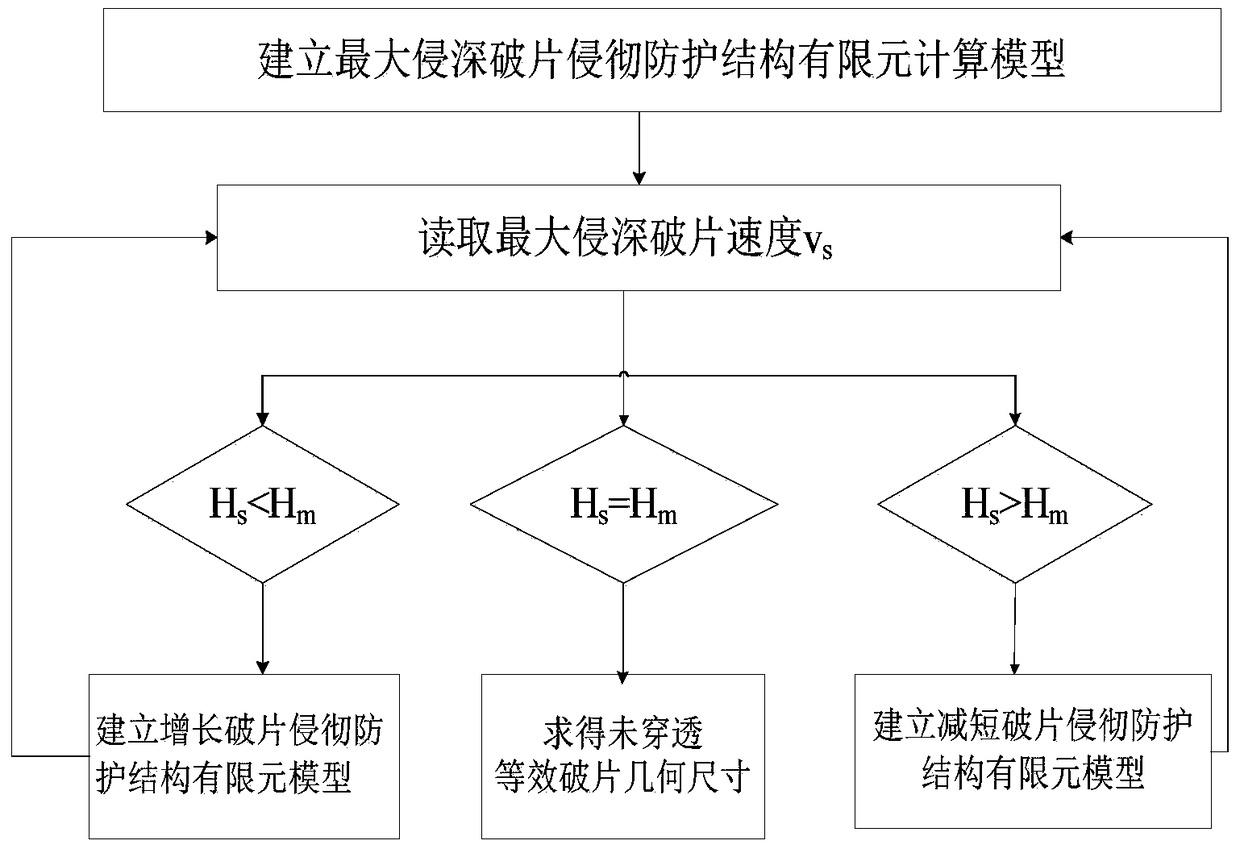
Examples
Embodiment 1
[0080] Example 1. Steel Fragment Group Penetrates Single High-Strength Polyethylene Fiber Reinforced Composite Board
[0081] (1) The step of establishing the finite element model of the fragment group penetration protection structure, including the following sub-steps:
[0082] (1.1) Establish the finite element model of the fragment group, set the shape of a single fragment as a cuboid, the geometric size of a single fragment as 7.5mm×7.5mm7.5mm, the material of the fragments as steel, use the Mat_Plastic_Kinematic constitutive model, and the number of fragments N 0 = 25 pieces, the layout of fragments is orthogonal and equidistant S i = 1mm layout, such as Figure 5 Shown; the element type is solid 164 entity element, each fragment hits the initial velocity V 0 =650m / s, target angle ω=0°;
[0083] (1.2) Use finite element modeling commercial software to establish a finite element model of the protective structure, including setting the protective structure type as a sing...
Embodiment 2
[0099] Embodiment 2. Lead alloy fragments penetrate into a single aramid fiber reinforced composite board;
[0100] (1) The step of establishing the finite element model of the fragment group penetration protection structure, including the following sub-steps:
[0101] (1.1) Establish the finite element model of the fragment group, set the shape of a single fragment as a cylinder, the geometric dimensions of a single fragment as diameter d=8mm, length L=13mm, the material of the fragments is lead alloy, adopt the Mat_Plastic_Kinematic constitutive model, and the number of fragments is N 0 = 30 pieces, the layout of the fragments is an equal spacing S = 10mm layout, such as Figure 10 ;The element type is solid 164 entity element, each fragment hits the initial velocity V 0 =450m / s, target angle ω=15°;
[0102] (1.2) Adopt finite element modeling commercial software to set up the finite element model of protective structure, its steps are the same as the neutron step (1.2) in...
Embodiment 3
[0113] Embodiment 3. The group of tungsten alloy fragments penetrates into a single high-strength glass fiber reinforced composite board.
[0114] (1) The step of establishing the finite element model of the fragment group penetration protection structure, including the following sub-steps:
[0115] (1.1) Establish the finite element model of the fragment group, set the shape of a single fragment as a cone cylinder, the geometric dimensions of a single fragment as diameter d=5mm, cone angle θ=60°, and length 10mm, and the material of the fragments is tungsten alloy, using Mat_Plastic_Kinematic constitutive Model, number of fragments N 0 = 37 pieces, the layout of fragments is unequal spacing, the minimum spacing is 0.8mm, and the maximum spacing is 13mm, such as Figure 11 ;The element type is solid 186 entity element, each fragment hits the initial velocity V 0 =450m / s, target angle ω=0°;
[0116] (1.2) Adopt finite element modeling commercial software to set up the finite...
PUM
 Login to View More
 Abstract
Description
Claims
Application Information
 Login to View More
 - R&D
- Intellectual Property
- Life Sciences
- Materials
- Tech Scout
- Unparalleled Data Quality
- Higher Quality Content
- 60% Fewer Hallucinations
Browse by: Latest US Patents, China's latest patents, Technical Efficacy Thesaurus, Application Domain, Technology Topic, Popular Technical Reports.
© 2025 PatSnap. All rights reserved.Legal|Privacy policy|Modern Slavery Act Transparency Statement|Sitemap|About US| Contact US: help@patsnap.com